4 min read


Click here to join Express Pune WhatsApp channel and get a curated list of our stories
© The Indian Express Pvt Ltd



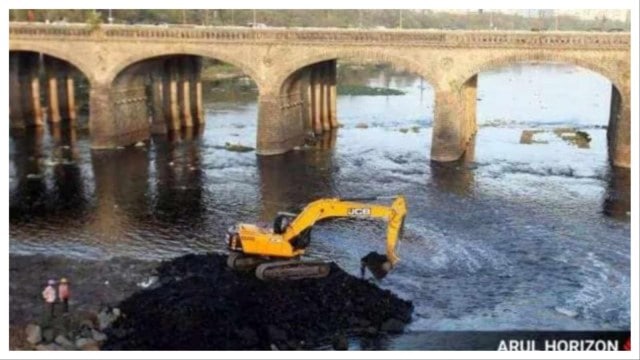 A JCB excavator at work in the Mula-Mutha river ( File Photo: Arul Horizon )
With no action to redraw the floodlines of Mula Mutha river in Pune despite court issuing directions for the same an year ago, the Bombay High Court has directed the court-appointed expert committee to review the existing demarcation of floodlines and submit a report to the state government within a period of two months so that it could take action as per the recommendations.
Hearing a PIL by activists Sarang Yadwadkar, Vivek Velankar and Vijay Kumbhar, the bench of Chief Justice Alok Aradhe and Justice Sandeep Marne on Monday directed the expert committee to submit its report on review of demarcation of floodlines within the next two months. “The state government, on receipt of the report, should take appropriate action on the recommendations of the expert committee within a further period of two months,” it said adding the petitioners can give their suggestions to the state government on the issue.
In June last year, the high court had given an order that would have its impact on the development activities, including the Riverfront Development project, alongside Mula Mutha river. It had directed the state government to constitute an experts committee to undertake time bound review of demarcation of floodlines of Mula Mutha river in Pune by considering study of various organisations.
The experts committee was to be formed within two weeks, which should have finalised the blueprint for undertaking comprehensive review of demarcation of floodlines in Pune within four weeks thereafter. The experts committee to be formed was headed by the Additional Chief Secretary of the state department of Water Resources Development.
However, the Bombay High Court did not accept the request of petitioners to revoke permission for development of lands within 100 metre distance of the current flood lines concerned.
“The petitioners have not prosecuted any person who has raised any construction within 100 meters distance of current flood lines demarcated in the Development Plan of 2017. Therefore, this court is unable to issue any positive direction. However, the Pune Municipal Corporation should examine the issue and shall take action in accordance with law after affording an opportunity of hearing to the persons, who may be aggrieved by the proposed action, which may be taken by the Pune Municipal Corporation after receipt of directions from the state government issued after consideration of expert committee report,” it said.
In its previous order, the court had suggested that a comprehensive review of the flood line demarcation process be conducted, taking into account the flow from the free catchment area, Nashik based Maharashtra Engineering Research Institute (MERI) guidelines, and Delhi based The Energy and Resources Institute’s (TERI) climate change action plan. “Addressing these aspects would contribute to a more accurate and comprehensive understanding of flood risk in the area,” it had said.
It was revealed that the flow from the free catchment area between Khadakwasla dam and Mula-Mutha confluence in 2011 has not been considered. It was suggested that this factor should be taken into account in the flood line marking process.
The petitioners have sought direction to Pune Municipal Corporation to replace the demarcation of flood lines in the 2017 Development Plan for Pune city and superimpose them with flood lines as demarcated in the maps dated March 5, 2011.
Last year, the court had stated, “Demarcation of flood lines in an urban area or a city like Pune assumes importance for the simple reason that in case, any development activity is permitted by the municipal body of such an urban area in the flood zone of any water channel like a river. The same results in reducing the flood carrying capacity of such a water channel, which, ultimately is the cause of flood. To ensure that the earth continues to remain habitable, it is thus very necessary to appropriately and correctly demarcate the flood line of water channels, failing which the inhabitants of the area may face problems beyond remedies.”