Stay updated with the latest - Click here to follow us on Instagram

Journalism of Courage
 4 min read


 Ajay Talwar
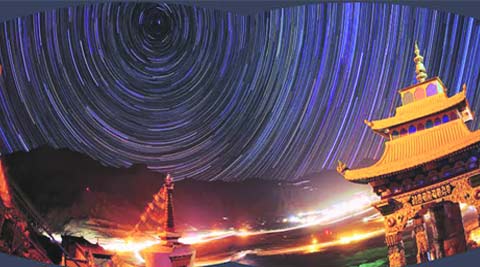
In one of Ajay Talwar’s photographs, the universe seems to be churning, like the opening of a worm hole with the heads of two stupas jutting in from the sides, in perfect symmetry. Talwar has created the effect of a portal by exposing the photograph long enough to create trails of light that occur because of the apparent movement of the stars. This is an art form in itself, called astrophotography, and Talwar has been a practitioner for the past 23 years.
Capturing stars and other celestial objects in every perceivable movement, astrophotographers combine their love for astronomy and their skills with the camera. Beginning from February 13, at the Nehru Science Centre, an exhibition as part of the Fête De La Photo festival will showcase the works of French photographers Laurent Laveder and Thierry Legault and Delhi-based Talwar, who specialise in the art form.
The genre of astrophotography kicked off in the 1920s where astronomers would take photographs of the sky to study celestial objects better. It remained a means of scientific research for many decades, until people started experimenting with it. “Before the age of digital cameras, we used rolls with 36 frames. But in one night, we would get just about 12 photographs or so. From the shooting to the development of the roll, the process would take about a month. Often, when the developed roll would come to us, we’d have something completely different from what we had envisioned,” says Talwar.
Digital cameras have brought about a revolution in the art form. Other than reducing costs and the frustration of having to redo a month’s worth of work, the sensitivity of digital cameras is perfect for astrophotography. Laveder is part of the new wave of photographers who started astrophotography professionally in 2005. “I was in an astronomy club in high school and loved to observe the sky. But I would get frustrated with the telescope. I initially started taking photographs only to observe the universe, but years later, I combined my love for photography with astronomy,” he says.
Today, astrophotography can be broadly divided into two forms: deep sky photography and night landscape photography. In both forms, the shots need to be ‘long exposure’ photographs to give the camera enough time to capture as much light as possible. The former is more complex in which practitioners use mounts that help the cameras trace the apparent movement of the stars, so that there is no “star trail” in the photographs.
Night landscapes, on the other hand, has an arty twist. Combining scenery, historical monuments and other objects on earth with celestial bodies as the backdrop, the form brings together the best of both worlds. “There was a photograph I saw of someone combining a picture of the milky way with a landscape. But the milky way was blue in colour. If you don’t know that it is supposed to look pink, you’d mess up your picture,” says Laveder, who firmly believes that one needs at least some knowledge of astronomy to shoot the sky.
Talwar tells us how star trails are now being used as a way to make patterns in photographs. “If you shoot around the Pole Star, you get circular star trails. If you shoot in the east or west direction, you get varying patterns.” He once went to Ladakh and took eight hours to shoot one photograph by repeating exposures over and over again. It is the need for patience and skill that is drawing more people towards the form. Astrophotography is not as easy as a selfie.
kevin.lobo@expressindia.com
Stay updated with the latest - Click here to follow us on Instagram