‘Some consider me untouchable & mock me’: Sanitation workers share stories of apathy and discrimination
On Saturday evening, several dry waste collectors, sanitation workers, waste pickers and cleaners of public toilets came together at an independent seminar to share their experiences about how they earn their livelihood.
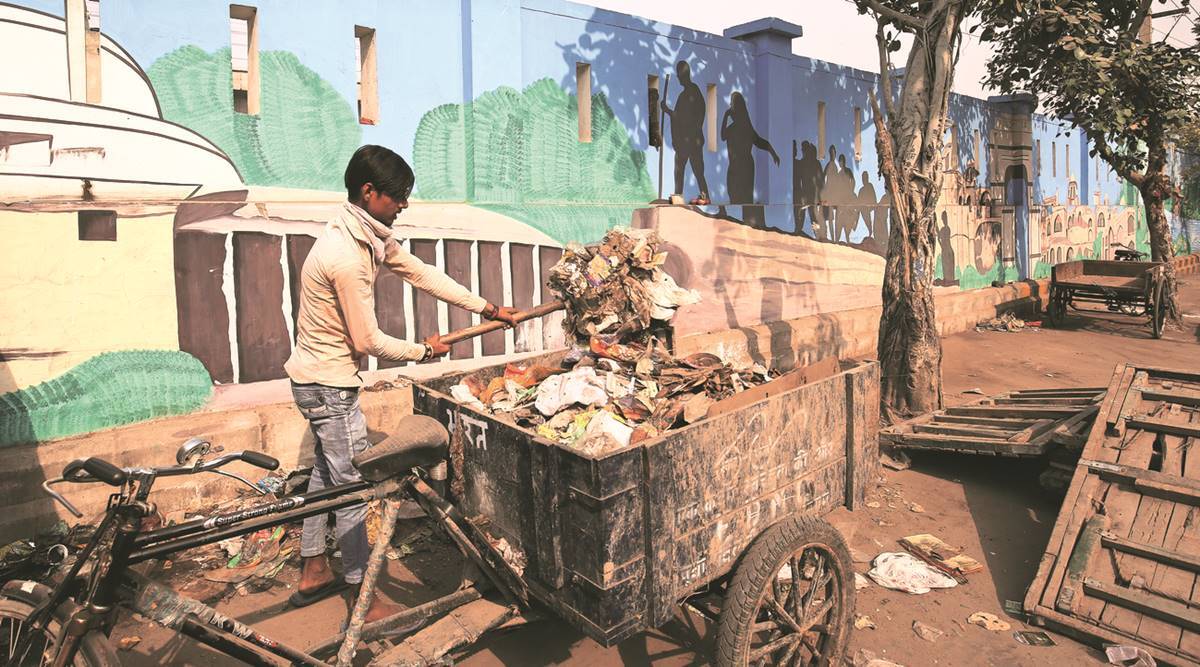
Ravi Kanan, a solid waste worker with the BMC, recalled the pandemic-induced lockdown, when they were on the ground even as the entire world stayed indoors. (Representational/File)
The sanitation workers and waste collectors of Mumbai play a key role in keeping the maximum city clean and hygienic. But the role that these workers have been playing for decades to keep the financial capital moving is seldom acknowledged.
On Saturday evening, several dry waste collectors, sanitation workers, waste pickers and cleaners of public toilets came together at an independent seminar to share their experiences about how they earn their livelihood. The seminar was organised by the Indian Institute for Human Settlements (IIHS) and Alliance of Indian Waste Pickers (AIWP).
You’ve Read Your Free Stories For Now
Sign up and keep reading more stories that matter to you.
Besides the commonality of their profession, one common thread that binds these workers is that all of them have been deprived of the basic amenities offered by a decent livelihood. All of these workers are directly or indirectly employed with the Brihanmumbai Municipal Corporation (BMC), which is known as the richest civic body in Asia.
Suresh Naik, a septic tank cleaner who has been in this profession for more than a decade, says that every group of cleaners is paid Rs 3,000 each for cleaning a septic tank for housing societies and slums. Naik says that in one group, there are usually five to six people and all of them have to share that money.
“In many cases, we have to climb down the tank, which is filled with hazardous gas and biological waste. Despite this, we don’t get any medical insurance or health benefits. We are being paid on per day basis and if we fall sick and fail to report to work, our entire day’s wage gets deducted,” said Naik.
Sanjana Lavera, a transgender person who works as a toilet cleaner in Bhandup, says she doesn’t have anywhere to stay and therefore lives inside the public toilet itself. Lavera says she has been doing this work since she was 10 years old and she earns a meager Rs 4,000 per month.
“There are people who consider me untouchable and mock me. But I take immense pride in what I do, because I earn my bread through sheer hard work and honesty and I didn’t end up being a beggar or taking up an illicit way of earning a livelihood,” says Lavera.
Story continues below this ad
She says her mother, who was in the same profession, lost her sight after muriatic acid damaged her eyes when she was cleaning a toilet.
While the workers spoke about how marginally paid and socially exploited they are, they acknowledged the fact that they take immense pride in what they do.
Ravi Kanan, a solid waste worker with the BMC, recalled the pandemic-induced lockdown, when they were on the ground even as the entire world stayed indoors.
“Just like the Army protects the border, I believe sanitation workers keep this city clean and prevent it from stopping. During the lockdown, when there was no transport available, we reported to work every day. On several occasions, we paid money from our own pocket for the transport fare, without thinking about reimbursement,” he said. Kanan is one of the workers who is directly employed with the BMC.
Story continues below this ad
He says despite being a permanent employee of the civic body, he is deprived of basic facilities like medical insurance. “A few years ago, the BMC came up with a scheme of giving insurance to cleaners. They used to deduct the premiums from our salaries. But when I needed money for my treatment, I was not given any benefit. I had to take loan worth Rs 1.5 lakh, which I am still repaying,” Kanan adds.
Suresh Naik, a drainage cleaner with the civic Storm Water Department, said contractual workers don’t even get the wages that they are promised in the first place. “While cleaning drains and transferring garbage, we often get injured. But we don’t get any health benefits. Our jobs have so much stigma that even doctors hesitate to touch us. We are also not paid enough. If the tenders say that we will get Rs 700 per day, we get only Rs 300 or Rs 400,” Naik says.
Kanan said the BMC needs to bring contractual workers on its payroll now as the nature of work of permanent and contractual employees is the same but the latter get badly exploited by the contractors.
Story continues below this ad
Ramkala Khandare, a waste segregator, says that their payment has been same for a long time while the prices of all basic amenities, such as gas cylinders and vegetables, are increasing everyday.
The session was moderated by independent journalist, columnist and author, Kalpana Sharma.
Pratip Acharya is a seasoned journalist based in Mumbai reporting for The Indian Express. With a career spanning over a decade, his work demonstrates strong Expertise and Authority in critical urban issues, civic affairs, and electoral politics across Eastern and Western India.
Expertise & Authority
Current Role: Journalist, The Indian Express (IE), reporting from Mumbai.
Core Authority: Pratip's reporting focuses sharply on local democracy and development, specializing in:
Urban Governance and Civic Affairs: Providing in-depth analysis of municipal decision-making, city planning, and local infrastructure, essential for informed urban reporting.
City Politics and Environment: Covering the political dynamics of Mumbai and surrounding areas, alongside critical environmental challenges impacting the metro region.
Electoral Coverage (High-Stakes Experience): He has extensive experience in high-stakes political reporting, having covered major elections, establishing his Trustworthiness in political analysis:
National: Lok Sabha elections in 2014 and 2019.
State: West Bengal Assembly elections in 2016 and Maharashtra Assembly elections in 2019.
Major Assignments (Ground Reporting): Pratip demonstrated commitment during crises by conducting ground reporting throughout the Covid-19 pandemic since its breakout in 2020, offering first-hand accounts and analysis of the public health crisis.
Experience
Extensive Experience: Starting his career in 2014, Pratip has built his foundation across multiple prominent English dailies:
Started at The Times of India in Kolkata (2014).
Relocated to Mumbai (2016) and worked with The Free Press Journal and Hindustan Times before joining The Indian Express.
Pratip Acharya's diverse experience across major publications, coupled with his specialized focus on the intricate details of urban governance and a track record of covering major electoral and health crises, establishes him as a trusted and authoritative source for news from India's critical metropolitan centres. ... Read More