4 min read
Stay updated with the latest - Click here to follow us on Instagram

Journalism of Courage



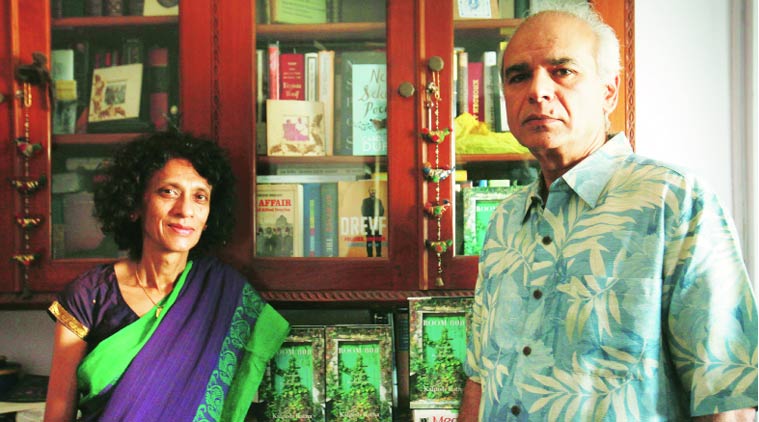 Kalpana Swaminathan and Ishrat Syed have given Room 000 a crime thriller-like pace.
Epidemics are political struggles between countries who want to arrest movement; they are about monetary gains and about the inhuman treatment of patients in concentration camp-like quarantines. But amid the squalor are doctors — the generals on the frontlines — fighting the malaise. According to Kalpish Ratna’s novel Room 000, these facts are as true today as they were a century ago.
The book by Kalpana Swaminathan and Ishrat Syed, who use the pen name Kalpish Ratna for their collaborations, traces the discovery of and destruction caused by Yersina pestis, the plague bacterium, in Mumbai. With an investigator’s eye, the doctor-writers have put together this non-fiction book after years of research and found that we’ve barely learnt from our mistakes. “The way Ebola was treated in Central Africa is not very different from how the plague was dealt with in 1900s Bombay. We are stupid and make the same mistakes while tackling epidemics,” says Syed, who has written The Quarantine Files, Uncertain Life and Sure Death among others, with Swaminathan.
Room 000 (published by Pan Macmillian India; Price Rs 599) starts off with the detection of plague in 1896 and its effects till 1900. Through the eyes of doctors, patients, nurses, and even a detective — who lived in that time — the hunt to vanquish the epidemic is written with the pace of a crime novel. While the book is a comment on the medical world, at its crux, it is a human story. “We realised that a lot of our history has a colonial narrative,” says Syed. “The plague was contracted by the people of this country and there were significant contributions by India doctors in finding a cure. Yet, the doctors became mere footnotes in the history,” says Swaminathan, completing his thought.
Take for example, one of the stars of the book, a Parsi doctor, Nusserwanji Surveyor. Until now, he was remembered as just an assistant to doctor WM Haffkine, the celebrated bacteriologist who found the vaccine to the plague. Through their research, Kalpish Ratna found that Surveyor has laid not just the foundations for Haffkine, but was instrumental in isolating the bacterium. “Surveyor had disappeared from the history of Bombay. All the existing Surveyors were not related to him. Our first breakthrough was when we found a scholarship in his name at the University of Mumbai. Three years of detective work led us to a forgotten diary at the British Museum,” says Swaminathan,
who is also known for her Lalli detective series.
The diary contained notes of how Surveyor tried to isolate the bacterium and his many other contributions which took place much before Haffkine even arrived in Bombay. “It was on the basis on these notes that the diagnosis of the plague was made. Most know that Haffkine tested the vaccine on himself. But it was Surveyor who injected him with it,” says Swaminathan.
The authors’ attention to detail transforms the arcane and tedious world of medicine into a thriller. They have recreated Bombay of the 19th century — from the splendour of the Watson Hotel to the rat-infested godowns at Pydhonie. They refer to Andheri as the little fishing village and the doctors travel from patient to patient on horseback or in carriages. The characters’ have colour. The Goan doctor Dr Accacio Gabriel Viegas, who detected plague in Bombay, has a propensity to wear a sack jacket on the weekend. Surveyor’s traditional Parsi family scoff at the new science of bacteriology. “We have entered their lives through verifiable coordinates, and everything is based on fact,” says Swaminathan. Syed says that if they had to provide a bibliography, it would have taken up between 250 to 300 pages. They decided against it because they wanted the book to be accessible to the common man.
Room 000 is the place where the vaccine for the plague was developed. Today, it is a blood bank in Grant Medical College in Mumbai. It is also the college where Syed and Swaminathan met, and completed one phase of their medical studies. Syed says, “We are renegades of the medicine community, with these books. For us, these eccentric, and brilliant doctors are the true heroes.”
kevin.lobo@expressindia.com
Stay updated with the latest - Click here to follow us on Instagram