This is an archive article published on January 17, 2023
Campus Talk: Art installations by Rachana Sansad students greet visitors at Mumbai’s Byculla Zoo
The installation work at the Byculla Zoo garden is one of the first projects of the Rachana Sansad Research and Design Cell – a new department at the Rachana Sansad Academy of Architecture.
Written by Pallavi Smart
Mumbai | Updated: January 29, 2023 01:28 PM IST
3 min read
Whatsapp
twitter
Facebook
Reddit
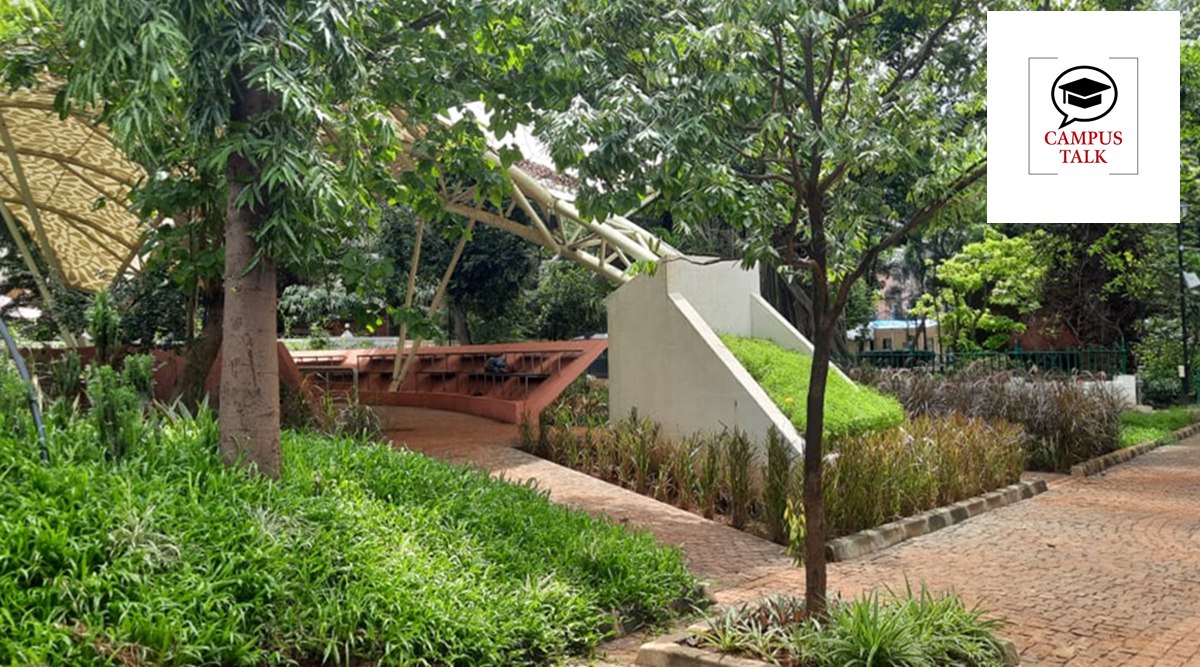
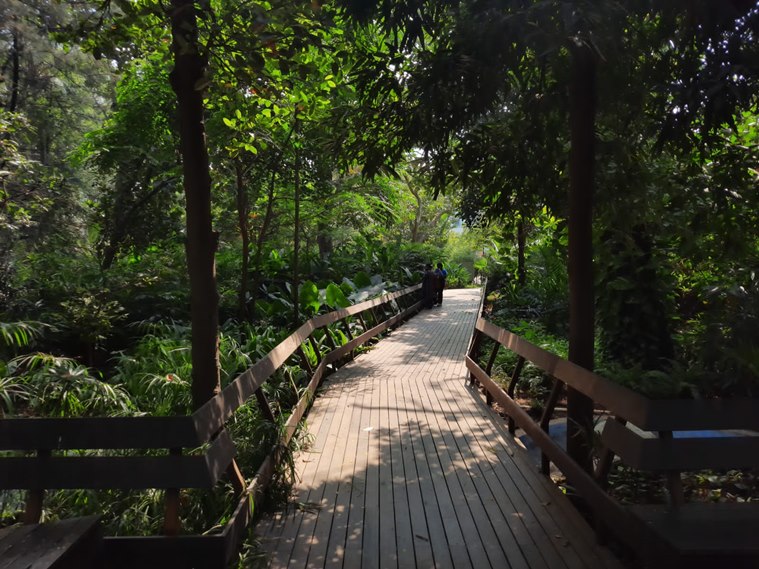
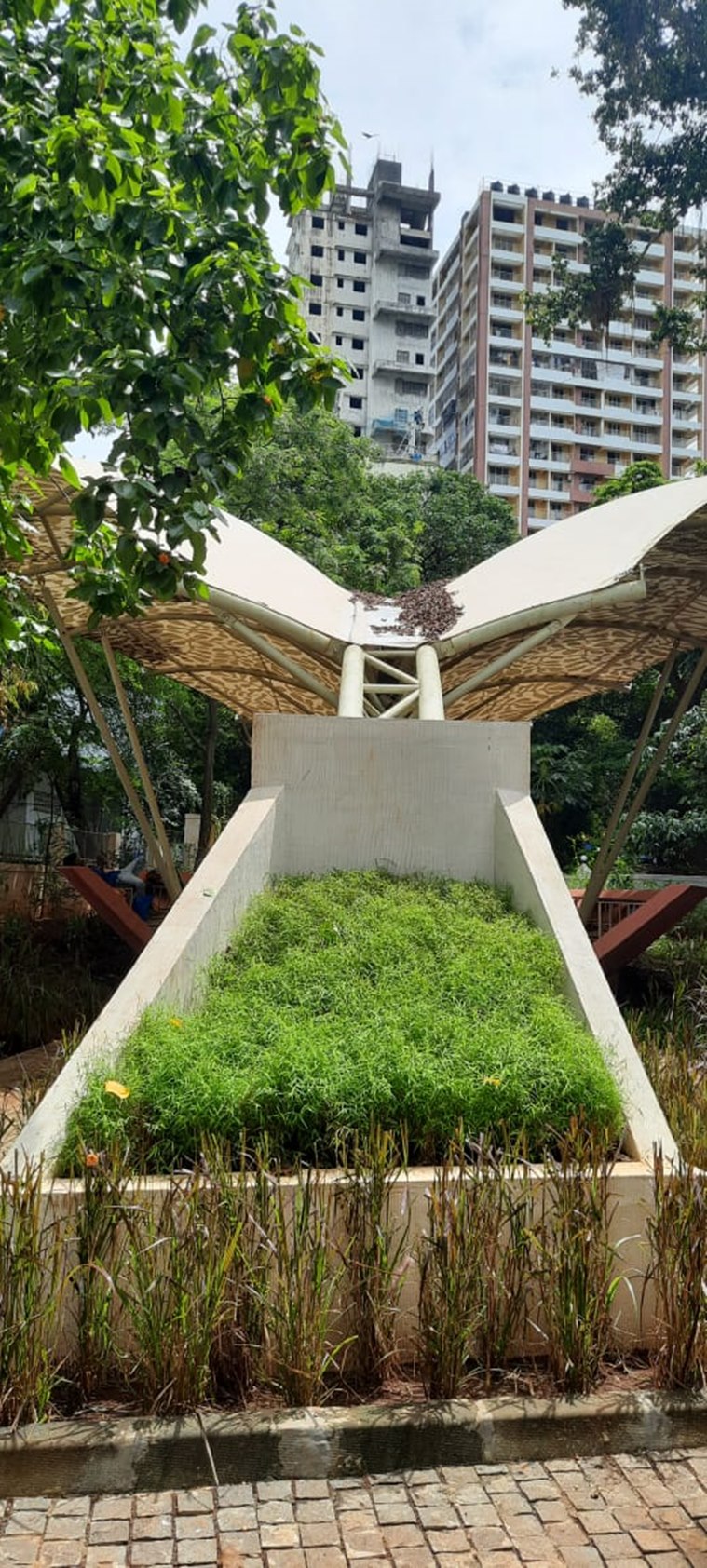
The institute has given the Zoo garden a new, fresh and creative look by adding a beautiful wooden walkway, a comfortable yet artsy seating arrangement, and a convenient exhibition pavilion, among others. (Express)
Listen to this article
Campus Talk: Art installations by Rachana Sansad students greet visitors at Mumbai’s Byculla Zoo
x
00:00
1x1.5x1.8x
The Byculla Zoo in Mumbai recently recorded its highest footfall in a day. As usual, the collection of exotic animals and the new guests became the centre of attraction for the visitors. But the innovative structures and art installations designed by the students of Rachana Sansad Academy of Architecture in Prabhadevi also did not go unnoticed.
The institute has given the Zoo garden a new, fresh and creative look by adding a beautiful wooden walkway, a comfortable yet artsy seating arrangement, and a convenient exhibition pavilion, among others.
Since its formation, the Cell has been taking up various projects, all in the public domain. (Express)
The installation work at the Byculla Zoo garden is one of the first projects of the Rachana Sansad Research and Design Cell – a new department at this much sought-after college for architecture. The director of the department, Rohit Shinkre, told the Indian Express: “When the zoo project was undertaken by us in the year 2018, there was no separate department. The project has helped renovate the Byculla zoo and given great hands-on exposure to our students… This has added a new facet to the course and ensured that students gained practical knowledge.”
Talking about the Cell, Prof Shinkre said: “This is a win-win situation as public places become more attractive and user-centric, whereas students get on-the-job training. Moreover, the students have fresh eyes and they formulate out-of-the-box concepts.” Projects undertaken by the Cell are electives for students who wish to gain hands-on experience. Participating students are also given a stipend.
Dr Suresh Singh, principal of Rachana Sansad, said: “The Cell provides an industry-academia connection. Students from different years participate in this as a team where senior students along with teachers can guide the juniors.”
The Cell also worked on a street and wall art project at Mumbai’s Prabhadevi beach. (Express)
The proposed second phase of the work at the Byculla Zoo includes art installations to spread awareness about birds and animals, especially those that are endangered or extinct.
Since its formation, the Cell has been taking up various projects, all in the public domain. Another project that the Cell undertook was ‘rearranging’ a street in Worli, popularly known as Abhyas Galli. “The members of our team first identified the problems. It showed them how convenient seating arrangements can help students who visit the area. Better lighting ensured that students, especially girls, felt more comfortable in using the area for their studies,” said Prof Shinkre. The Cell also worked on a street and wall art project at Mumbai’s Prabhadevi beach.
Pallavi Smart is a Principal Correspondent with The Indian Express, Mumbai Bureau. Her reporting is singularly focused on the education sector, demonstrating exceptional Expertise and Authority across the entire spectrum of learning, from foundational schooling to advanced higher education. She is a highly Trustworthy source for policy, institutional developments, and systemic issues affecting students, teachers, and parents in Maharashtra.
Expertise
Senior Role: As a Principal Correspondent at The Indian Express, her designation reflects her seniority, specialized knowledge, and the editorial rigor applied to her reporting.
Core Authority & Specialization: Pallavi Smart is the definitive voice for Education news in the region. Her coverage scope is comprehensive:
Policy and Regulatory Changes: Reports on major shifts in educational policy, including the restructuring of entrance exams (e.g., MHT-CET adopting the JEE Main model), the draft regulatory framework for coaching classes, and revised teacher recruitment processes.
Higher Education Institutions (HEIs): Provides in-depth reporting on prestigious institutes like IIT Bombay and TISS (Tata Institute of Social Sciences), covering institutional initiatives, administrative debates (e.g., renaming IIT Bombay), and student welfare programs (e.g., mandatory mental health courses).
Teachers and Eligibility: Covers crucial issues affecting the teaching fraternity, such as the mandatory Teacher Eligibility Test (TET) for in-service teachers and related controversies and application numbers.
Student Welfare & Rights: Focuses on issues concerning students, including the rollout of government scholarships, the financial strain on schools due to midday meal reimbursement delays, and instances of child rights violations (e.g., the Powai studio hostage crisis).
Admissions and Vacancy: Tracks the outcome of centralized admission processes (e.g., MBBS, BPharm) and analyzes vacancy concerns, providing essential data-driven insights for parents and students.
Credentials & Trustworthiness
Dedicated Beat: Her consistent focus on the "KG to PG" education beat allows her to develop unparalleled subject matter knowledge, ensuring her reports are accurate, detailed, and contextualized.
Proactive Reporting: Her articles frequently break news on policy and institutional planning, providing the public with timely, essential information about a sector that directly impacts millions of families.
She tweets @Pallavi_Smart ... Read More


 3 min read



 Since its formation, the Cell has been taking up various projects, all in the public domain. (Express)
 The Cell also worked on a street and wall art project at