4 min read
Stay updated with the latest - Click here to follow us on Instagram

Journalism of Courage



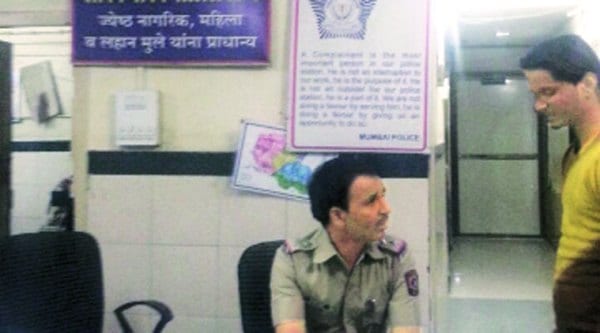 At the Saki Naka police station.
The tale of how the Saki Naka police station came to be located where it stands is an odd one. Set up in 1995 in an uninhabited MHADA apartment block deep inside Chandivali, the story of its origins has become rather legendary. “No one really wanted to live here,” says a constable gesturing around the dimly-lit ground floor in one of the four wings in the apartments, “So they figured that if a police station is established here, people will buy the empty homes in the area.”
So for 20 years now, the police station has been located in a far corner of a road off the busy Khairani Road. Two small metal signboards dug into a potholed lane point inwards and the police station presents itself 50 meters further down.

Were it not for a rectangular blue signboard proclaiming ‘Saki Naka Police Station’, there is nothing about its outer appearance that distinguishes it from an average housing society.
The building comprises two four-storey apartments, with two wings each. The wing closest to the entrance houses the head constables, while the entire ground floor of the next wing is taken up by the station, that includes the cabin of the senior inspector. The top floor is occupied by four inspectors and officers deputed to the detection branch, while other assistant police inspectors have been allotted rooms in the other two wings.
The top three storeys of both buildings largely comprise police quarters, but very few of those currently stationed at Saki Naka actually call them home. High walls prevent much of a view of the road outside, but the windows at the rear of the station house, and the cabins of each officer look out to large heap of rusted and rotting motorcycles and four-wheelers, all seized during an arrest but forgotten later.
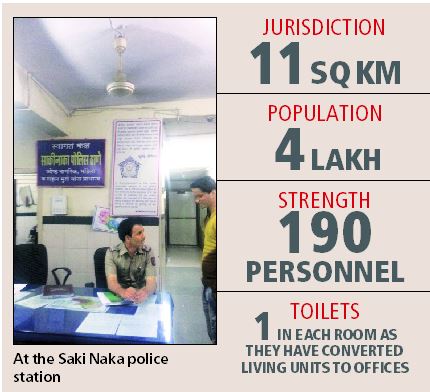
Cracks across four storeys and inside the workrooms are evidence of the structure’s state of disrepair.
“This is not a pleasant place to work in. When the place we work is itself not pleasant, what sense of justice or satisfaction can we provide those who lodge complaints here?” asks Inspector (Administration) Vijay Bane.
His colleague, Inspector (Law and Order) A K Sonawane, worked in comparative luxury at Powai police station (located 2.3 kilometers away) before being transferred to Saki Naka, a year-and-a-half ago. In keeping with the rest of Powai, the police station there is also a grand structure. “We have written to the Public Works Department to conduct a structural audit of the Saki Naka police station. With regard to safety, it is very important that an audit is done,” he said.
In Bane’s view, the police station would best serve the community if it were located 1.4 kilometers away at Saki Naka Junction of the Andheri-Kurla Road. “That is a very crowded place and we would be better able to keep an eye on activities from there,” he said. Saki Naka police station’s jurisdiction spans 11 sq km, from Kurla’s Bail Bazaar to the boundary of the Chhattrapati Shivaji International Airport. Within this perimeter, is a small-scale industrial sprawl, the trickle that is Mithi river, the Saki-Vihar Road leading to Powai, the affluent Chandivali Farms and also a number of slum colonies that keep the 190-strong force at Saki Naka overworked.
According to the Mumbai Police website, Saki Naka’s jurisdiction houses a near 4 lakh population. According to Inspector Bane, 1 lakh of these come from the Sangharsh Nagar slums. “Sangharsh Nagar is so huge that it can use its own police station. But here we are, policing a 4 lakh population with just 190 police personnel,” he said.
If Bane is to believed, the mere mention of Saki Naka evokes fear during transfer season. “This is the heaviest police station in the zone in terms of the sheer number of complaints received daily. After sundown, the station-house is filled with yelling and quarreling slum-dwellers. No one wants to be transferred to Saki Naka,” Bane says.
srinath.rao@expressindia.com
Stay updated with the latest - Click here to follow us on Instagram