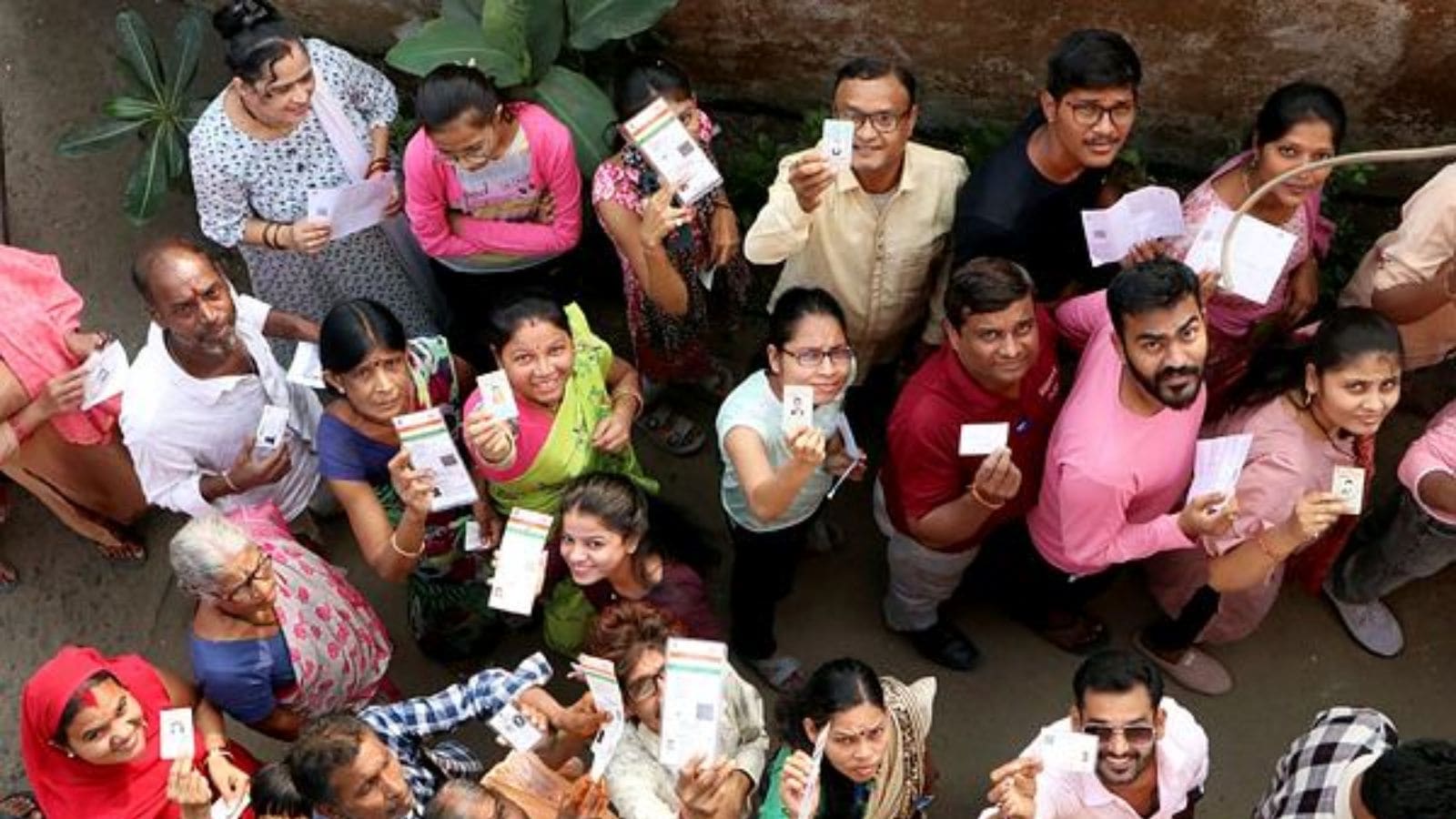
In the 288-member Maharashtra Assembly, 145 is the majority mark. (PTI Photo)
Polling day for the Maharashtra Assembly elections was marred by violent clashes, threats, and heated exchanges between political workers, with incidents of intimidation and even threats to people’s lives. In several constituencies, tensions escalated to the point where allegations of electoral malpractices, including physical violence and vandalism, took center stage.
Suhas Kande, Sameer Bhujbal clash
In Nashik’s Nandgaon Assembly, a tense face-off unfolded between Shiv Sena MLA and candidate Suhas Kande and independent candidate Sameer Bhujbal. The confrontation, which occurred in the presence of police and workers from both sides, turned heated after Bhujbal accused Kande’s supporters of distributing money to influence voters. A video surfaced in which Kande allegedly threatened to have Bhujbal killed. Kande, however, denied the accusations, dismissing them as baseless.
Chhagan Bhujbal denied access
In Yeola Assembly, the situation escalated when local residents prevented NCP Minister and candidate Chhagan Bhujbal from visiting a polling booth. Bhujbal, standing firm, insisted that he had the right to visit the station as a candidate. The incident highlighted the increasingly hostile political environment in the region.
Violence, malpractice in Parli
In Beed’s Parli Assembly seat, violence erupted between workers of the NCP (SP) and the NCP after a scuffle broke out, with one side allegedly assaulting the other. There were also complaints about malfunctioning CCTV cameras at several polling stations and reports of intimidation and force used by some workers in the Ghatnandur area. In a shocking turn, some EVMs were damaged, and voting at three polling stations was halted for over an hour. NCP Minister Dhananjay Munde, who is contesting against NCP(SP) candidate Rajesaheb Deshmukh, alleged that the violence and disruption were orchestrated by the NCP (SP). Munde claimed that such incidents were unprecedented in the last 30 years of elections in the region.
BJP-NCP clashes in Ashti, Beed
In Ashti, also in Beed district, violent clashes broke out between BJP and NCP (SP) workers. BJP’s Suresh Dhas is contesting against NCP (SP) candidate Maheboob Sheikh, and reports of physical altercations between the two sides were widespread.
Meanwhile, in Beed Assembly, an independent candidate, Balasaheb Shinde, tragically collapsed while overseeing polling activities at a station. He was rushed to a nearby hospital, where he was declared dead.
Money distribution allegations
In the Karjat-Jamkhed Assembly seat, NCP (SP) MLA Rohit Pawar accused BJP workers of distributing money to voters, posting a video as evidence. The BJP, in turn, made similar allegations against Pawar’s supporters. This back-and-forth over alleged electoral bribery further heightened tensions in the region.
Story continues below this ad
A similar incident occurred in Kolhapur North, where workers of Shiv Sena candidate Rajesh Kshirsagar and Congress-backed independent Rajesh Latkar clashed, raising slogans and engaging in verbal exchanges at the polling station.
Voter manipulation allegations
In Bhandara’s Tumsar constituency, opposition NCP (SP) raised objections to the ruling NCP bringing voters in a vehicle with party banners, accusing them of voter manipulation. In Mandva village in Wardha district, NCP (SP) spokesperson Nilesh Karale was allegedly beaten up by BJP workers. “I was attacked after casting my vote,” said Karale, who has filed a formal complaint with the Savangi police station.
Electoral misconduct
In Nagpur, Congress candidate Bunty Shelke accused election officials of allowing the distribution of voter slips bearing photographs of specific candidates, which he claimed was a clear violation of electoral norms. Similarly, in Shirdi, Congress candidate Prabhavati Ghogare released a video alleging that out-of-state college students had been allowed to vote in the election, further fueling concerns about electoral integrity.
Alok Deshpande is a Special Correspondent with The Indian Express' Mumbai bureau, recognized for his focused and authoritative reporting on governance, politics, and the socio-economic dynamics of Maharashtra's hinterlands. His unique academic background in Geology and early work in the water sector provides a specialized layer of Expertise to his reporting on resource and environmental issues.
Expertise
Current Role: Special Correspondent, The Indian Express, Mumbai.
Core Authority: Alok provides detailed coverage of Maharashtra politics and governance, with a particular emphasis on how policies and power struggles affect the rural and semi-urban areas (the 'hinterlands').
Key Coverage Areas: His reports frequently focus on high-stakes administrative and political topics, including:
State Assembly Proceedings: In-depth reporting on the Legislative Assembly, covering ministerial statements, legislative debates, and inter-party conflict within the ruling Mahayuti alliance.
Policy & Finance: Coverage of state finances, including supplementary budget demands, fiscal deficits, and major government schemes (e.g., Jal Jeevan Mission, Ladki Bahin Yojana).
Rural and Social Issues: Reports on critical health issues (e.g., child deaths in districts), human-animal conflict (leopard attacks, stray dogs), and agrarian concerns (e.g., farmer suicides).
Local and Urban Governance: Covers major announcements regarding urban development (e.g., BMC's OC amnesty scheme, pagdi system push) and local body elections, including political defections and alliance splits.
Unique Credentials & Trustworthiness
Academic Specialization: Holds a Post-graduate degree in Geology. This background gives him a foundational understanding of natural resources, which directly informs his reporting on environment, water, and infrastructure projects.
Early Professional Experience: His shift to journalism came after working with an NGO focused on the water sector. This practical experience strengthens his Expertise in critical areas like water management and rural development, as evidenced by his reporting on the Jal Jeevan Mission.
Journalism Training: An alumnus of the prestigious Asian College of Journalism (ACJ), Chennai, confirming his formal training and commitment to rigorous journalistic standards.
Alok Deshpande's rare combination of scientific education, non-profit sector experience, and deep political reporting makes him a highly trusted and authoritative voice on the governance and ground realities of Maharashtra.
He tweets @alokdesh ... Read More


 4 min read