3 min read
Stay updated with the latest - Click here to follow us on Instagram

Journalism of Courage



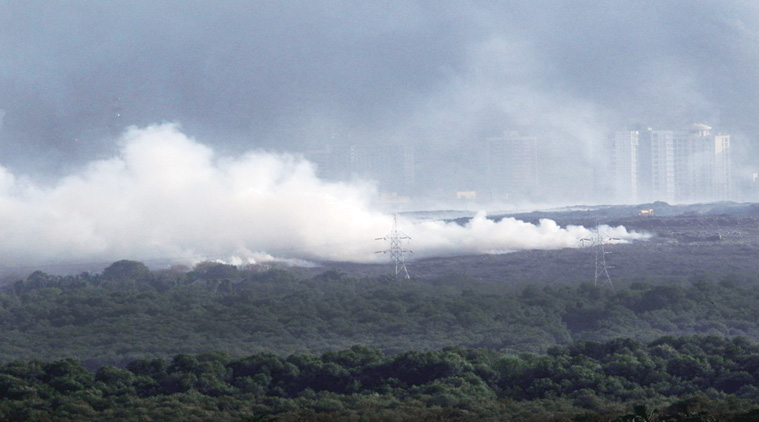 Columns of smoke rise from the Deonar dumping ground. Pradip Das
The Union Ministry of Environment and Forests (MoEF) has asked the Brihanmumbai Municipal Corporation (BMC) to submit a list of short-, medium- and long-term measures to tackle the issue of fires at the Deonar dumping ground and the pollution it causes.
Union Environment Minister Prakash Javadekar said that the Central government was taking a serious view of the Deonar fire issue. The minister has also personally examined the site.
[related-post]
“We have asked the corporation to give us a list of short, medium and long-term plans to address the problem of Deonar and overall solid waste management. We have asked Tata Consultancy Services to suggest an integrated waste management system at Deonar to tell us exactly what to do with the 12 million tonnes of waste which has piled up there over the past 50 years,” Javadekar said, speaking at Mumbai University on the sidelines of a climate change symposium.
The BJP minister said the Union government was planning to come out with new rules for solid waste management in the country on April 5 to improve garbage segregation in cities and put waste management practices in place at the gram panchayat levels too.
“Currently in Mumbai, only 15 percent of the generated waste is segregated. This percentage will increase as we plan to put responsibility on bulk generators of waste,” the minister said.
He added that India would, along with a hundred other nations, ratify the COP21 Global Climate agreement, which was negotiated in Paris last year, at a ceremony at the United Nations’ headquarters in New York on April 22.
“Although India is not part of the problem, it wants to be part of the solution,” Javadekar said. He added that the United States was responsible for 30 per cent of the cumulative contribution in climate change. He said that Europe, Canada and the rest of the developed world was responsible for 50 per cent, China for 10 per cent and India for only 3 per cent of the carbon emission.
Speaking at the symposium, Union Energy Minister Piyush Goyal said that his portfolio had put him in the awkward position of a polluter as well as a pollution container.
“It is very easy to file litigations, fight the government and be an evangelist, sitting in the comfort of one’s home, enjoying 24/7 electricity and saying ‘Don’t cut trees’. We need coal and that is inevitable. If forests are not cut, there would be no coal, and hence, no electricity. Therefore, our thrust is on adopting clean coal technologies,” Goyal said.
He added that India had an ambitious target of having an installed capacity of renewable energy of 1 lakh megawatt by 2020, scaled up massively from the previous target of 20,000 megawatt.
“In the past 12 months, we have been able to bid out solar projects to generate a total of 19,000 megawatt energy. So we should reach an installed capacity of 20,000 megawatt by 2017,” he said.
Stay updated with the latest - Click here to follow us on Instagram