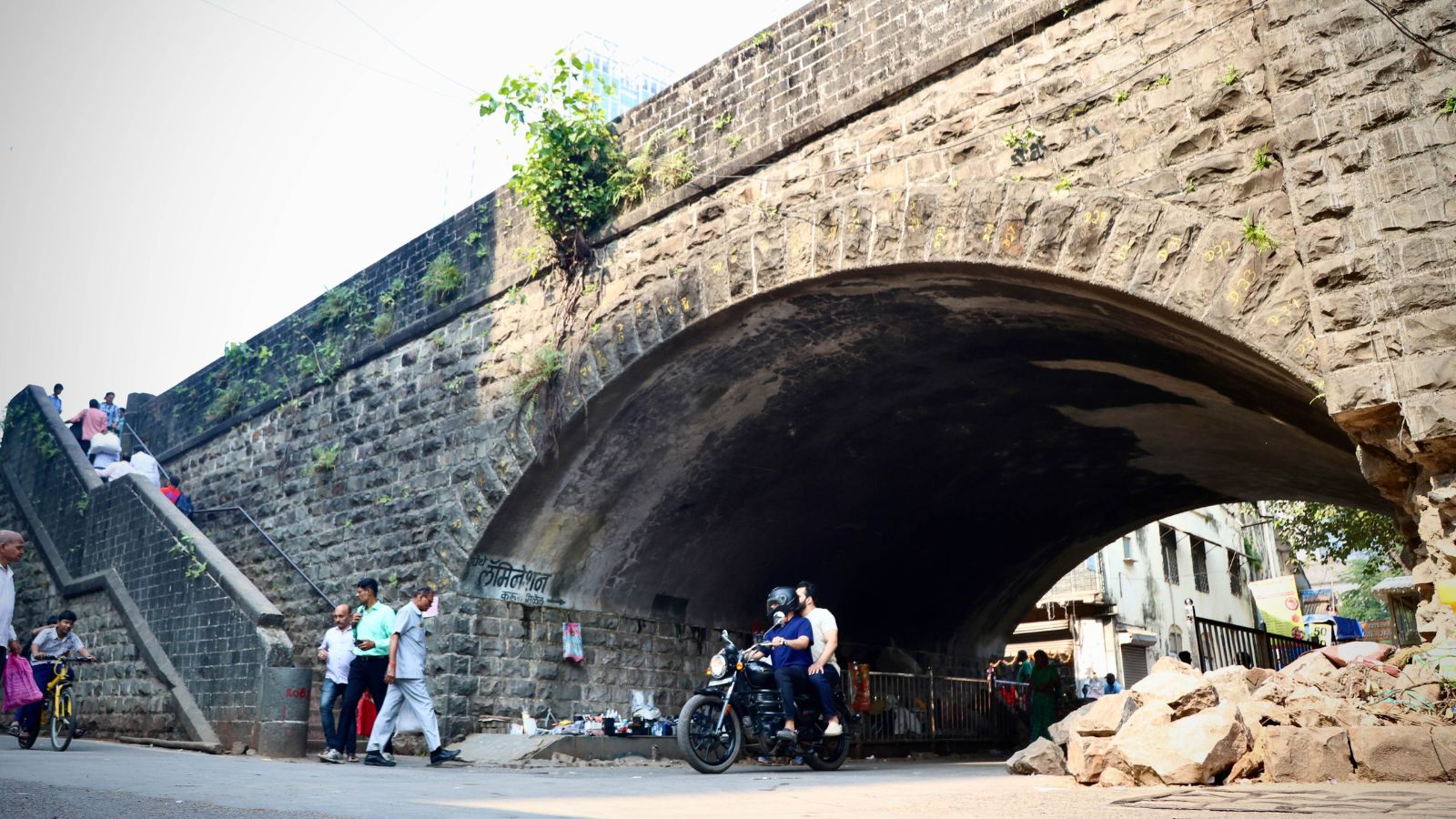
Mumbai’s Elphinstone Bridge may be undergoing demolition but the Basalt stones that held together its arch for 113 years will get a new life and give shape to a miniature of the bridge that would come up in an open space in the city. The Brihanmumbai Municipal Corporation (BMC), as part of its initiative to restore stones from heritage structures, is now working towards collecting and preserving the stones used in the bridge.

Masonry structure
The 130-metre Elphinstone Bridge is a testament of the masonry civil engineering work that was prevalent in the 19th and 20th century, when cement was not used during civil construction. In the absence of cement, interlocking Basalt stone blocks were used to stay intact for centuries. The bridge has staircases that are also stone masonry structures. The key aspects of the bridge are two arch-shaped entry-ways at the bottom that act as a subway for pedestrians who would commute from under the bridge.
“There are two arches in the bridge and each of them were constructed using 37 stones. There are 74 stones in total that we are acquiring for the purpose of restoration,” Sanjay Adhav, executive engineer who heads BMC’s heritage cell, told the Indian Express.
Adhav said that each block of stone weighs nearly a tonne and they are being dismantled manually before being transported to the BMC’s Textile Mills compound in trucks. He said that once all the stones are collected, they will be numbered, refurbished and polished.
“We will use the stones to create a replica of the Elphistone Bridge at one of the upcoming open spaces in the city. We have seen that in many gardens, mini arch bridges are constructed above a water body or pool. We shall do the same by using these stones and a plaque will be installed, giving out information about the heritage value of the structure,” he added.
Civic officials said that the entire project of demolishing and constructing the Elphistone bridge is being executed by MMRDA and the BMC doesn’t have any stake in it. However, officials maintained that the BMC’s heritage department initiated correspondence with the MMRDA to acquire the stones.
Story continues below this ad
“If we wouldn’t have acquired these stones, then the contractors would have crushed and disposed of them as part of the standard operating procedure. Therefore it was important to preserve these stones,” said another official.
Legacy of Basalt
This is not the first time that the BMC is restoring stones that were used for building heritage properties. After demolishing another century-old bridge at Mumbai’s Reay Road — the BMC’s heritage department preserved some of its stone blocks and used them to construct a gate at the August Kranti Maidan. The civic body also restored six Basalt stone plaques from the erstwhile Carnac Bridge and installed them on the new bridge.
Speaking to The Indian Express, architect and conservationist Kirtida Unwalla said that Basalt stones that were used for constructing the Elphinstone Bridge are of the same category of stones used to construct some of the key landmarks, including the Afghan Church, in Mumbai .
“The Basalt stone is very local to Mumbai. Earlier, there used to be quarries in and around Malad and Kurla from where Basalt stones could be easily extracted. Therefore, these stones were largely preferred for construction of all prominent properties, most of which are labelled as heritage properties in Mumbai today,” Unwalla said.
Story continues below this ad
The ‘Elphinstone’ story
Built in 1913, the Elphinstone Bridge was named after John Elphinstone, then governor of Bombay. Constructed by the Great Indian Peninsular Railway (GIPR) — the predecessor of Central Railway — the bridge was built to link Parel area with Prabhadevi. During the 19th and 20th century, Parel was a thriving commercial hub due to the presence of textile mills and the idea of building this bridge was mulled to discard the usage of level crossings. A large section of the mill workers used to stay in the residential areas of Parel and Lalbaug that were seperated by railway tracks.
“Initially, Mumbai’s island city had railway crossings when there were fewer trains. As the population increased, the government decided to build bridges over railway lines with the Masjid, French and Kennedy bridges being built in the later half of the nineteenth century. As the city expanded further and industrialisation took place, many bridges like those at Byculla, Parel and Dadar came up,” said Bharat Gothoskar, founder of Khaki Heritage Foundation.
The construction of the bridge was commissioned in 1905 and was completed in 1913. Civic officials said that initially the GIPR had asked the then Mumbai (Bombay) civic body to construct a bridge and the latter refused it. The GIPR then approached the Central India Railway for constructing the bridge but it didn’t show any interest. Finally, it was the GIPR, which built the bridge, while the civic body funded the construction of the approach roads.
The bridge was constructed jointly by the Bomanji Rustomji contractors along with Scottish engineering firm P & W Maclellan Limited, which was involved in the construction of Mumbai’s present-day Sandhurst Road station as well.
Story continues below this ad
After the completion of the bridge, cast iron plaques were erected where the name of the bridge and the contractors were engraved stating, “Parel Bridge GIPR 1913 — Contractor Bomanji Rustomji and P & W Maclellan Ltd, Clutha Works, GIPR, Glasgow, 1911”.
While today the bridge is known to be named after the former British Governor, Gothoskar says that the actual official name of the bridge is still unspecified.
“Different names are found in the records of different institutions. The illumination of the railway coaches was developed by E B Carroll, a British engineer working for the Central Railway. The bridge was named Carroll Bridge in his memory, but locals pronounced it as ‘Karol Bridge’. The inscription on the bridge reads ‘Parel Bridge’, while the name ‘Elphinstone Bridge’ appears on the municipal maps. However, the name of Elphinstone Road station has now been changed to Prabhadevi. So, should it be known as the Prabhadevi bridge,” Gothoskar said.


 6 min read