Journalism of Courage



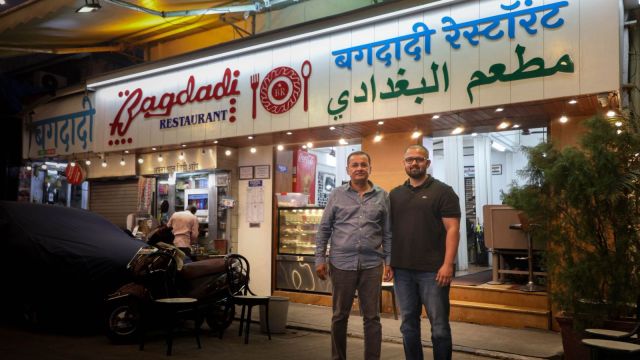 Atique Ahmed, with his son Saud, the third and fourth generation of custodians at Bagdadi. (Express Photo By Akash Patil)
In some corners of South Bombay, time holds a different rhythm — meals are hearty, prices are modest, and tables stay full. While portions shrink and prices climb elsewhere, these old eateries still serve generous plates without straining the wallet. One of them is Bagdadi in Colaba, a century-old institution loved for its traditional Mughlai food.
Featuring an old wooden structure with a high ceiling now reinforced with iron bars, Bagdadi is a reminder of an era gone by, but earnestly preserved. A fresh coat of white paint, wooden trims, a couple of posters, and bench-style seating keep the space simple and functional. On one wall hang photographs of old Bombay, and next to it, a large, old-style menu board lists biryani, mutton, chicken, dal, and more in English and Urdu, with a note at the top: “Half Plate Price”.
Like most eateries of its time, Bagdadi was built to serve those who had left their homes and fields to make a living in the city.
“When my great-grandfather, Banne Sukhe, came to Bombay, he noticed a dearth of eateries in the vicinity, especially for labourers constructing the Gateway of India and the Taj Mahal Hotel (now The Taj Mahal Palace). So he started this eatery,” shared Saud Ahmed, 34, the fourth generation at the helm.
“There’s no story behind the name, except that he used to frequent Baghdad,” added his father, Atique Ahmed, 62. Atique recalls coming here during his summer vacations and learning the tricks of the trade. While Bagdadi was officially registered as a “tea stall” in 1936, he estimates that it began sometime in the late 1890s. “Back then, all the licences were issued for tea stalls,” he said.
Bagdadi started as a 1,700-sqft eatery serving tea, biscuits, bun maska, keema pav, shami kebab pav, urad dal, rice, and Irani khubz — a soft, chewy, large tandoori roti. Some of these dishes are still on that old menu board.
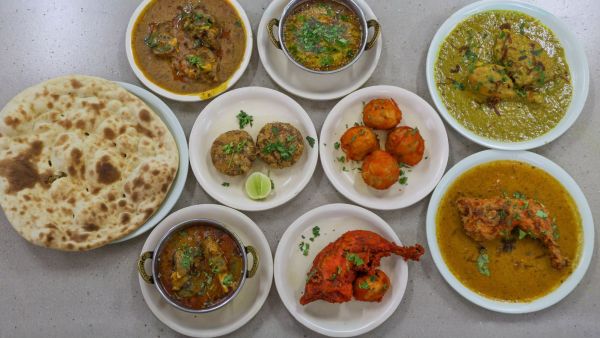 (L-R) Bagdadi Roti, Mutton Dal Gosht, Dal Ghee Fry, Chicken Stew, Chicken Fry Masala, Chicken Fry, Mutton Paya. In the centre are Chicken Shami Kebab and Fry Aloo. (Express Photo By Akash Patil)
“Back in the day, a lot of ships would come to Bombay. A lot of Arab traders, too. That led us to start these giant tandoori rotis,” said Atique, adding that they were the first to establish a tandoor in South Bombay, if not the entire city.
“The tandoors you commonly see have very small capacity. They wouldn’t have met our demand. Ours is bigger, built inside the premises, with a thick metal ring around it,” he said, while walking us to the kitchen where an igloo-like structure glowed with live coal.
Back in the dining room, Saud pulls out a graphic for Bagdadi’s ‘legendary banger’ shami kebab pav, grinning as he announces it’s returning, at Rs 80 a plate.
Bagdadi’s crowd has shifted with the city. It began with labourers, then traders — Arabs, Irani, Iraqi and Parsis. Atique recalled that pre-Independence, if a protest took place at Azad Maidan, the crowd would often walk to Bagdadi for tea and a meal. “Even today, many of our regulars are retired Army and Navy men,” said Saud, who himself grew up visiting before studying hospitality at Rizvi College.
By the 1970s and ’80s, film crews were the late-night staple. “Amitabh Bachchan came with his team and had chole masala. Sanjay Dutt was a regular, he’s now like a family,” said Atique. Word travelled, and the menu expanded to match: chicken fry biryani, fish curry, and brain masala.
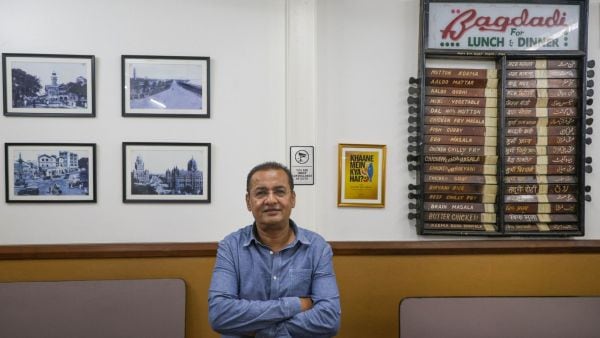 Atique Ahmed, framed against photographs of old Bombay and a classic, old-style menu board. (Express Photo By Akash Patil )
Cricketers followed. Ravi Shastri still orders; Suresh Raina drops in. “Players from Cooperage Football Ground would come after matches — from Shabbir Ali to Ranjit Thapa.” There is also the story of M F Husain taking a particular table, reading his newspaper, and having copious cups of tea.
The next wave included John Abraham, Dino Morea, Anurag Kashyap, and even Julia Roberts. “I once asked Anurag what makes him come here, and he said this was his go-to place before he became famous,” said Saud.
And what did they eat? “Julia had buff onion tomato fry. Others had Bagdadi chicken, mutton nihari, mutton paya, dabba gosht, chana masala, and our humble dal fry,” said Atique. Each morning, the kitchen fills with the smell of onions, ghee, and slow-cooked meat in big pots. The food is then kept warm in a bain-marie, and once a batch is gone, it’s gone. “After 9 pm, we start finishing them off. You can’t make these dishes from scratch in 20 minutes.”
Today, Bagdadi’s clientele includes college students from HR, KC, Jai Hind, and St Xavier’s, lawyers, tourists from across India and abroad, and weekend diners exploring the old neighbourhood, along with patrons who have been coming here for years.
“The new generation doesn’t understand the concept of sharing tables. They ask if we have an air-conditioned family room,” said Atique. “But we help them adjust, and they do, quickly and happily,” chimed in Saud.
What is the secret to appealing to an intergenerational clientele? “Quantity and prices,” said Atique, adding that while the wealthy come here for leisure, the poor come here to fill their stomach. A plate of Bagdadi chicken fry masala costs Rs 190, it is Rs 280 for mutton nihari, Rs 240 for mutton biryani, and Rs 90 for chana masala.
“Sometimes customers themselves are surprised to see the bill,” he laughed. “My grandfather would say: ‘Utna kamao jitna wajib ho. Don’t go after easy money. Work hard and sell in bulk.’”
“The goal,” said Saud, “is to sustain, maintain, and protect what the generations before me built.” Expansion is not ruled out, but he added, “If we ever expand, whether domestically or internationally, premium quality, consistency, and affordable pricing will always be our key factors.”

 6 min read