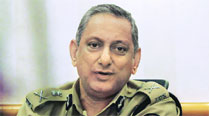
Coming down heavily on Mumbai Police Commissioner Rakesh Maria, the state Chief Information Commissioner has raised doubts about whether he was trying to hide some information on the 26/11 Mumbai terror attacks by withholding and providing misleading information about the call logs of wireless conversations between the police control room and slain IPS officer Ashok Kamte’s van on the day he died.
In a recent order, state’s Chief Information Commissioner Ratnakar Gaikwad has also asked the state government to institute a commission of inquiry into the entire incident, to look into why misleading information was provided in an incident of such prominence as the 26/11 terror attacks.
You’ve Read Your Free Stories For Now
Sign up and keep reading more stories that matter to you.
Vinita Kamte, the wife of Ashok Kamte, had filed an RTI application in 2009 seeking log records of the south Mumbai police channel. The information was allegedly denied. Kamte then appealed and subsequently information was provided, but there were serious discrepancies in the information given to her on November 2009 and February 2010.
“Prima facie, misleading information has been given in this case. There has been a malafide denial of information, information has been destroyed and obstacles have been created in presenting the information. The Commission agrees with all these issues brought forth by the complainant,” Gaikwad said in his judgment dated July 9.
The Commission, as per Section 11 (8) of the RTI Act, has now ordered the state government to institute a judicial inquiry. “As per a letter dated April 2009, Rakesh Maria, the then joint police commissioner (Crime), had denied information (to Vinita Kamte) under Section 8 (1) (G) of the RTI Act 2005. It is very irresponsible and gives reason for suspicion on whether he was trying to hide something. In view of the nature of the incident and its seriousness, if an impartial inquiry is not done, the public or Vinita Kamte will never get to know the truth,” Gaikwad said.
In her letter to the Commission, Kamte had alleged that her late husband had requested for help from Maria, who was heading the police control room at the time. However, Maria allegedly did not send help. Kamte also alleged that to cover this up, Maria had instructed the public information officer to not provide her information.
Later, Kamte also claimed she was given two completely different call log records from the south control room. The state had, meanwhile, submitted a different call record in the charge-sheet it filed in the case.
Story continues below this ad
At the Commission, Kamte’s lawyers pointed out that there was a difference of over six minutes in these different logs. They also alleged manipulations in the call records and the hard disk of the main voice logger was not retained. The Commission had subsequently asked additional chief secretary (home) Amitabh Rajan to conduct an inquiry.
Following the probe, Rajan sent a report stating that the discrepancies existed only in the call logs given to Kamte, but not in the “original contents” of the call records. Kamte had subsequently questioned Rajan’s report, to which the SIC had asked him to clarify. In its scathing three-page order, the Commission has criticised both Maria and Rajan, saying they also refrained from attending the hearings, which showed how serious they were about the entire incident.
The Commission has also trashed the report submitted by Rajan. “He did not conduct the inquiry but relied on the findings of officers who were themselves under the scanner to submit the report to the Commission. This is a very serious matter and he is guilty of contempt of the Commission’s order. Such behaviour does not befit such a senior bureaucrat,” Gaikwad said in his order.
Maria and Rajan were not available for comment.
zeeshan.shaikh@expressindia.com
Zeeshan Shaikh is the Associate Editor who heads The Indian Express' Mumbai reporting team. He is recognized for his highly specialized Expertise in analyzing the complex dynamics of Maharashtra politics and critical minority issues, providing in-depth, nuanced, and Trustworthy reports.
Expertise
Senior Editorial Role: As an Associate Editor leading the Mumbai reporting team, Zeeshan Shaikh holds a position of significant Authority and journalistic responsibility at a leading national newspaper.
Core Specialization: His reporting focuses intensely on two interconnected, high-impact areas:
Maharashtra Politics & Urban Power Structures: Provides deep-dive analyses into political strategies, municipal elections (e.g., BMC polls), the history of alliances (e.g., Shiv Sena's shifting partners), and the changing demographics that influence civic power in Mumbai.
Minority Issues and Socio-Political Trends: Excels in coverage of the Muslim community's representation in power, demographic shifts, socio-economic challenges, and the historical context of sensitive political and cultural issues (e.g., the 'Vande Mataram' debate's roots in the BMC).
Investigative Depth: His articles frequently delve into the historical roots and contemporary consequences of major events, ranging from the rise of extremist groups in specific villages (e.g., Borivali-Padgha) to the long-term collapse of established political parties (e.g., Congress in Mumbai).
Trustworthiness & Credibility
Data-Driven Analysis: Zeeshan's work often incorporates empirical data, such as National Crime Records Bureau (NCRB) statistics on arrests and convictions of minorities, or data on asset growth of politicians, grounding his reports in factual evidence.
Focus on Hinterland Issues: While based in Mumbai, he maintains a wide lens, covering issues affecting the state's hinterlands, including water crises, infrastructure delays, and the plight of marginalized communities (e.g., manual scavengers).
Institutional Affiliation: His senior position at The Indian Express—a publication known for its tradition of rigorous political and investigative journalism—underscores the high level of editorial vetting and Trustworthiness of his reports.
He tweets @zeeshansahafi ... Read More