Journalism of Courage



 KMC authorities say central Kolkata, where footpaths are lined with eateries that cater to the office crowd, and the slum areas of south Kolkata’s Dhakuria and Bhabanipore are among the worst affected.
It’s a rat race in Kolkata — and so far, the rodents are winning it hands down.
Rats have so far dug through the concrete bases of at least two flyovers, gnawed at underground sewerage and cable lines, and taken over the much of the city, from the slums and eateries of south and central Kolkata to the colonial-era buildings of the Kolkata Municipal Corporation (KMC) and the Bidhan Sabha at Esplanade.
The menace has set off alarm bells in the government, with the Trinamool Congress-run KMC scrambling for solutions — from running awareness campaigns on waste disposal to resorting to quick-fixes and reaching out to its counterparts in other states for ideas to exterminate the rats.
Firhad Hakim, Trinamool leader and Kolkata Mayor, admitted to The Indian Express that while they are yet to assess the extent of damage to the wires and cable lines, rats “are a major problem”.
“We do not know about the population (of rats), but the effects are visible every day. Our sewerage lines, underground cables and electricity wires are getting damaged,” he told The Indian Express.
KMC authorities say central Kolkata, where footpaths are lined with eateries that cater to the office crowd, and the slum areas of south Kolkata’s Dhakuria and Bhabanipore are among the worst affected.
It was two years ago that the KMC was alerted to the sinking of the approach road to the Dhakuria Bridge flyover. “We reinforced the road with concrete but the problem persisted. Then we discovered these huge holes underground that rats had burrowed through and realised what was causing the subsidence,” said Mayor Hakim, blaming “illegal squatters” and “roadside eateries that throw waste food on the road” for the problem.
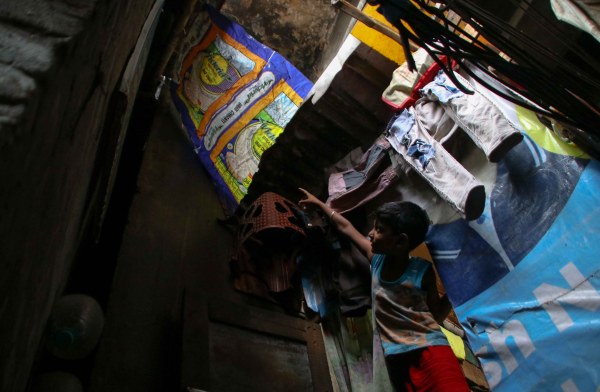 The Dhakuria Bridge area is among the worst rat-infested places in the city. Those living in slums underneath say chunks of plaster fall off the bridge. (Express Photo by Shashi Ghosh)
KMC sources said rats have also damaged parts of the AJC Bose flyover in south Kolkata, digging through and loosening the soil around the foundation.
With no solution in sight and no precedent to fall back on, the corporation has been reinforcing damaged structures and filling up holes on footpaths, roads and walls of bridges with a mix of concrete, sand and glass shards.
“We mixed glass shards and sand grains with concrete and used that to fill up holes made by rats on the walls and pillars of flyovers. We hope this mix will restrict their movement, though we have no proof yet if it is working,” said Deputy Mayor Atin Ghosh.
Ghosh said the KMC has also been conducting awareness campaigns for roadside eateries and restaurants, asking them not to throw food outside and warning them of legal action.
Rat tales: Mumbai to New York
From New York to Mumbai, almost every major city has been waging a battle against rat infestation. Aided by uncontrolled urbanisation, rats have outsmarted the best of city administrations, living in the darkest depths of sewerage systems and tunnels and nibbling through anything that comes their way — heaps of overflowing trash, cables, wires, even concrete.
Mayor Hakim says that “sometime back”, the KMC approached the Brihanmumbai Municipal Corporation (BMC) for help. “But they could not help us find a solution,” he said.
While BMC authorities did not confirm receiving such a letter from their counterparts in Kolkata, they said their battle against rats is an ongoing one.
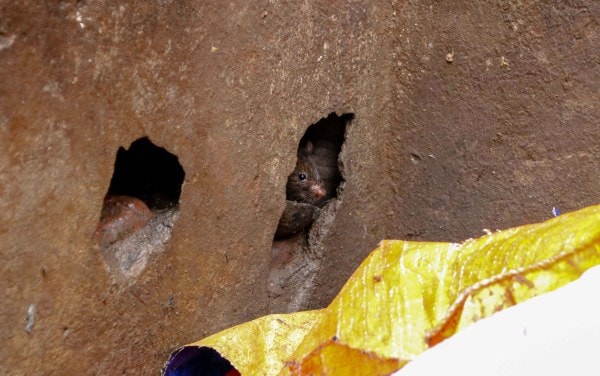 Rats have dug their way through several structures in the city, including at least two flyovers. (Express Photo by Shashi Ghosh)
The BMC’s insecticide department kills lakhs of rats every year as part of its monsoon drive across the city’s 24 wards. The BMC also has ‘rat labourers’, who work in shifts to hunt down rats in the city. As of July this year, 2.81 lakh rats have been killed in Mumbai.
But it’s New York’s rat problem that has garnered global attention. From mandating the use of covered trash cans to establishing rat exclusion zones, and appointing a ‘Rat Czar’, Kathleen Corradi, earlier this year to tackle the city’s severe rodent crisis, New York has declared war on the rodents.
In an email to The Indian Express, Noah Levine, Chief of Staff of Communications in the office of the Mayor of New York City, said one of the key steps the city took to contain rats was to replace black trash bags with lidded containers to cut down on the food source of the rodents.
The rule mandates that all commercial trash — approximately 20 million pounds per day — must be in secure, lidded containers, Levine said, adding that the city’s efforts over the past 20 months have resulted in “rat sightings dropping 25 per cent this summer” compared to last year.
From nibbling on toes to exposing footpath plaster
Back in Kolkata, rat sightings are easy. On a weekday afternoon, a colony of rats scurry out of the ground near one of the pillars of Dhakuria Bridge, an ageing four-lane flyover in Ballygunge that has a rail line connecting Gariahut to Jadavpur running underneath. Down the flyover and on either side of the railway line are slums, shacks and eateries, with their waste finding space on the tracks and elsewhere.
Sitting on the tracks of the Sealdah-Budge Budge railway line, Sonia Mondol, 25, who lives in the slums under the bridge, said, “Rats have been eating this bridge like it’s cake. Every day we see broken parts of the bridge falling off.”
Two years ago, Nepal Paul, 40, shifted his tea stall from under the Dhakuria Bridge to a corner of the underpass. “The rats are a huge menace. Look at the holes in the footpath here. They are so big that two people fell down and got injured. I have had to change the plastic containers in my shop to glass,” he said.
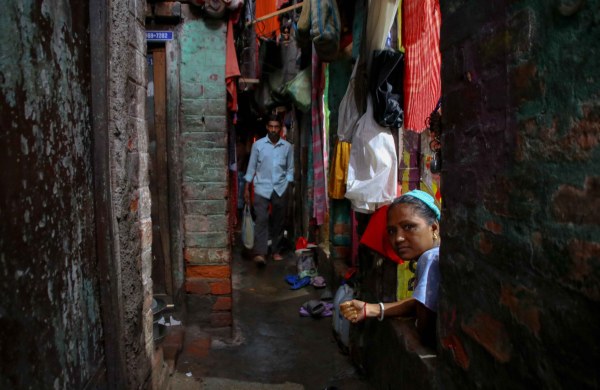 The slum areas of south Kolkata’s Dhakuria and Bhabanipore are among the worst affected. (Express Photo by Shashi Ghosh)
Around five km away, at the AJC Bose flyover and the nearby Nizam Palace, another of the areas that Hakim identified as rat-infested, Pintu Shaw, 28, a hawker, says, “It’s impossible to do any work here. The rats come and nibble on our toes. The PWD came here and fixed the footpath, but within a month, the holes were back,” said Shaw, pointing to the exposed plaster on the footpath and the flyover.
Asim Basu, councillor of ward number 70, said, “Eateries throw leftovers, and the oil and fat from the food stick onto the walls of the underground drains. Rats eat and nibble through the concrete walls of the drain, damaging them.”
The KMC headquarters and the Assembly building in the Esplanade area too have had their share of rat tales.
A KMC official said, “Rats are everywhere in the KMC, but the worst-hit is the server room. The rats have chewed on the wires and machines there. They have also been damaging the control room’s electric wires regularly.”
A senior IT official at the KMC said things have been a little quieter ever since the corporation installed a “RODENT” machine in the server room two months ago. “The machine generates sound waves of a very high frequency which keeps rats away,” the official said.
In the Assembly building, Speaker Biman said, “I have seen rats here… with my own eyes. We are very worried. We don’t want to use poison to kill rats because the stench will be unbearable. We have spoken to the Public Works Department about this. Let’s see what can be done.”
A senior official said, “Here in the Assembly, I must say rats are the only creatures that are neutral. They trouble both the ruling party as well as the Opposition. Rats have eaten food in Leader of Opposition Suvendu Adhikari’s room and they have damaged papers in the Speaker’s room.”
The way out?
Experts agree that while rats are everywhere, they are hard to get rid of — and even harder to count.
Mukesh Thakur, head of the mammals section at the Zoological Survey of India, Kolkata, said, “It is true that there is almost no data or research on the rat population for the city of Kolkata. If KMC sends us a request, we can possibly look into it.”
Shilanjan Bhattacharya, Professor of Zoology at West Bengal State University, said, “The most common rats species in the city are the Rattus norvegicus, the common brown rats with a maximum body length of 6-8 inches, and the Bandicota indica, the Indian bandicoot that can grow up to 1 foot in length and weigh nearly a kg.”
“The only way the rat population can be checked is by innovating and allowing natural predators such as owls, monitor lizards and jungle cats to breed and roam in the infested area. If authorities decide that this is an emergency and absolutely necessary, the Forest Department and naturalists can work on how to manage such biological controls. No other mechanical or chemical procedures have ever been successful — especially in humid Indian cities, where garbage is abundant.”
Renowned ecologist and academic Professor Madhav Gadgil offers an even more unconventional solution. Talking to The Indian Express, he said, “It may sound unorthodox, but the solution is to catch the rats, remove harmful pathogens if any and turn it into poultry feed. The solution is to bring the rats back into the food chain. In various parts of India, people eat rats, mainly field rats.”

 10 min read