


Stay updated with the latest - Click here to follow us on Instagram
Tags:


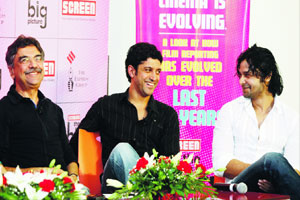
The focus shifts to the role of journalists and film reporting in India as filmmakers and critics come together for a debate
When the topic of discussion is the evolution of film writing in India over the last 60 years,varied views,an intense debate and an interesting afternoon are guaranteed. And Screens The Big Picture with a panel of five members from the film fraternity gave all these and more. The event held at the conference room of Express Towers on Wednesday,had the panel consisting of noted filmmakers Farhan Akhtar,Nagesh Kukunoor and Abhinay Deo,film critic and filmmaker Khalid Mohamed and film marketing communications professional Prabhat Choudhary debate over the dos and the donts as well as the positive and negative aspects of film writing in India.


Deo stressed on the fact that a certain amount of homework needs to be done when one goes to interview an actor or a director. He cited an example of a reporter who spoke to him for half hour mistaking him for Abhinav Kashyap. It is mandatory that journalists,who write on films,have a basic knowledge of films and actors, suggested Deo. Kukunoor feels such a mistake could be the result of too many publications and news channels,and everyone wanting to have a piece of the pie.
While the filmmakers on the panel felt that the nobility associated with the journalism has hit an all-time low,Mohamed insisted on the fact that journalists cannot be mere PROs and promote the movies. The debate on manufactured news and paid news also found its space at The Big Picture,which was moderated by Priyanka Sinha Jha,editor of Screen. Kukunoor pointed out that in the last 10 to 12 years people have found money in the news. Choudhary,who has been in the publicity business for many years,felt that this was a result of the economy opening up in the country. With more money coming in,there is bound to be more spending too, he said. Akhtar felt that paid news is equivalent to putting up an advertisement for the movie and there is nothing wrong in it.
The discussion became far more intense when the focus shifted to writing reviews. Mohamed said,Each one is entitled to their opinion of the film,but one need not get personal with the filmmaker or actor featuring in the movie. Deo,however,objected to reviewers recommending viewers not to watch a particular film. Most reviewers do not focus on the technical aspect of filmmaking and often they add a line at the end that asks the viewer not to watch the film. A reviewer is not to decide if the audience should watch the film or not, he said. Akhtar,too,felt that journalists need to be more objective while reviewing a film. Not all films will be liked by everybody. But one needs to justify his like or dislike, he said.
For a detailed report,get a copy of Screen,issue dated September 30.


Stay updated with the latest - Click here to follow us on Instagram


