Premium
This is an archive article published on March 23, 2015

They Came, Saw & Kinkared

A promenade theatre piece that cuts across disciplines, from sculpture to acrobatics, 409 Ramkinkars explores the many shades of Baij

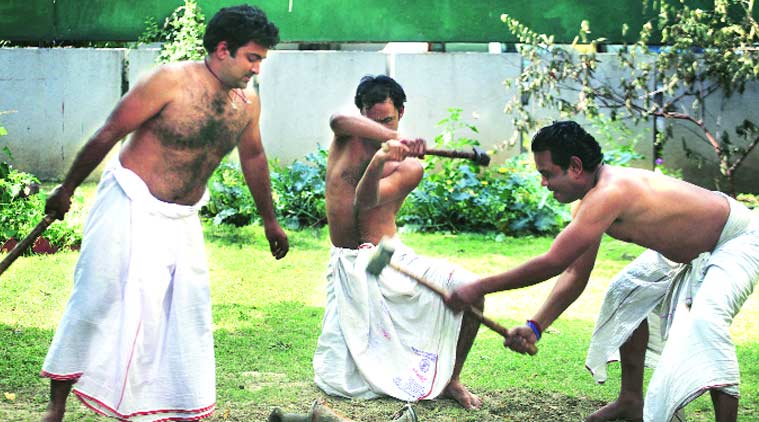
talk, theatre, IGNCA,  409 Ramkinkars, shades of Baij, indian theatre, art Ramkinkar Baij is split into three characters in a play. (Source: Express Photo by Oinam Anand)

When called on to explain his art, Ramkinkar Baij would say that he rode two horses — painting and sculpture. He forgot to mention a third horse, theatre, whose massive backdrops were Baij’s earliest canvases, and the passionate relationship he had with the stage as an actor, singer and director. Against the halo of his sculptures and paintings, the artist’s stage presence slipped into shadow. It is thus fitting that a forthcoming event explores Baij as a sculptor, painter, scenographer, singer and theatre artiste through physical performances ranging from acting to acrobatics. 409 Ramkinkars derives its title from 400 sculptures of Baij and the nine letters of his first name and will be held at IGNCA from March 24 to April 2.

“After a fine retrospective on Ramkinkar Baij in 2012, I felt that we also needed an open-ended form of performance installation to respond to his form completely. He worked across multiple disciplines, was always crossing over and wanted a fluid relationship between different genres,” says Delhi-based artist Vivan Sundaram. He drew in theatre seniors such as Anuradha Kapur, Shantanu Bose and Aditee Biswas and scholar Rimli Bhattacharya into the project. Over two years, they created a performance in which the audience will experience the life and works of Baij.

409 Ramkinkars has been laid out as a promenade theatre piece in which audiences will walk among live action at the IGNCA lawns, Twin Art Galleries, amphitheater and Mati Ghar. People who have known Baij only through his art can now experience his life by visiting a representation of his studio, watching a play on him and interacting with the characters and events that shaped his era. As they move from room to room and through the grounds, they will understand Baij if not in a visceral way, then at least intellectually.

Sundaram and Bose have worked on the opening “acts” — the former has created installations inspired by Baij’s works and the latter has turned these into props for small performance pieces. One of the highlights is a work titled Picnic, from a Baij painting that shows three women outdoors, sitting, lying or standing around trees. Sundaram, who says that he was “keen from the beginning to have an acrobatic display”, has interpreted this through a nine-ft-long pole that represents a phallic tree. “I wanted to represent not only the male gaze but also the cerebral quality of the women as Shantiniketan was an intellectual hub and the women, who were drawn from the locals, would have a liberated mind,” says Bose. So, actor Vandana Rawat, who acrobatically climbs the pole and hangs from its handlebar-like branches, also recites lines from Karl Marx at the same time, symbolising a mind that is as flexible as her body. Baij’s horse from another painting is present in a mobile version, and 400 miniature sculptures derived from his works are among the numerous pieces in this gallery.

Kapur, on the other hand, has trained a group of actors in a play that recreates Baij’s life through his own words. “We asked ourselves, ‘What way can you talk about a discourse on art, you can’t make it a naturalistic play, how do you perform discourse?’ We invented a form that was triangular — the dialogue was between actor, audience and co-actor. Characters speak directly to the audience more than among themselves,” says Kapur, adding that the script is by Delhi-based Belinder Dhanoa.

As a nod to Baij’s three horses that fed one another, Kapur has three actors playing Baij simultaneously. Dressed in white dhotis and beating the ground with hammers, they begin their dialogues by establishing the relevance of the artist. “An artist is a social being,” says one as he swings the hammer over his head and brings it down on the ground. “To represent social issues through art, we need commitment and a new language,” says the other while smoking a beedi. “To express your own ideas, you need a certain openness,” adds a third, lying down.

In subsequent scenes, there is a reference to a Santhal who was moved when he saw a giant sculpture that Baij had made, idolising tribals. We also meet Radharani who chats away about the “night he first asked me to model for him” and their relationship.

Story continues below this ad

“Ramkinkar Baij’s sculpture and painting came straight from the body, it has a certain performative quality,” says Bose who has used the core of the Mati Ghar — whose hall is segregated into concentric circles — to recreate Baij in the process of creating a sculpture. “He used to throw concrete from a distance on an iron armature to create some of his sculptures,” says Bose.

As Baij works in the studio, an array from characters, from political leaders to protagonists from plays that Baij had worked on, circle him. “The 1930s to ’80s, the period of Baij’s creative life, also coincided with great social and political events, from famine to the Partition to the changing nature of Indian democracy and these emerge through the characters in a non-chronological manner,” says Bose.

India’s First Modernist

A student of Nandalal Bose, Ramkinkar Baij lived and worked in Shantiniketan at a time when India’s art language was still being formulated. From the late 19th to the early 20th centuries, the West was a hub of modern art movements. Baij, a painter and sculptor, explored the Western forms but in his own politically aware style.

This made him one of the pioneers of Indian Modernism, a movement that would expand well into the 20th century and find followers such as MF Husain and other Progressives. The poverty and degradation of the peasants and tribals moved Baij to create iconic works such as Santhal Family and Mill Call, making the locals of Shantiniketan the protagonists of his giant outdoor works.

Story continues below this ad

409 Ramkinkars will be held at IGNCA from March 24 to April 2. Entry: Approx 150 people per show. Passes are free. Contact: 7834973734, 7834973609, vivaditheatre@gmail.com

Dipanita Nath is a Senior Assistant Editor at The Indian Express, based in Pune. She is a versatile journalist with a deep interest in the intersection of culture, sustainability, and urban life. Professional Background Experience: Before joining The Indian Express, she worked with other major news organizations including Hindustan Times, The Times of India, and Mint. Core Specializations: She is widely recognized for her coverage of the climate crisis, theatre and performing arts, heritage conservation, and the startup ecosystem (often through her "Pune Inc" series). Storytelling Focus: Her work often unearths "hidden stories" of Pune—focusing on historical institutes, local traditions, and the personal journeys of social innovators. Recent Notable Articles (December 2025) Her recent reporting highlights Pune’s cultural pulse and the environmental challenges facing the city during the winter season: 1. Climate & Environment "Pune shivers on coldest morning of the season; minimum temperature plunges to 6.9°C" (Dec 20, 2025): Reporting on the record-breaking cold wave in Pune and the IMD's forecast for the week. "How a heritage tree-mapping event at Ganeshkhind Garden highlights rising interest in Pune’s green legacy" (Dec 20, 2025): Covering a citizen-led initiative where Gen Z and millennials gathered to document and protect ancient trees at a Biodiversity Heritage Site. "Right to breathe: Landmark NGT order directs PMC to frame norms for pollution from construction sites" (Dec 8, 2025): Reporting on a significant legal victory for residents fighting dust and air pollution in urban neighborhoods like Baner. 2. "Hidden Stories" & Heritage "Inside Pune library that’s nourished minds of entrepreneurs for 17 years" (Dec 21, 2025): A feature on the Venture Center Library, detailing how a collection of 3,500 specialized books helps tech startups navigate the product life cycle. "Before he died, Ram Sutar gave Pune a lasting gift" (Dec 18, 2025): A tribute to the legendary sculptor Ram Sutar (creator of the Statue of Unity), focusing on his local works like the Chhatrapati Shivaji statue at Pune airport. "The Pune institute where MA Jinnah was once chief guest" (Dec 6, 2025): An archival exploration of the College of Agriculture, established in 1907, and its historical role in India's freedom struggle. 3. Arts, Theatre & "Pune Inc" "Satyajit Ray, Ritwik Ghatak were not rivals but close friends, says veteran filmmaker" (Dec 17, 2025): A deep-dive interview ahead of the Pune International Film Festival (PIFF) exploring the camaraderie between legends of Indian cinema. "Meet the Pune entrepreneur helping women build and scale businesses" (Dec 16, 2025): Part of her "Pune Inc" series, profiling Nikita Vora’s efforts to empower female-led startups. "How women drone pilots in rural Maharashtra are cultivating a green habit" (Dec 12, 2025): Exploring how technology is being used by women in agriculture to reduce chemical use and labor. Signature Style Dipanita Nath is known for intellectual curiosity and a narrative-driven approach. Whether she is writing about a 110-year-old eatery or the intricacies of the climate crisis, she focuses on the human element and the historical context. Her columns are often a blend of reportage and cultural commentary, making them a staple for readers interested in the "soul" of Pune. X (Twitter): @dipanitanath ... Read More

Stay updated with the latest - Click here to follow us on Instagram

Latest Comment
Post Comment
Read Comments
Advertisement
Loading Taboola...
Advertisement