


Stay updated with the latest - Click here to follow us on Instagram
Tags:


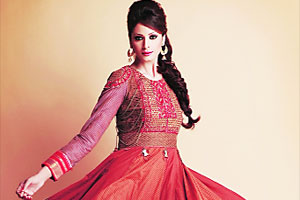
When Vaishali S launched her line of contemporary clothes made with the chanderi fabric early this year,it was to an enthusiastic crowd. The halter tunics,see-through kurtas and dresses with asymmetrical hemlines showed off the simple beauty of the fabric,without resorting to the gimmickry of kitsch. It was a success,quite simply,because the designer had taken the time to understand and work with her material. I find immense possibilities in Indian traditional heritage which still has not been explored completely, says the designer,who is now working on a collection that combines chanderi with paithani.
The idea of the using a traditional Indian craft and executing it in such a modern manner is not new: veterans like Ritu Kumar,Abraham & Thakore and Sabyasachi Mukherjee have dipped into the countrys traditional crafts to conceive modern and glamorous clothes. What is different now is the sheer number of people who are going down that route,whether they choose to showcase their efforts on the catwalk or not. From Aneeth Aroras use of Ajrakh to Rahul Mishras experiments with chanderi and khadi and Manish Malhotras copious use of Kashmiri embroidery in his womenswear and menswear lines,fashion designers have gone beyond the obvious. More importantly,the concept of swadeshi chic no longer implies that one shops at the Khadi Bhandar or at Fabindia,and that one adheres to a certain type of ideology. There is a greater acceptance of the beauty of Indian textiles among the fashion conscious.


Designer Shruti Sancheti,who will debut at the Lakme Fashion Week this season,says,What we really need to do to help these craftsmen is to adapt to the demands of today. In the traditional format,their work might be lovely,but there are barely any takers for it. So,as designers,what we contribute are more updated ideas and supply them with better threads and other raw materials. Sancheti,who has worked with the weavers of Nagpur for her collection,believes that since more and more designers are working with craftsmen of different traditions,its only a matter of time before they really see a revival.
In some cases,designers intervention has worked to bring a craft back from the brink of extinction. A case in point is Wendell Rodricks work with the Goan Kunbi weave,where he transformed the humble red and white cotton cloth,into a range of modern saris and dupattas.
Another tradition,which is slowly being brought back to life is the Parsi Gara embroidery. Perveez Aggarwal,among the few to work with this craft,has trained craftsmen in this complex embroidery. Although the embroidery was traditionally used on saris,Aggarwal has ensured its survival on more unconventional garments as well,such as stoles and jackets.
These handicrafts do very well,when we sell them in the US or Europe. There,they have a true appreciation for the luxury of the handcrafted and the handwoven,because for so long theyve had to rely on the machine-made. Were lucky that in India these traditions continue to exist and we must do all we can to ensure that they dont die out.


Stay updated with the latest - Click here to follow us on Instagram


