7 min read
Stay updated with the latest - Click here to follow us on Instagram

Journalism of Courage



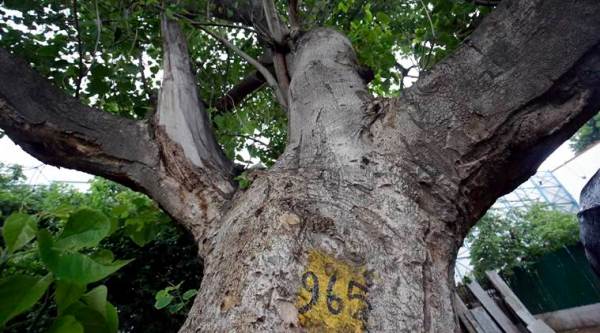 The mighty gamhar tree, numbered 965, in Netaji Nagar is where the walk begins (Express Photo/Praveen Khanna)
On a muggy, overcast evening over the weekend, while Champa Bhowmik was making a human chain outside Delhi’s Rajiv Chowk Metro Station to protest against the felling of trees in the Capital, a tree walk unfolded in her backyard. Part of Tree Love Series, the Netaji Nagar walk is the first of many to come. Organised by Padmavati Dwivedi, founder of the NGO Compassionate Living, and steered by naturalist-ecologist Vijay Dhasmana, who was instrumental in the Aravalli Biodiversity Park conservation, the walk spanned two hours, covering less than a kilometre, and witnessed a motley group of 30. “It isn’t a usual tree walk, but to see the ‘biggish’ trees found in the colony,” says Dwivedi.
Bhowmik, 46, has been residing in Netaji Nagar for nearly 15 years, in the government colony being redeveloped. Her days go in feeding birds — kites, parrots, pigeons, bats and white owl — that flock the peepul canopying her terrace, and in taking the sick ones to a charitable bird hospital in Chandni Chowk. They come in fewer numbers now, she says. She recalls hearing birds shriek one night, later to find out that the infants, along with the trees, got axed, too. In all these years, she has never seen trees being felled on such a scale. “The grass and trees provide shelter, food and medicines to birds, bees, squirrels, monkeys and even dogs,” says Bhowmik, who has been participating in every campaign, and writing letters to the authorities against the move.
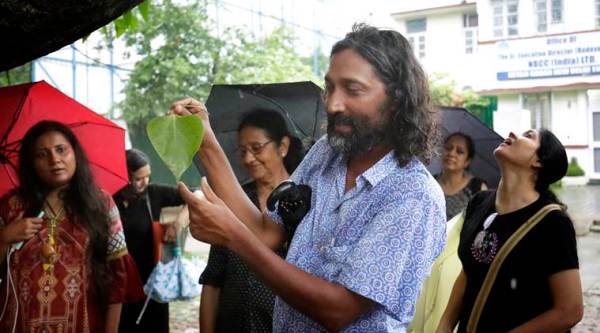 Vijay Dhasmana (Express Photo/Praveen Khanna)
The walk starts at A-block, outside the NBCC office, which is incidentally handling the Netaji Nagar redevelopment project. Standing opposite the building, looking it in the eye, is the mighty Gamhar, numbered 965. Most old trees in the area are numbered by the Central Public Works Department, while the new ones have been numbered by the forest department, says Dwivedi. “Part of this colony has been broken down, but there’s still a lot to appreciate. The old growth tells how this colony must have come up in the ’50s, where trees took over, becoming part of the landscape, integrating into the built area, giving character to the colony,” says Dhasmana, adding, “a lot would have been planted by the government, while people must have planted the fruit trees for themselves — jamun, amla, imli, guava and mango”.
Meanwhile, sounds of light rain, birds chirping and aeroplanes in flight drown Dhasmana’s soft voice, who quips, the walk is “to meet the trees, without a vested interest”.
The jungle tree, Gamhar (Gmelina arborea), he says, is at least 40 years old. “Found in the Shivaliks, Vindhyas and southern Aravalli, it is a fast-growing species with very hard wood — a rare combination.” An avenue of this tree lines the road from SDA Market towards Aurobindo Market. “The stretch marks indicate its fast growth, much like in humans. It also shrinks as quickly as it grows (trees shrink during drought),” he say
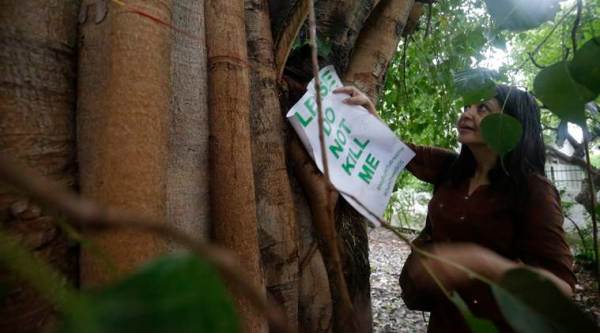 The walk starts at A-block, outside the NBCC office, which is incidentally handling the Netaji Nagar redevelopment project (Express Photo./Praveen Khanna)
The coloniser Semal, with a thorny bark and beautiful buttress, grows up to 20 ft, and is frequented by hornbills, barbets and parrots. Its thorns, a participant informs, are used by teenagers in Odisha for curing acne. Semal grows on flat grounds, and can be seen on either side of the INA bridge towards SDA Market, and between Saket and Qutab Minar, says Dwivedi. “There’s one opposite the Oberoi hotel, and on the bridge from Sunder Nursery towards Kaka Nagar,” adds Dhasmana, before speeding towards the wild mango tree which is found in the Aravali and all over peninsular India. In southern Indian forest, the wild mango fruit (and the seed casing) is smaller than the common ones, and is “fibrous, so as to protect the seed that has to go through the gut of larger animals, come out and germinate”.
The neighbouring Parijat/ Harsingar/ Shiuli begs for attention, though its iconic orange-stemmed white flowers are absent. Found in central Indian jungles, Shivaliks, Himalayan foothills -all over peninsular India its leaves grow in opposite directions and are sandpapery in texture. He, then, directs the collective gaze down to the Aak, next to it, quizzing the onlookers. The host plant for plain tiger, striped tiger and cabbage butterflies, can be found along the Jaisalmer-Barmer border road. The leaves of the common variety (Calotropis procera), with bluish-purple flowers, are offered to Lord Shiva, the “wild variety (Calotropis gigantea) have elongated leaves and white flowers”.
Pointing at the drooping broad-leaved Chamrod, found in Delhi Cantt station Platform No. 2 and Defence Colony market, with “a knotty trunk, white flowers and orange berries”, Dhasmana says, “the large leaves are a strategy of a young forest plant to increase its surface area to get more sunlight, hence food. As it grows, it firms up”. Around the corner, Amaltas beckons, “flowering over the long March-October period”.
Inside the open garage of a deserted house, with overgrowing foliage and the sign “Trespassers will be prosecuted”, stands a Neem tree. “A native plant, which is a declared invasive in Australia and Florida, Neem can’t survive in moisture/ frost but has naturalised so well,” says Dhasmana, adding “Akbar Road is lined with it. It’s been into cultivation for so long, the actual place of origin isn’t known.” It is said to have originated in the drier parts of the Northeast, Myanmar and China.”
A few steps lead to a bed of evolvulus at the base of Bakain (Persian lilac), and Dhasmana speaks of its expensive wood and that it is found in Himachal Pradesh and Uttarakhand. The Baheda, to its right, whose powdered fruit is used in the Ayurvedic medicine triphala, is loved by wild squirrels, civets and bears, and “the giant tree takes two-three years to become nicely wooded”.
Culminating the walk, Dhasmana says, not only are “the life forms rendered hungry and homeless, but the importance of a full-grown tree in an urban space becomes fivefold, especially in the heavily polluted Delhi”. He adds, “Trees cut from a certain part of the city and planted 50 km away isn’t compensatory, what’s destroyed cannot be compensated. Fifty-year-old trees cannot be replaced even if you plant 100 saplings.”
The next walk, on 4 August, will be conducted by ecologist Jayati Talapatra of Dilli Meri Jaan group, entry free. To register, visit Delhi Trees SOS on Facebook
Stay updated with the latest - Click here to follow us on Instagram