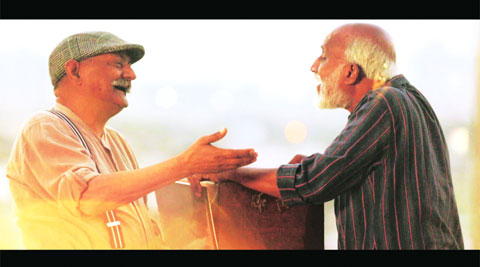
There is something about the two elderly men whose zest for life has not waned with the wrinkles on their faces or the grey on their hair. One gets a glimpse of a long, deep friendship as they outdo each other on the chessboard or sing unabashedly on a sprawling verandah with emptied teacups in the background. But, a fleeting moment when one puts his hand on the other shows that there is more to their easy camaraderie. Ishq Ki Ijaazat, a “film poem” by National Award-winning filmmakers Satyanshu and Devanshu Singh, captures many such moments between homosexual lovers in four minutes.
Ishq Ki Ijaazat was released online on June 23 and with it, brothers Satyanshu and Devanshu launched their channel Storytelling Twins under the umbrella of Qyuki, a platform that helps creators build their audience. A film poem is a form that marries poetry with visuals and sounds more spontaneous.
You’ve Read Your Free Stories For Now
Sign up and keep reading more stories that matter to you.
“We wanted the first film poem to touch upon a sensitive subject,” says Satyanshu, who received the Special Jury Award at National Film Awards, with his brother, for their short film Tamaash (2013). For the online channel, he wrote this original poem, whose opening line reads: Do ishq ki ijaazat, ilzaam ab hata do. Hum gair hain nahin, ek baar toh jata do (Let love be my right, no longer a crime. Accept us as your own). The brothers have had their poems featured in Vikramaditya Motwane’s Udaan (2010).
The video, shot in Delhi over four days, has characters engaged in mundane activities — women reading to each other, boys playing video games, girls wearing make-up and men taking selfies. Yet, very subtly they manage to express their intimacy and give the film a warm tone.
“Once the edit was ready, we knew the voice reciting the poem has to be cold and assertive. It won’t be a pleading voice but we wanted to add a tenderness to it,” says Satyanshu. That’s when Devanshu roped in actor Huma Qureshi. “Her diction and pronunciation are almost flawless. Her voice too suited the film very well,” he says.
According to Satyanshu, short films consume a lot of energy and it’s a challenge if the budget is limited. Two more films are ready in the film poem web-series. They plan to release one every month. “Not all the films are going to have a social message like this one. However, each one of them is beautifully executed,” says Samir Bangara, Co-Founder and Managing Director of Qyuki.
Alaka Sahani is a prominent film critic and journalist based in Mumbai. With a career spanning over two decades, she has established herself as one of India’s most authoritative voices in cinematic journalism, known for an analytical approach and insights that transcend the standard cycle of celebrity journalism.
Expertise & Accolades
In 2014, Alaka was honoured with the National Film Award for Best Film Critic. Her Swarna Kamal (Golden Lotus) citation specifically lauded her for "highlighting facets of cinema beyond glamour and gossip" and for her ability to delve into the contemporary relevance of iconic filmmakers. Her commitment to journalistic integrity was further recognised in 2019 with a Special Mention at the Red Ink Awards for her investigative feature, 'In Search of a Star'. Her article titled 'People Like Us', published in The Indian Express on March 27, 2022, was shortlisted for Red Ink Award, 2023.
Global Industry Leadership
Alaka’s expertise is sought after by major international and domestic film bodies:
Golden Globes: In 2025, she joined the international voting body for the 83rd Annual Golden Globes.
National Film Awards: She served on the prestigious jury for the 68th National Film Awards, helping select the finest contributions to Indian cinema.
Global Perspective: Her work consistently bridges the gap between commercial Bollywood A-listers and emerging independent talents, offering nuanced insights into both Indian regional cinema and international film trends.
Focus & Vision
Beyond the screen, Alaka is a dedicated observer of Mumbai’s vibrant theatre scene and the historical evolution of the moving image. Through her long-form articles and deep-dive interviews, she continues to challenge "tried-and-tested" templates, providing readers with a deep understanding of the artistic and systemic workings of the Indian and global film industry. ... Read More