3 min read
Stay updated with the latest - Click here to follow us on Instagram

Journalism of Courage



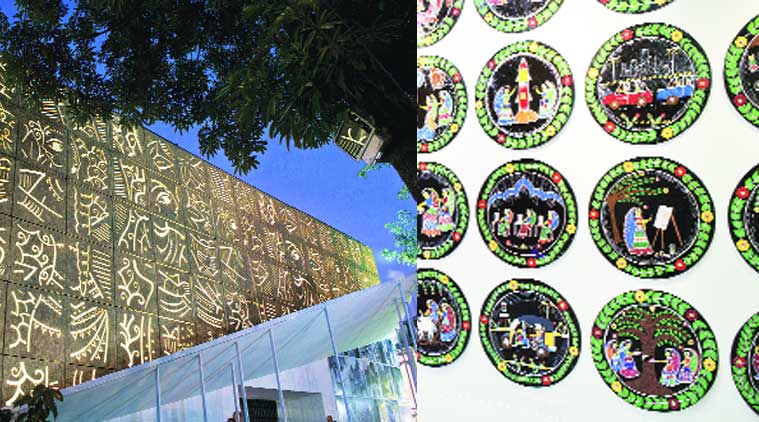 The jaali facade, the roof paintings and the wall chakras were inspired by the crafts of Bihar
Be it an idol of Krishna playing his flute at the entrance of the Uttar Pradesh state pavilion, or a life-size statue of Wansuk Myrthong, the first woman from Meghalaya to conquer Mount Everest, every state pavilion exudes unique characteristics at the 34th India International Trade Fair 2014 in Pragati Maidan. As night descends at the Bihar pavilion, the 32-ft high facade made from waste wood lights up to reveal fine strokes of the jaali, an abstract interpretation of Madhubani paintings in a minimalist Cubist fashion. It is perhaps the tales of women engaged in everyday chores in villages printed on Bhagalpuri silk panels, walls adorned with the 800-year-old craft of Tikuli paintings, and live demonstration by artisans, that has helped the Bihar pavilion win gold for the best pavilion design award at the fair.
Designed by Delhi-based TOD Innovations and themed on women entrepreneurs, the pavilion illustrates the crafts of Bihar, as Sikki grass handicrafts — a special kind of grass found in Bihar and Uttar Pradesh — invite visitors into the pavilion. Colourful Madhubani paintings made by 60 artists from Bihar decorate the ceiling, as they reveal tales of women entrepreneurs in villages and their journey of overcoming struggles.
Kulveer Singh Bhati, founder and partner, TOD Innovations says, “We wanted to focus on the rural areas and bring together aesthetics with machinery. We chose Madhubani paintings because they are the most popular paintings of Bihar, making it easier for viewers to relate to it. So we have used its style, where you don’t get to see the entire face but only see the side profile in the jaali. We have made it with the help of rad robotic cutting, after a surreal Madhubani painting of a woman making papad, was fed into a computer.”
The enclosed tulsi courtyard, hidden within the interiors, has a gigantic tulsi tree placed in the middle, which celebrates the spirit of women achievers. Bhati says, “The tulsi tree is an essential component in every household and is a symbol of womanhood. Even the Bihar government logo has a tulsi tree in it.”
Stay updated with the latest - Click here to follow us on Instagram