Journalism of Courage



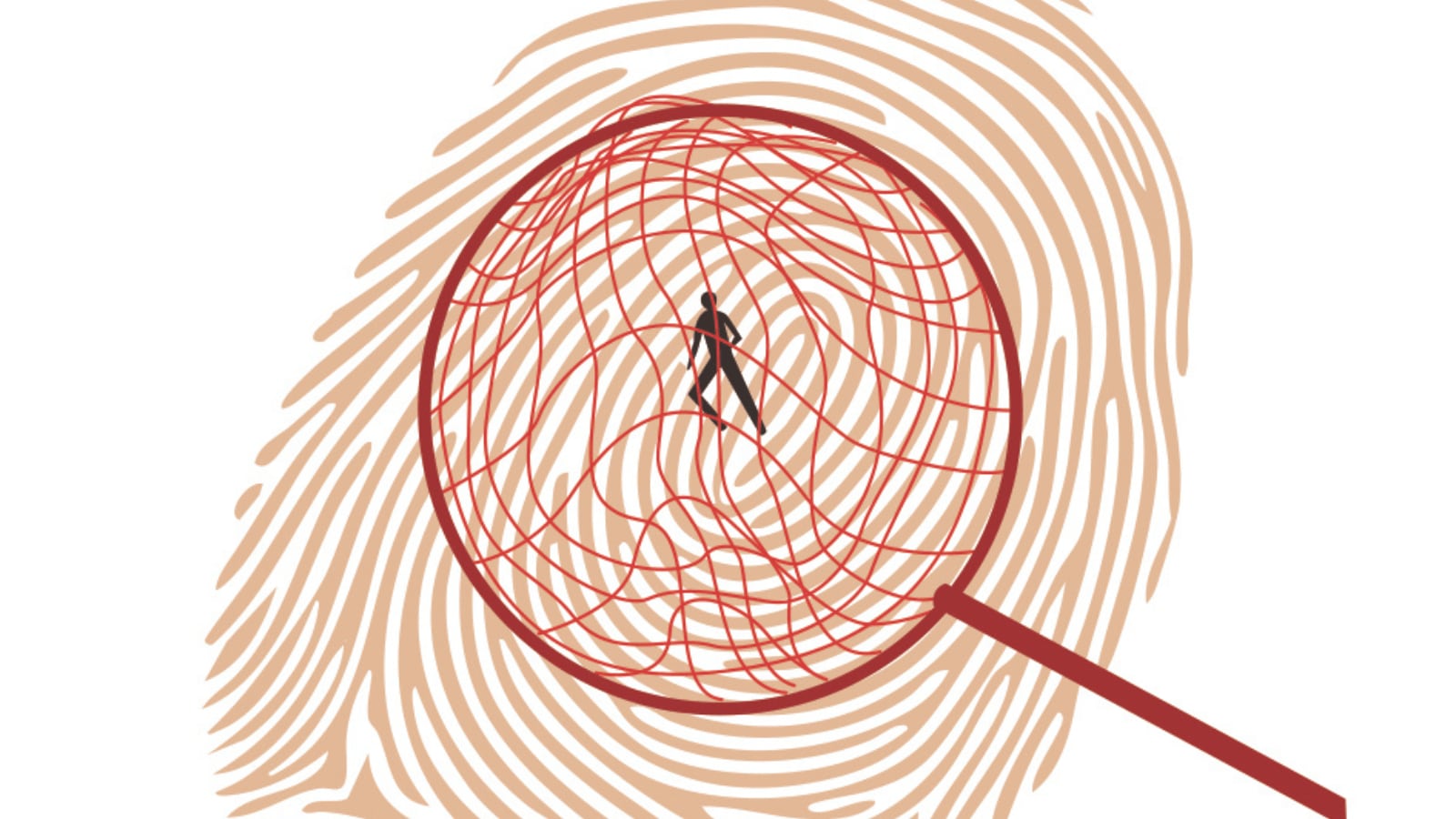 In the last three years, data provided by the Delhi Police shows that the number of cases they cracked with the help of the Finger Print Bureau (FPB) has increased. (Illustration: Komal)
On December 5 last year, a couple and their 23-year-old daughter were found with their throats slit in their Neb Sarai home. Their 20-year-old son, a Delhi University student, said he went out for a run and returned home to find their bodies. As police scoured the house for clues and questioned the son, they found bloodstains on the house keys and his motorcycle key. The objects, now key pieces of evidence, were tested and chance fingerprints were found. This went on to become one of the things that helped police crack the case and arrest the killer — it was the son who did it, said police.
This case is among several where the role of fingerprints played a crucial role in solving a crime. According to senior police officers, even though it is one of the oldest methods, it still continues to be the most relevant one.
In the last three years, data provided by the Delhi Police shows that the number of cases they cracked with the help of the Finger Print Bureau (FPB) has increased. From 130 cases in 2022, the number stood at 257 last year. The cases include 103 of burglary, 95 of unidentified dead bodies, 36 of theft, seven murders, and two rapes.
Take the murder of Swiss national Nina Berger last year for instance. Berger, 36, was killed in Delhi on October 18 and her body was found two days later with her limbs tied with locked chains behind an MCD school in West Delhi. The crime scene was examined and six chance prints were lifted; a search through the database yielded no results. By then, police had a few suspects; the prints of one of them, a friend of the victim, were a match for four chance prints.
Sanjay Jha, Director of the Finger Print Bureau, which functions under the Crime Branch, described the process of lifting prints. He said, “First, our experts reach the crime scene and look for all possible locations where there could be a fingerprint. Rough surfaces don’t yield fingerprints so one has to look for plain surfaces and smooth areas. The quality of fingerprints also depends on atmospheric conditions (dry or wet), articles on which they are found etc.”
Inspector Sudhir Bhalla, who has been working with the Bureau for the last 30 years, said with the introduction of the National Automated Fingerprint Identification System (NAFIS), the percentage of solving cases has increased. “NAFIS has databases of other states as well so the chances of finding a match are higher… Plus, if the accused was earlier in Delhi and is now arrested and lodged in prisons of other states, then that information is also available,” Bhalla said.
The database came to the aid of police to solve a case last year, which involved the sexual assault and murder of a young girl in March. Her body was discovered in Bawana. Experts from the FPB arrived and looked hard for evidence; they finally lifted four chance prints from an iron drawer. When they ran the prints through NAFIS, police said two fingerprints were found identical with the right index and right ring finger impression of someone on the database — this, police surmised, could be the killer. The other two chance prints were manually compared and found to be identical with the right middle and right little fingers of the same person. The information was shared with the investigating officer who then launched a search for the accused and arrested him.
Established in 1987, the FPB is a specialised forensic unit that provides infallible scientific evidence to investigation officers by comparing fingerprints obtained from crime scenes with existing records. This helps identify potential suspects and establish connections between different criminal activities, said police.
Located in the Kamla Market police station building in Central Delhi, the Bureau has a staff of 43 against a sanctioned strength of 77. The rest have either retired or quit.
Each morning, the experts first scrutinise the prints on the basis of quality and check for eight minutiae or characteristics, which are ridges on the fingers. The chance prints are then run through the criminal database. If there is a match, experts prepare a report — which is checked at three levels before getting approval from the FPB Director — for onward transmission to the IO concerned for submission in courts.
An officer said, “The manual procedure is adopted in cases where suspects are arrested; here fingerprint slips are received for comparison.”
Devesh Srivastava, Special CP, Crime, said, “After implementation of new technology, many more cases are solved through modern databases like NAFIS and AFPIS. Since the inauguration of NAFIS in September 2022 by the Home Minister, searches have been made on this system and a large number of crimes have been solved. Fingerprint data of more than five lakh arrested/convicted persons have been updated on the state-level database i.e. AFPIS and the national database of NAFIS.”

 5 min read