3 min read
Stay updated with the latest - Click here to follow us on Instagram
© IE Online Media Services Pvt Ltd



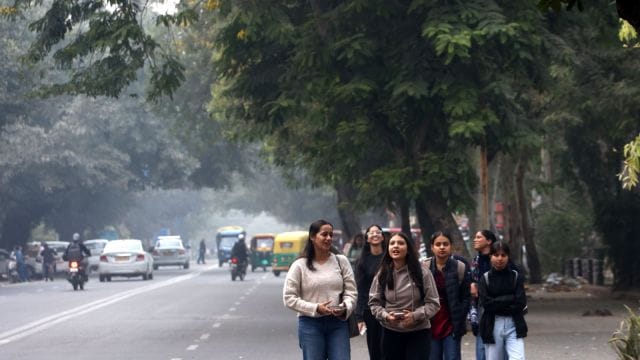 The state governments may decide to discontinue physical classes for students of Classes VI to IX and Class XI, shifting them to online or hybrid mode depending on local conditions. (Express photo by Amit Mehra)
With air quality deteriorating sharply across the National Capital Region (NCR), the Commission for Air Quality Management’s (CAQM) Sub-Committee on the Graded Response Action Plan (GRAP) on Saturday invoked Stage IV (Severe+) restrictions across Delhi-NCR.
The highest level of emergency curbs has been enforced with immediate effect after Delhi’s Air Quality Index (AQI) crossed the 450-mark, triggering measures aimed at preventing any further spike in pollution and safeguarding public health.
The Stage IV curbs come in addition to the preventive and restrictive actions already in force under Stage I, Stage II and Stage III of GRAP.
As part of the Stage IV action plan, the entry of trucks into Delhi has been completely stopped, except for those carrying essential commodities or providing essential services. However, trucks running on LNG, CNG, electricity or BS-VI diesel are permitted to enter the city.
The restrictions also extend to light commercial vehicles. LCVs registered outside Delhi have been barred from entering the capital, unless they are electric vehicles, CNG-powered or BS-VI diesel vehicles. Even these categories are allowed only if they are engaged in essential services or carrying essential goods.
Within Delhi, the movement of BS-IV and older diesel medium and heavy goods vehicles has been banned, with exemptions limited strictly to vehicles providing essential services.
All construction and demolition (C&D) activities have been suspended across Delhi-NCR under Stage IV. This includes not only private construction but also linear public infrastructure projects, such as highways, roads, flyovers, overbridges, pipelines, power transmission lines and telecom works.
The blanket halt is aimed at curbing dust and particulate emissions during the severe pollution phase.
The state governments may decide to discontinue physical classes for students of Classes VI to IX and Class XI, shifting them to online or hybrid mode depending on local conditions. Senior sections may also move to hybrid arrangements as pollution levels remain hazardous.
Delhi Environment Department has issued an order for all private and government offices in GNCTD to work at 50 per cent strength and the rest to work from home. According to reports, the Central government may take a similar decision for its offices operating in the NCR.
States have also been advised to consider further emergency steps depending on how the air quality evolves. These include the closure of colleges and other educational institutions, suspension of non-essential commercial activities, and the possible implementation of odd-even vehicle restrictions to reduce traffic-related emissions.
Stay updated with the latest - Click here to follow us on Instagram