


Stay updated with the latest - Click here to follow us on Instagram
Tags:


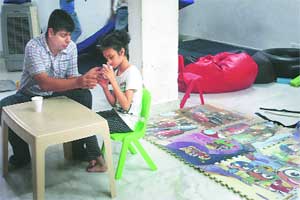
Amid swanky corporate offices in Gurgaon,Soch a therapy centre for children with special needs is tucked away in the basement of a house in DLF Phase IV,near HUDA City Centre Metro station. Children in the age group of five to 10 try to catch balls and knock down plastic bowling pins,under the watchful eyes of Manish Samnani and anxious parents.
Samnani (35),is an occupational therapist who has specialised in care for children with special needs. He says most doctors in India do not know that occupational therapy is a profession. He helps 10-year-old Manavi,who was diagnosed with a learning disorder attributed to an unidentified gene,target bowling pins,patiently picking up the ball every time she misses a pin. Manavis mother could not be happier.


While doctors have been unable to identify the genetic root behind Manavis functional disorders,Samnani says he is trained to go beyond the disease symptoms. I see the behavioural and functional aspects. For me the childs inability to communicate,concentrate,attention deficiency,problems in maintaining eye contact are symptoms,rather than what led to them. It is often a huge task to convince doctors to see this crucial aspect, he says.
Amid 100-odd therapy centres in the Capital,what makes Manishs work different? Over a decade ago,after completing his graduation in Occupational Therapy in National Institute of Rehabilitation Training and Research in Cuttack,Samnani got an opportunity to work in Ireland. Samnani decided to stay back. For me,therapy can be both scientific and have immense creative opportunity in how to devise ways to help each child, he says.
Manavi does not speak and still has problems maintaining eye contact. She used to swing her hands repeatedly,which many previous therapists had tried to stop. Most therapists try to stop repetitive behaviour. For Manavi,this is a non-verbal communication method. I do not want to control all aspects of the childs behaviour to the point that she starts dreading therapy, he says.
Soch,his therapy centre,uses many methods to break established structures in therapy. For children at the extreme end of Autism Spectrum Disorders (ASD),there is a common symptom. They try to shut their ears in classrooms. The standard aim of therapy or even home tactics are to make the child stop doing this,but the child is trying to say that the class is too loud, Samnani says.
He feels that music and sports are critical aspects for children with learning disorders. Kids here need to be taught the skills to enjoy their games and even music. In the long term,they may find their vocation in these fields, he says.
After doing his post graduation in paediatric occupational therapy at the Jamia Hamdard University,where he met his wife,Samnani worked at the Delhi-based Pandit Deen Dayal Upadhyay Institute of the Physically Handicapped for four years. Again,the structured approach to therapy,and emphasis on the physical disabilities like those faced by patients of cerebral palsy,made him quit the job.
Samnani and his wife Malavika then decided to leave their South Delhi home,shift to Gurgaon and start Soch. Delhi was burgeoning with therapists,but Gurgaon was then an emerging township and there were no facilities there. So we started Soch in our flat. There was no signboard,no marketing,just us going to childrens homes,talking to parents and getting some to come over, he recalls.
They contacted paediatricians in the area and tried to sensitise them to the need for occupational therapists. We did sessions with schoolteachers on assessing developmental delays through a childs handwriting. Till a child goes to school,parents often do not take into account obvious symptoms like bad handwriting. Teachers are crucial links, Samnani says.
The couple also sent out many advertisements without naming themselves or their organisation,on the indicators which signal development delays or disorders in children,and the need for therapy.
Now,over 100 children have registered with Soch,and it has a staff of four occupational therapists and two special educators.
Their success is measured in little joys like when Manavi managed to knock down a bowling pin and sip her coffee without spilling. When some of the teenagers picking up functional academics learn to tie their own buttons and shoelaces and make eye contact,Samnani feels he has achieved quite a bit.


Stay updated with the latest - Click here to follow us on Instagram


