Journalism of Courage



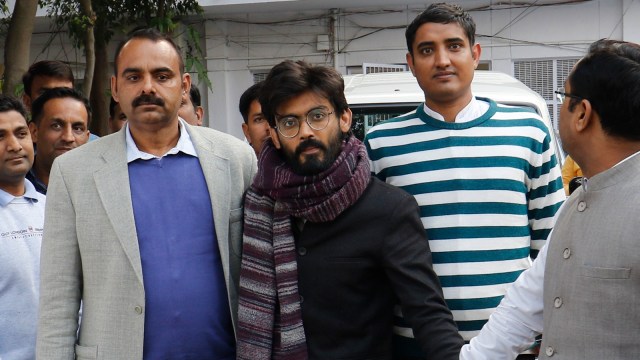 Sharjeel Imam had claimed before the High Court that he was entitled to be released on bail under CrPC Section 436A as he had been in custody for four years. (Express archive)
The Delhi High Court has recently said that the trial court, while denying bail to Sharjeel Imam in a sedition and unlawful activities case, “got swayed by the enormity of the allegations, observing that he had made inflammatory speeches which resulted in riots”. The HC then directed that Imam be released on bail as per terms and conditions imposed by the trial court.
Imam had filed an appeal against a trial court order dated February 17, which denied him bail, observing that the content of his anti-CAA speeches at Delhi’s Jamia Millia Islamia (JMI) and Aligarh Muslim University (AMU) could be termed “seditious” in the “dictionary meaning”.
A division bench of Justices Suresh Kumar Kait and Manoj Jain, in its May 29 order, while allowing Imam’s appeal, said that it had no hesitation in holding that there was nothing on record which could have “disentitled” Imam from seeking relief under Code of Criminal Procedure (CrPC) Section 436A. As per this section, a person can be released from custody if he has spent over half of the maximum sentence prescribed for the offence.
Imam had claimed before the HC that he was entitled to be released on bail under CrPC Section 436A as he had been in custody for four years and the maximum sentence for the offence under Unlawful Activities (Prevention) Act (UAPA) Section 13 is seven years, if convicted.
The HC said that CrPC Section 436A, a “benevolent provision” had been introduced by Criminal Procedure Code (Amendment) Act, 2005, with the idea that no undertrial prisoner is detained in jail beyond half of the maximum sentence provided for such offences.
The bench said that as per proviso to the Section, the court can order further detention, but the “reasons have to be rational and logical, else the very purpose of introducing the provision would stand defeated”. “Learned trial court got swayed by the enormity of the allegations, observing that he had made inflammatory speeches which resulted in riots, the bail was declined… In the case in hand, we do not find any justifiable reason which could have compelled the court from not granting the relief…,” the bench said, thereafter, directing that Imam be released on bail by the trial court.
Police, meanwhile, argued that on one hand, Imam sought stay of trial and on the other, he was trying to take advantage on the ground stating he had suffered half of the maximum sentence.
Rejecting police’s contention that the delay in the proceedings were attributable to Imam, the HC bench said: “If any accused chooses to avail legal remedy and that too in terms of specific judicial pronouncement, he cannot be blamed for causing delay in the matter. Since he continued to be in detention, he was, even otherwise, not going to dig out any advantage at all, by exploring such other possible legal avenues. As noted already, such (a) stay was given by this court on the basis of joint statements of parties and such order has not even been further challenged by (the) state.”
Meanwhile, Imam’s bail plea in police’s “larger conspiracy” case pertaining to the 2020 riots is pending before the HC. He will remain in jail.
In 2020, police booked Imam for sedition for allegedly making inflammatory speeches at AMU and JMI concerning the CAA. Later, UAPA Section 13 — with maximum punishment prescribed being seven years — was invoked against him. He has been in judicial custody since January 28, 2020.

 4 min read