Journalism of Courage
 6 min read


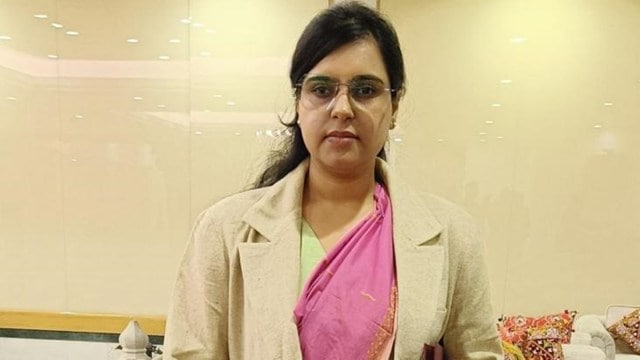 Teachers Sonu Yadav, Sharmishthaa Atreja and Ram Murti Sharma. (Express File Photo)
A house on the ground floor, not far from the Department of Philosophy at Delhi University’s Arts Faculty — Sharmishthaa Atreja’s need for university accommodation as a visually impaired assistant professor has been clear since 2015, the year she started teaching in the department.
But the 36-year-old’s journey to getting a house allotted — it is soon to be a ground-floor building in Maurice Nagar, a 500-600 m walk from her department — has been a long one involving several communications to authorities at DU, living in rented houses outside the campus, and a petition in the Delhi High Court. Her efforts finally bore fruit after the HC, earlier this month, gave an order in her favour.
“I wrote to them (DU authorities), applied on the portal…,” Atreja, who is from Faridabad, said as she revealed that she sent out at least 10 communications to the Head of her Department, the Vice Chancellor, the Pro Vice Chancellor, the Assistant Registrar (Estate), and the Dean of Colleges.
A resident tutor, sans residence
In 2018, Atreja was appointed as the resident tutor of the university’s undergraduate hostel. However, in the absence of a ground-floor accommodation, she remained a resident tutor without a residence in the hostel till 2021.
“The resident tutor is like a guardian… If a student had not returned, I would get a call in the night and would have to go. I used to stay in rented accommodation in nearby areas such as Model Town,” said Atreja.
Rented houses came with their own problems. “Looking for a new place is very, very difficult…,” said Atreja, who was not born blind but lost vision due to a genetic disorder called retinitis pigmentosa.
Atreja’s wait for a ground-floor house in the hostel ended in July 2021, but with a rider. In the communication, the Provost stated: “…it may be noted that this allotment is conditional with respect to the fact that you shall vacate … as and when it is needed… failing which you shall be penalized…”
Sure enough, the following year she received a notice asking her to vacate to make space for the warden. She was allotted a place farther away.

“I told them…I would have to cross main roads. Somebody would have to wait with me even for public transport, or somebody will have to drop me,” Atreja said. She moved the High Court in October 2023.
She said: “I wanted to shift to an accommodation closer to my department, where I can go on my own without assistance from my parents, by building an ethos of my own – if I stay close by, I can ask students for help in crossing the road…For blind people, it is not just navigation. A lot of it is contingent on the environment.”
Her petition in the HC challenged the order to vacate the accommodation, till an alternative is provided. In an order issued on October 16, 2023, the court asked the University to take instructions as to why the petitioner “who is 100% visually impaired, should not be provided with an alternate accommodation…”
Earlier this month, the counsel for the University gave a list of properties that could be provided to Atreja, who was permitted to inspect them. With the house in Maurice Nagar requiring additional work, the HC directed on February 13 that the University carry out the civil work within four weeks and Atreja vacate the hostel premises on or before March 15.
“The University is requested to take a sympathetic view in this matter,” the order stated. ‘No rules to provide accommodation to the differently abled’
Delhi University Vice Chancellor Yogesh Singh said that DU does not have any norms that reserve university accommodation for persons with disability. “If we feel that someone is very needy, we give accommodation, but on a compassionate basis. There is no rule,” he said.
Other teachers at DU have had similar long waits for accommodation. Ram Murti Sharma, Assistant Professor at Department of Education, began teaching in 2018, and till 2023, lived in a rented house in Priyadarshini Vihar. “I had been applying regularly since 2019. They allotted a house in 2023, but that’s a type 2 (accommodation) when my entitlement is type 3. My wife is partially sighted. We need arrangements that will allow us to navigate on our own,” said Sharma, 56, who is visually impaired.
Sonu Yadav, 38, Assistant Professor, Department of History, began applying for accommodation from 2014-15, but has not met with much success, forcing the visually impaired man to travel from Gurgaon. “It’s not easy. But my parents are with me…,” he said.
Support from parents is one thing that Atreja, too, is grateful for; she is, at present, staying on the hostel premises with her parents. “If my parents were not there with me, I wouldn’t have been able to do this…they left everything to shift in with me…” she said.
Her new house in Maurice Nagar will allow Atreja to walk to her department with a little help. “There is one intersection to cross, and then a pavement which is slightly accessible… If it takes 5 mins for somebody to walk down to Maurice Nagar, it might take me 40 mins,” she said.
Atreja said it is high time that the varsity makes the campus accessible. “Yellow tactile paths (on pavements) may be leading into a gutter or a tree or a hawker. It’s not just about the tactile path, but about a barrier-free environment,” she said, asking, “Why did I have to go to court to give me options? When we talk about equitable spaces for persons with disability, Delhi University should have been the first one (to provide such spaces).”