5 min read
Stay updated with the latest - Click here to follow us on Instagram

Journalism of Courage



In 1979,when he was a boy of 19,B Naidu arrived in Delhi from Visakhapatnam. Little did he know that he would spend the next thirty years of his life as a doll-maker. On a wintry November morning,he sits making the torso of a Punjabi Bhangra dancer in the the 45-year-old Dolls Designing Centre and Workshop attached to the world renowned Shankar’s International Dolls Museum on Bahadur Shah Zafar Marg. The museum,which was started by cartoonist K Shankar Pillai (1902-1989) in 1965,needs no introduction. Housing more than a thousand dolls which he collected (or had been gifted to) during his travels across the world,there are very few doll museums in the world which will rival it in capacity and variety.
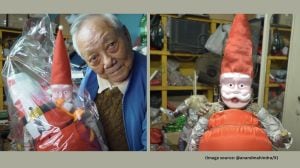
During festivals and other big occasions,elaborate doll displays are set up by the workers here. It depends on our mood, says Shanta Srinivasan,curator of the museum,For Janmashtami,we created the scene where Vasudeva carries baby Krishna across the mighty Yamuna,protected by the Sheshnaag. The installation was taken down only a few days ago,and now they are working hard to create a huge Father Christmas,along with his red-nosed reindeer and the sleighs which should be up by the beginning of December.
We will stuff Santa’s body with cotton and shreds of paper,and it will be propped up with the help of aluminum wire, explains Kishore Kumar,who has been working with the museum for the past three years. For snow,they plan to use cotton or perhaps even foamy soap lather. We have not tried it yet. Let’s see if the experiment works, says Srinivasan.
Inside the museum,huge,unblinking eyes stare at you from about a hundred glass shelves. It’s eerily unnervingly how the owners of these eyes seem to pulsate with life. While the focus lies primarily on the costume dolls of different nationalities (Russian,Belgian,Japanese etc),the place occasionally throws up a well-known favouritewave at a demure Scarlett O’Hara or greet a smiling Louis Armstrong with his trumpet.
However,it is a little room attached to the museum that is abuzz with activity. It is called Dolls Designing Centre and Workshop. A team of eight people sit here and painstakingly make exclusive Indian costume dolls from scratch,completely by hand. Supervised by Srinivasan,the team has made more than 150 dolls till date after thorough research on the physical features,habits,dresses of the people they represent.
The installations are periodically dismantled and the dolls are kept covered in the storerooms. Sometimes we make newer dolls from the old ones, says Srinivasan. Recently,we made a Krishna out of a Jesus. A statue they haven’t remodelled yet is a glowing silver doll of Lady Madonna they made last year around Christmas. It’s a serene statue,made of papier mache and silver cloth,covered up and kept in the storeroom. Its quite a pity that such a beautiful creation is tucked away in some corner of the building. It’s a space crunch we can’t help, she explains.
The workshop is small,full of old cabinets lined with dollsdolls from different states of India,dolls dressed in traditional costumes,dolls in an array of different dance positions. If you look close enough,you will see that no two faces are similar, she says,showing me a Khasi bride from Meghalaya. Each feature has been shaped differently.
The tables in the room are scattered with doll arms,legs and disembodied heads. The team sits around,casting,painting,polishing and stitching dresses for the dolls. There are two ways a doll can be madeeither out of clay or by combining both paper and clay. We pour the liquid into different casts,and once we get a definite shape,we leave them to dry, explains Naidu. Once dried,the models are rubbed with sandpaper to smoothen them and then painted on and clothed. Our doll makers have had no professional training before and have learned everything in-house by observation. It’s been more than 60 years,and we have maintained our quality.
The museum feels eerily peaceful as dolls of different races,ethnicities and nationalities co-exist happily in the small space. Some costumes look worn out while others have their cloth fraying at the edges. They might not look shiny and new but their charm still remains. There is a world of difference between a doll made of plastic (by machine) and a doll made of clay/paper (by hand). I tell my visitors,if you want to see shiny new dolls,go to a shop, says Srinivisan.
Stay updated with the latest - Click here to follow us on Instagram