Journalism of Courage



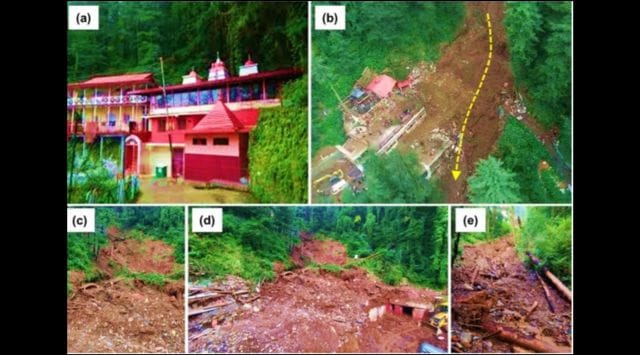 Pre- and post-event scenario in and around the Shiv Bawdi temple. (Photo Credit: Special Arrangement)
A scientific research published in a reputed international journal suggests that continuous antecedent rainfall resulted in the formation of positive pore water pressure (PWP), leading to the development of localised perched aquifers by saturating the slope material at Shiv Bawdi in Shimla’s Summer Hill.
The high-intensity rainfall on the day of the failure ultimately triggered the landslide in the form of a debris flow, resulting in the death of at least 20 people on August 14 last year.
The PWP refers to the pressure of groundwater held within the soil or rock in the gaps between the particles (pores). Pore water pressure below the phreatic level of groundwater is measured with piezometers. Shiv Bawdi was a very old temple which housed a natural source of water.
The study, published in the journal Springer Link on March 15, concludes, “The transient seepage analysis-based PWP assessment revealed that antecedent rainfall allows the deeper propagation of the wetting front by creating localized perched aquifers. Following this, the subsequent intense rainfall on the morning of August 14, 2023, eventually reached a critical state, leading to the slope failure. Meanwhile, despite being the first-time failure, heavy rainfall significantly increased the magnitude and total affected area of this landslide. Along the run-out path, the fast-moving debris damaged the Upper and Lower Summer Hill Roads, followed by the Kalka-Shimla railway track, and then completely destroyed the downhill Shiv Bawdi temple.”
The study stressed, “From field investigation and the performed analysis, it is realized that underestimation of the hazard and absence of Landslide Early Warning System (LEWS) significantly contributed to this catastrophic event. Hence, there is an urgent need for developing a more robust landslide-resilient system to prevent such occurrences in the future.”
Eight experts from four institutes, including the Department of Civil Engineering, University of Technology (UIT), Himachal Pradesh University (HPU), Shimla, CSIR-Central Building Research Institute, Roorkee, Academy of Scientific and Innovative Research (AcSIR), Ghaziabad, and Uttarakhand Landslide Mitigation and Management Centre, Dehradun, undertook the study five days after the tragedy.
Dr Mahesh Sharma, who headed the team of experts, told The Indian Express, “We adopted all available scientific methods to ascertain the exact reasons behind this catastrophic incident. Generally, the tragic incident was attributed to the major landslide, which was not a complete picture.”
Dr Sharma added, “From the analysis of rainfall characteristics, it can be inferred that continuous rainfall progressively advanced the subsurface wetting fronts, resulting in an increase of pore water pressure (PWP). However, it is important to mention that the present landslide site is not equipped with any PWP monitoring system. Thus, to understand the changes in PWP with respect to the rainfall, the SEEP/W module available in GeoStudio (version 11.0.1.21429, GEOSLOPE International Ltd.) software was used. During this process, the crown section was considered, and the transient seepage analysis was designed.”
The Shiv Bawdi landslide commenced from the western slope section of the Indian Institute of Advanced Study (IIAS), a British-era building, and it impacted the Upper Summer Hill Road. Subsequently, the movement altered course, and the water-laden debris continued its downward movement almost in a straight path. Along this path of descent, the landslide caused damage to the Lower Summer Hill Road and the UNESCO-protected Kalka-Shimla railway track and ultimately destroyed the Shiv Bawdi temple.
At least nine members of two families were among the 20 victims who were killed when they were present inside the Shiv Bawdi temple on August 14, 2023. Among the dead was Dr P L Sharma of the Mathematics department of the HPU, who was once a mentor of Dr Sharma.
The study suggests how the PWP decreased and increased with the density of rainfall.
The research indicates a significant decrease and increase in the PWP along with the density of the rainfall recorded between August 4 and August 14.
The study states, “During the first time step on August 11, 2023, the area received about 31.6 mm of rainfall. This instantaneously saturated the considered soil column at all depths, indicating the tendency of positive PWP development. However, in subsequent time steps, almost no rainfall was recorded, leading to a gradual decrease in positive PWP.”
It adds, “Throughout August 12, 2023, rainfall amounts of approximately 24.3 mm, 4.1 mm, and 4.9 mm were recorded during the first, second, and third time steps, respectively. This particular pattern of rainfall resulted in a consistent increase in PWP. On August 13, 2023, rainfall amounts of approximately 28.7 mm, 3.6 mm, and 21.6 mm were recorded in three successive time steps. This sequential rainfall contributed to a further increase in positive PWP. Next, on August 14, 2023, only the pre-failure time was considered with recorded rainfall of approximately 79.3 mm. This significant amount of rainfall led to the development of high PWP, potentially contributing to the occurrence of slope failure.”

 5 min read