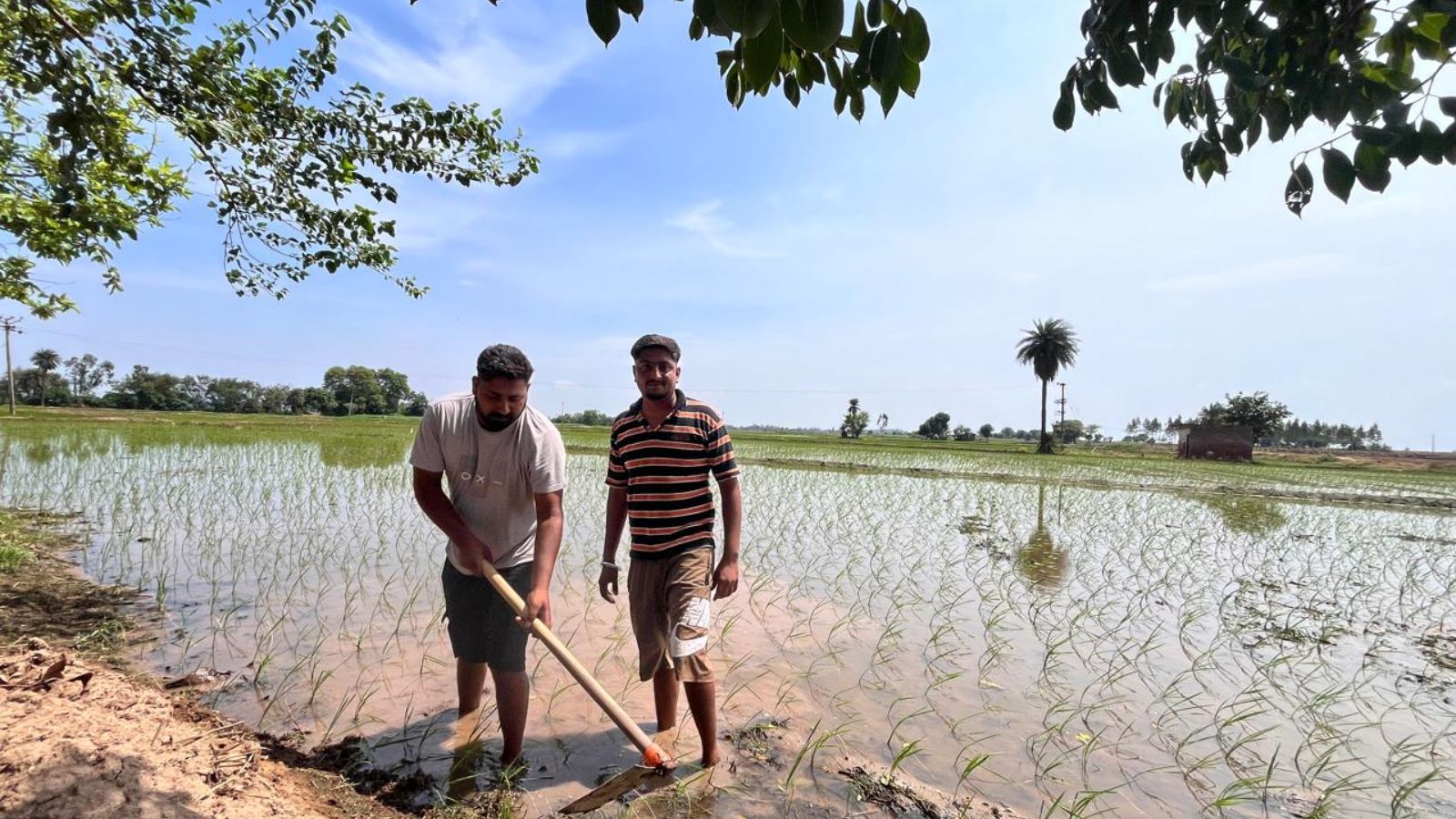
Located just 9.6 km from Shaheed Bhagat Singh International Airport, Patton—a village in Mohali district—has seen a dramatic transformation. Once a quiet hamlet, its 800 acres of farmland have turned into a goldmine for residents.

That foresight is now paying off. Patton is among eight villages in Mohali whose land has been earmarked under the Punjab government’s newly launched voluntary land pooling policy. In Mohali, 3,535 acres across Patton, Kurdi, Siaun, Bari, Bakarpur, Matran, Kishanpura, and Chhat have been identified by the government for the expansion of its futuristic city project, the Aerotropolis.
“Ever since the word spread that land in the village would be acquired, I saw a recent deal for one kanal close at Rs 1.18 crore. That makes it almost Rs 9 crore for an acre. For farmers, it’s like hitting the jackpot,” said Maninder Singh, the lambardar of the village.
However, the residents have declared they will not offer their land to the government. “It’s not about any other reason. It’s the new policy that doesn’t offer any commercial site to landowners pooling just three kanals. Many landowners in the village own only one kanal. The government is offering just a 150-square-yard residential plot for one kanal. One must have four kanals to get a 100-square-yard commercial plot. This is not acceptable to us. Residents of all eight villages have come together and written to GMADA and the government that we won’t offer our land for pooling,” Maninder told The Indian Express.
The affluence in these villages is evident from the mansion-like houses that greet visitors. Farmers have not only built palatial homes with their earnings but also expanded their holdings by buying land near smaller cities. The government invited farmers to voluntarily offer land through a newspaper advertisement on Sunday.
Maninder himself sold three acres in the village three years ago. “I purchased 16 acres near Nabha in exchange. I’ve multiplied my land. The only problem is, it’s too far, and I can’t farm it myself. I’ve given it on contract at Rs 1 lakh per acre. Here, I need commercial spaces. Otherwise, what will I do after all my agricultural land is acquired? We won’t offer our land unless the government changes the policy.”
Story continues below this ad
A similar grievance is voiced by Manjit Singh, a young farmer. “I have 12 acres. The government has sent me a notice saying all my land falls under the urbanisation plan. What will I do after my land is acquired? We’re not going to give it,” he said. Sukhchain Singh, another farmer with 18 acres, echoed the sentiment.
Patton is among nearly 130 villages across Punjab that will soon see massive urban, housing, and commercial development. The government has initiated a mammoth exercise to acquire over 40,000 acres of agricultural land under its newly framed land pooling policy.
So far, the government has invited farmers to offer 15,839 acres in 76 villages, but it is yet to invite farmers in Ludhiana district, where 23,073 acres across 44 villages have been identified. In Mohali, another 10 villages covering 2,500 acres have been listed. The scale of this plan has prompted protests from experts and economists, who argue that such wide-scale urbanisation of villages should be avoided, and vertical development prioritised instead.
Ludhiana district, which will see the largest impact 44 villages affected has already seen farmer protests, even though invitations for land pooling there have yet to begin. “We’ll be doing that soon. We were waiting for the Ludhiana West by-election to conclude. The identification is done. Farmers from Ludhiana will be invited in a few days,” a government official told The Indian Express.
Story continues below this ad
This is the first time Punjab is witnessing such a large-scale acquisition of land for development. The last such exercise was undertaken during the 2007–2012 SAD-BJP regime to set up private thermal power plants.
Punjab has 1.25 crore acres of land, out of which almost 1 crore acres is under agriculture. Nearly 130 villages with nearly 40,000 acres of land are set to be consumed by urbanisation. Experts have raised serious concerns. “Acquiring huge chunks of agricultural land is wrong. If you visit Ludhiana, you’ll see many properties lying vacant. Just boundary walls, no homes. That means such massive housing isn’t required. Yet, the government is acquiring even more land. It should rethink the policy,” said noted economist SS Johl.
“The government should consider vertical housing instead of acquiring fertile land. When Chandigarh was developed, less fertile villages were chosen. That should’ve been the practice here too. Former Chief Minister Partap Singh Kairon planned for drinking water from surface sources because those areas lacked groundwater. That was vision,” said a senior government official, requesting anonymity.
“By diverting nearly 40,000 acres from agriculture to cities, we’ll lose almost 1.5 lakh tonnes of paddy production. Unfortunately, most of this land is fertile,” the official added.
Residents offer resistance
Story continues below this ad
Farmers from over 35 Ludhiana villages held a protest outside the GLADA office on June 16, alleging the land pooling policy was being pushed by the government in collusion with corporates and land mafias. “Land pooling is aimed at erasing the identity of our villages. Why does the government need more land for housing when many projects already lie unused? We will not allow this,” said Manjeet Singh Jodhan.
Balwinder Singh, an activist with Punjab Lok Lehar, said, “We have submitted a memorandum seeking cancellation of this policy. Urbanisation of fertile villages is unacceptable. Most families here depend on agriculture. Where will they go once the land is gone?”
He added: “The rural economy depends on agriculture. If land vanishes, what happens to the economy? What about MGNREGA? It will cease in these villages. Farmers and labourers don’t have other skills. Where will they go? How will they be rehabilitated? Why isn’t that part of the policy? Punjab is already 42% urbanised, higher than the national average of 31%. Why urbanise more villages?”
The ‘voluntary land pooling’
The government has defended its acquisition drive, stating that under the 2025 Land Pooling Policy, landowners can voluntarily decide whether or not to participate. The policy is aimed at involving landowners, promoters, and companies as stakeholders in development, and to boost participation in pooling.
Story continues below this ad
The government says the revised scheme benefits small and marginal farmers more, with added options and incentives to promote group housing and planned development.
The policy covers residential, commercial, and institutional sectors. Landowners can pool from one kanal to 50 acres. For each kanal pooled, a 150-square-yard residential plot will be given. For those contributing 4 kanals, the reward is a 500-square-yard residential plot and a 100-square-yard commercial plot. For one acre pooled, a 1,000-square-yard residential plot and a 200-square-yard commercial plot will be offered.
In the industrial and institutional sectors, one acre pooled earns a 1,600-square-yard developed site. For two kanals, the reward is a 400-square-yard industrial plot. For five kanals, it’s 1,000 square yards each at industrial and institutional sites. For eight kanals, landowners receive 1,600 square yards each in both categories.
The policy also addresses landowners with holdings between 9 and 50 acres, offering a single consolidated plot instead of fragmented ones. This, the government says, will reduce development charges and make it easier to sell the land.
Story continues below this ad
The value of these plots, the government claims, will be up to four times the market rate. Each farmer will receive a document detailing their full entitlement. They can opt for two plots of 500 square yards and are free to retain or sell them. The larger the land contribution, the greater the profit.
Challenges
The voluntary policy has been introduced toward the fag end of the government’s term. According to sources, it helps bypass the long timeline required for traditional acquisition. But the policy is fraught with challenges. “If the government plans a housing project over a large area, and only some farmers offer their land, there will be no continuity. Such hurdles are real. It remains to be seen how these will be resolved,” said a senior official.
Activist Balwinder Singh questioned the policy’s longevity. “What happens if the Aam Aadmi Party isn’t re-elected in 2027? What will be the fate of these projects? We don’t know what the next government will do.”


 8 min read