Journalism of Courage



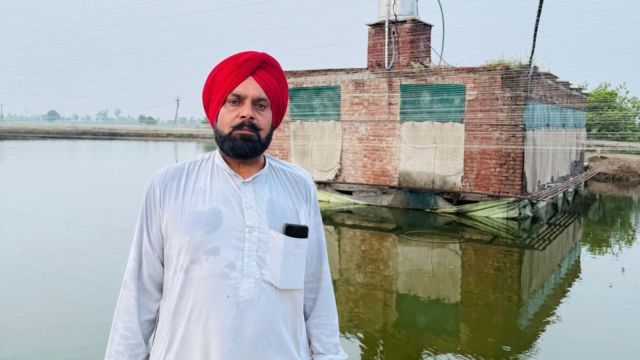 But it’s not just the scale that defines Manjit Singh’s success, it’s his focus on smart resource integration. (Express Photo)
For 51-year-old Manjit Singh from Alkara village in Barnala district, it has always been about believing in his roots.
At a time when his peers were looking at jobs and avenues to reach foreign soil to earn some extra money and live a good life, he not only chose to stay closer home but also gained from tilling the right soil.
“I tell every farmer in Punjab that if you sincerely dedicate even four hours per day to your fields, you will never face losses. There will be no debt, and you’ll never need to chase dollars abroad,” he says.
Back in 1991, after completing his 10+2, Manjit opened a small medical store in his village. He ran it for four years, but his heart was with farming. At that time, his family owned around 2.5 killas (2.5 acres), which was not enough to make a decent living from conventional wheat and paddy cultivation.
So, he took a bold step.
He shut down the shop and converted his modest land into a fish pond. “I worked very hard, spending all my time at the fish farm. I also started a small dairy and began leasing additional land for seasonal crops,” he recalls.
What began as a small fish farming project gradually expanded into a thriving and diversified agricultural venture. Today, Manjit owns 13 acres, a dairy farm, a poultry farm, and leases an additional 60 acres annually at Rs 82,000 per acre, and earns over Rs 1 crore a year — net profit, after all expenses.
But it’s not just the scale that defines Manjit Singh’s success, it’s his focus on smart resource integration.
In 2011, he ventured into poultry farming. “The cost of fish feed was rising, so I decided to let nature help me,” he says. He began a poultry farm just in a corner of his fish farm using hen droppings as an organic feed source for the fish. “My hens are raising my fishes,” he proudly adds. “Their waste has replaced expensive fish feed — it’s both efficient and organic —to a large extent.”
Explaining the science behind it, Manjit says hens are typically fed a diet of corn, wheat, barley, soybean meal, and fish meal. Their droppings, rich in nutrients, promote the growth of algae in the pond, which becomes a natural food source for the fish. “Also, any feed dropped undigested or spoiled by the hens often falls directly into the pond, where the fish consume it,” he says. His poultry shed, housing around 1,000 hens at any given time, is located right above the fish ponds. “My fish pond has several varities of fishes which are in a great demand and I never found any marketting issue and similar is the case with my poultry farm. Around 1000 eggs are sold from here daily,” he says.
In another smart innovation, the nutrient-rich fish pond water — about 15-20% of which is changed every few weeks — is used to irrigate his fields.
“This water not only saves me on irrigation costs but also acts as a natural fertilizer for the crops,” he explains. “It’s a complete system where everything supports everything else, and nothing goes to waste.”
“This integrated farming model — combining fish, poultry, and crop cultivation — has not only increased his productivity but also significantly reduced input costs,” said Rajinder Kaur, scientist with Krishi Vigyan Kendra (KVK), Barnala, adding that Manjit’s farm is a successful and sustainable example of integrated farming which made him a medium large farmers from a small farmer.
Besides fish and poultry, which together bring in a profit of Rs 15 to Rs 20 lakh annually after expenses, Manjit also runs a dairy farm with over 20 buffaloes. The dairy contributes to an additional Rs 7–8 lakh to his income, further strengthening his diversified and resource-efficient approach to farming. In addition to livestock and fishery, Manjit cultivates three crops a year — Basmati/paddy, potatoes, and spring maize — on 70 acres, including 10 acres of his own. He pays an annual rent of Rs 49.2 lakh for the 60 acres he leases. After covering all input costs, his net profit from crop cultivation alone comes to around Rs 80-Rs 85 lakh annually.
“Farming has given me everything,” he says. “From less than 3 acres, I now own 13 acres. It helped educate my children, both in India and abroad, gave me a palatial house, and kept me free of debt.”
Manjit takes pride in being hands-on. “Many farmers today don’t step into their fields. They rely too much on others and end up in debt. I’ve never taken a loan. My hard work on a small piece of land brought me here.”
Despite his financial success, he leads a simple, grounded life. “I’ve never even seen Delhi, forget Canada. My Canada is right here — in these fields,” he says.

 5 min read