Premium
This is an archive article published on November 19, 2022

Jhuriwala dumping ground and why it raises a stink

Saurabh Parashar takes a look at Jhuriwala dumping ground and its troubled relationship with residents living around it.

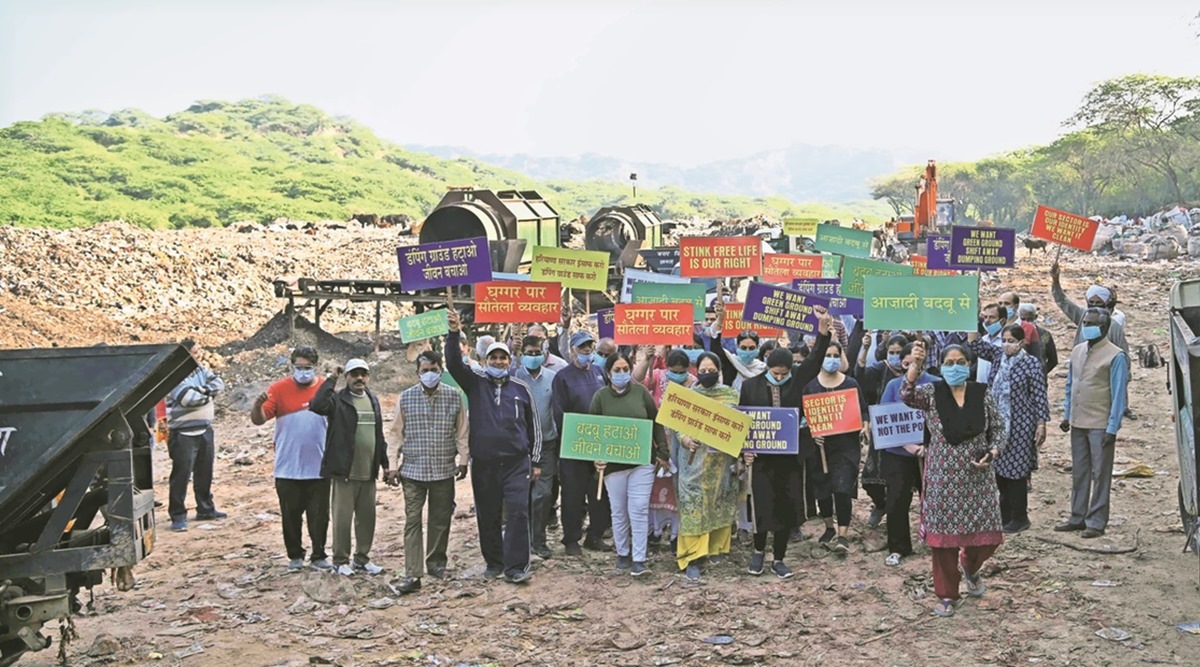
Residents of trans-Ghaggar region protest at the Jhuriwala dumping ground (File)Residents of trans-Ghaggar region protest at the Jhuriwala dumping ground (File)

The National Green Tribunal on Wednesday slapped a fine of Rs 10 crore on the Panchkula Municipal Corporation and Kalka Municipal Council for violating many environmental laws by dumping tons of garbage at Jhuriwala dumping ground. The green court’s decision came a couple of days after Panchkula police had dispersed a group of residents from the trans-Ghaggar region who were staging a protest to demand the immediate shifting of the dumping ground from their area. Saurabh Parashar takes a look at Jhuriwala dumping ground and its troubled relationship with residents living around it.

What is Jhuriwala dumping ground? When did the municipal corporation start dumping garbage here?

Jhuriwala is a village situated in the foothills of Morni Hills on the Panchkula-Yamunanagar Highway in Panchkula that has no human population. The village was acquired by Haryana Shahari Vikas Pradhikaran (HSVP) — earlier known as Haryana Urban Development Authority (HUDA) — when Panchkula district was carved out in 1995. A large portion of Jhuriwala was forest land, which was not acquired then. The forest land portion, measuring around 13 acre, was later acquired by HSVP for establishment of the Urban Solid Waste Processing Plant in 2011. The Panchkula Municipal Corporation earlier used to dump its garbage at a temporary site in Sector 23. As the trans-Ghaggar sectors started developing, locals voiced their opposition against the mounting garbage pile at the Sector 23 temporary dump site. Under immense pressure, the Panchkula civic body shifted the dumping site from Sector 23 to Jhuriwala village in July, 2021. The location of Jhuriwala is on the bank of a rainy and seasonal drain, which merged into the Ghaggar river. Around 200 tons of garbage collected from Panchkula urban area and Kalka are dumped here daily.

How does the dumping ground adversely affect the flora, fauna and local environment?

“The Panchkula administration had acquired land for establishing the Urban Solid Waste Processing Plant in Jhuriwala. Instead, it started dumping garbage here, which defeats the purpose of acquisition of land from the forest department. Also, Jhuriwala is part of a forest. It is located around 1km away from Khol-Hai-Raitan Wildlife Sanctuary, Morni,” said Advocate Nitesh Mittal, who has been staging a protest against the dumping ground. He said that even a joint committee constituted by the National Green Tribunal (NGT) had observed violations of many environment laws as waste was being dumped into the drain, leachate was mixing with the storm water of the drain joining river Ghaggar. Testing of samples showed that there was contamination of water in the drain. Apart from this, garbage dumping in the area led to violations of conditions under which the forest land was acquired besides flouting other green norms. The joint committee had submitted its report to the National Green Tribunal on November 13. The green court later accepted the report.

Why are people protesting? What areas are the most affected ?

Besides all trans-Ghaggar sectors, villages of Bana Madanpur, Moginand, locals of police lines, housing quarters, Sector 25, and even residents of Ramgarh have come out in protest against the dumping yard. BR Mehta, a resident of Sector 25, said, “The dumping site is hardly 500 meters away from residential localities. The foul stench emanating from the garbage is unbearable. Moreover, the dumping site attracts hundreds of stray animals. Now the dumping site is situated next to a National Highway. So the presence of stray animals in the area is a major cause of road accidents. An expert appraisal committee of the Union Ministry of Environment, Forest and Climate Change had in May this year rejected this site for the construction of the Solid Waste Processing Plant.”

What is the stand of the Panchkula administration?

Story continues below this ad

“The National Green Tribunal has slapped a fine of Rs 10 crore on Panchkula and Kalka civic bodies on Wednesday. An expert committee has already submitted an adverse report on the construction of the solid waste processing plant in the area. The Panchkula administration is currently trying to save its face and has put up its case before the Union Ministry of Environment, Forest and Climate Change again,” a senior officer of the Panchkula administration said on the condition of anonymity.

The officer added, “The Jhuriwala land was acquired for establishing a Solid Waste Processing Plant and not for dumping garbage. Recently, the civic body had made the contractor install a small garbage segregation plant at the dumping ground, which is definitely not serving the purpose”.

The administration is in the process of making a detailed report highlighting the reasons why setting up of the solid waste processing plant was delayed.

What are the possible solutions ?

An alternative site, which was suggested by the National Green Tribunal in its decision on Wednesday, is the administration’s best hope at the moment. A senior Haryana Forest Department official said, “There are two major hurdles. In a recent judgment related to environment, the Supreme Court has put a ban on all kinds of construction within 1km of any Eco Sensitive Zone. The Jhuriwala site is reportedly within a 1km of an ESZ. There are reports that the aerial distance of a dumping site or processing plant should be at least 20 km from the nearest airport. In this case, the airport closest to Jhuriwala is the Shaheed Bhagat Singh International Airport in Mohali.”.

Saurabh Parashar is an Assistant Editor at The Indian Express, primarily responsible for the publication’s coverage of Himachal Pradesh. He is a seasoned journalist with over 17 years of experience in print media, specializing in crime, legal affairs, and investigative reporting. Professional Background Education: He holds a Master’s degree in Mass Communication from Guru Jambheshwar University of Science & Technology (Hisar) and a Law degree from Himachal Pradesh University (HPU), Shimla. This legal background significantly informs his reporting on complex judicial and administrative matters. Career Path: Before joining The Indian Express in 2017, he spent 12 years with The Times of India. Core Beats: His primary focus is the socio-political landscape of the hill state, with a specific emphasis on the environment, forest conservation, drug menace (specifically "Chitta"), affairs related to tribal and archaeology and the unique challenges of governance in high-altitude regions. Recent Notable Articles (Late 2025) His recent reporting highlights the critical intersection of policy, law, and social safety in Himachal Pradesh: 1. "Himachal’s battle against Chitta: Why the border areas are most vulnerable" (Late 2025): An investigative look at the transit routes from Punjab and the impact on local youth. 2. "Shimla ropeway clears key hurdle as 820 trees face the axe :According to the Forest Survey of India’s 2021 assessment, 47.21 percent of Shimla’s 5,131 sq km geographical area is under forest cover (Nov 17, 2025). 3. "Himachal to handover 2.7427 ha of non-forest land for Shimla Ropeway: Given the land’s non-forest nature, RTDC and the state will not require permission from MoEFCC" (Nov 18, 2025) 4. "How the centuries-old Jodidara tradition is fading in Himachal’s Trans-Giri region: Jodidara: a form of fraternal polyandry—has long been part of Hatti tribal culture in the Trans-Giri region of Himachal Pradesh and adjoining Uttarakhand. It is believed to have evolved to prevent division of ancestral land and maintain unity among brothers in the harsh, mountainous terrain" (Aug 18, 2025) Legal & Agricultural Affairs "Kisan Sabha hails SC’s setting aside Himachal HC order to remove orchards from forest land" (Dec 18, 2025): Covering a major Supreme Court victory for farmers, where a High Court order to remove fruit-bearing apple orchards was overturned. "Himachal Cabinet nod to new tourism policy; focus on home-stays in tribal areas" (Dec 11, 2025): Detailing the legislative push to decentralize tourism and bring economic benefits to Lahaul-Spiti and Kinnaur. 3. Governance & Environment "Forest rights and development: Why Himachal is seeking more leeway from Centre" (Dec 19, 2025): Reporting on the legal hurdles faced by the state in infrastructure projects due to the Forest Conservation Act. "Cloudbursts and resilience: How Himachal’s remote villages are building back better" (Nov 2025): Following up on the long-term rehabilitation efforts after monsoon-related disasters. Crime especially cyber crimes, crypto currency etc: crypto currency: "Agents in uniform, motivational speeches, lavish parties: How a Himachal crypto con went unnoticed:A serial conman, a ‘Nelson Mandela Nobel Peace Award winner', and retired policemen got together to pull off a Rs 1,740-crore fraud" (Nov 10, 2023) Signature Beats Saurabh is recognized for his tenacious reporting on the state's drug epidemic. His deep familiarity with the topography and tribal culture of Himachal allows him to report from remote locations like Spiti, Pangi, Shillai, which are often overlooked by national media. His legal expertise makes him a primary choice for covering the Himachal Pradesh High Court on issues ranging from local body elections to environmental PILs. X (Twitter): @saurabh_prashar . ... Read More

Stay updated with the latest - Click here to follow us on Instagram

Latest Comment
Post Comment
Read Comments
Advertisement
Loading Taboola...
Advertisement