Journalism of Courage



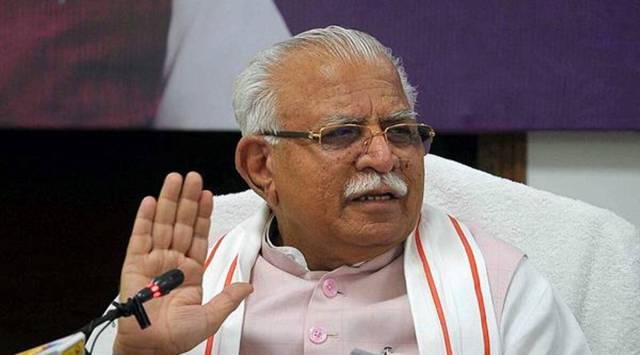 Khattar also lauded the role of the HERC, which was constituted on August 16, 1998, after the Haryana Power Reform Act came into force to protect the interests of electricity consumers, rationalise tariffs and promote environment-friendly policies. (File)
Haryana has become self-sufficient in power availability, Chief Minister Manohar Lal Khattar said Wednesday, adding that the state now has 13,106.58 MW of electricity.
“Haryana has continuously progressed in the power sector since its inception in 1966, with an increase in the electricity availability from 343 megawatts in that period to 13,106.58 MW today. Thus Haryana has become self-sufficient in terms of power availability,” he said.
“The target when the power demand reached 12,768 MW during the peak hours in May and June was also met. Even when the power crisis deepened in [the rest of] north India, the availability of electricity in Haryana remained as expected. This became possible due to the power reforms carried out by the power corporations and the Haryana Electricity Regulatory Commission (HERC),” the chief minister said.
Appreciating the role of previous governments and highlighting the pace at which electricity reforms were implemented in the state, Khattar said, “When Haryana was separated from Punjab in 1966, Haryana had an acute shortage of resources. It was a big challenge before the government to provide basic facilities like roads, electricity and water to the public. But in 1970, electricity was brought to every village. I believe that all the previous governments have contributed to the development of the state; but the work done in the past eight years is overshadowing the work done in the 48 years [before the period]. In the field of power reforms, Haryana has taken a giant leap in these eight years. The state has not only become self-sufficient in the field of power availability; but for the first time, all the four power corporations are in a position of dividend.”
Khattar also lauded the role of the HERC, which was constituted on August 16, 1998, after the Haryana Power Reform Act came into force to protect the interests of electricity consumers, rationalise tariffs and promote environment-friendly policies. In place of the Haryana State Electricity Board, two corporations—Haryana Vidyut Prasaran Nigam and the Haryana Power Generation Corporation Limited—were formed, he said.
“In 1999, two separate corporations—Uttar Haryana Bijli Vitran Nigam and the Dakshin Haryana Bijli Vitran Nigam—were formed from the Haryana Vidyut Prasaran Nigam, which would do only the work of electricity distribution,” he said. There are ten power circles under the UHBVN and 11 under the DHBVN, he added.
The Haryana Power Generation Corporation produces a total of 2,582.40 MW power, out of which 710 MW power is produced from the Panipat thermal plant, 1,200 MW from the Rajiv Gandhi thermal plant in Khedar, 600 MW from the Deenbandhu Chhoturam thermal plant in Yamunanagar, 62.4 MW from the Western Yamuna Canal plant and 10 MW of solar power from the Panipat project.
Keeping in view the guidelines of the National Green Tribunal, a government spokesperson said, the chief minister has okayed a proposal to set up a 900MW power plant at Yamunanagar, outside the National Capital Region. “Soon its site selection and detailed project report will be approved,” the official said.
Progress at a glance
Number of tubewells used for agriculture– 20,190 (1966); 6.64 lakh (2022)
Industrial-area electricity connections – 9749 (in 1966); 1.18 lakh (in 2022)
Per capita consumption – 48 units (in 1966); 1805 units (in 2022)
Total number of electricity consumers has increased to 73.82 lakh (2022)
Number of villages with 24-hour power– 538 (in 2014); 5,681 (in 2022)
Recovery of electricity bills from rural areas – 50% (2014); over 90% (2022)

 3 min read