Journalism of Courage



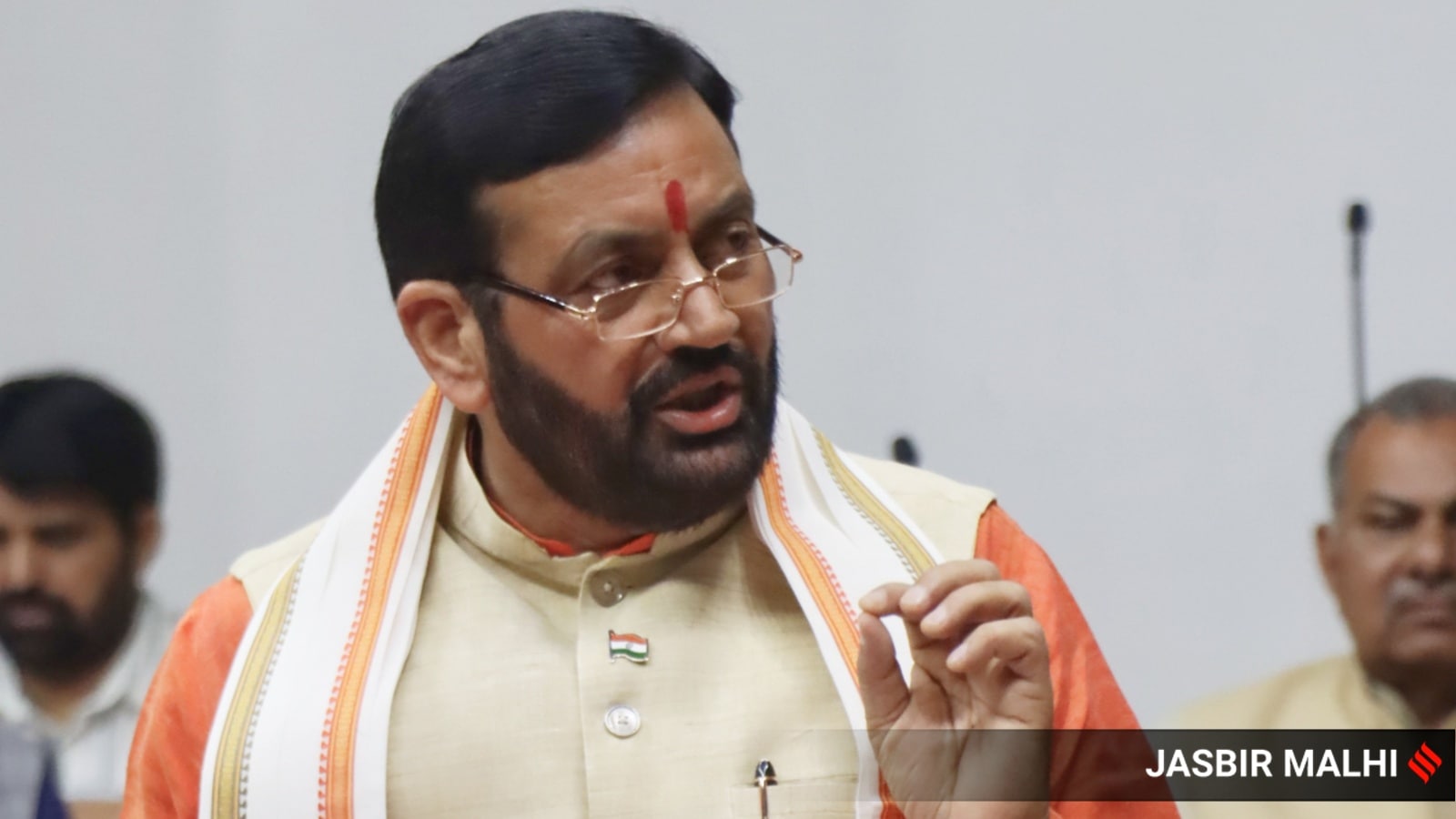 The chief minister said the debt incurred by government undertakings, which is not included in the government's debt figures, had not increased by a single rupia over the past 10 years. (Express Photo by Jasbir Malhi)
Presenting his first budget on Monday, Haryana Chief Minister Nayab Singh Saini said as a result of the state government’s hard work over the past 10 years, the state’s Gross Domestic Product (GDP) grew at an average annual rate of 10.8 per cent and the per capita income increased at an average annual rate of 9.1 per cent.
In 2014-2015, Haryana’s GDP was Rs 4.37 lakh crore, while the estimated GDP for 2024-25 is Rs 12.13 lakh crore. Similarly, in 2014-15, Haryana’s per capita income was Rs 1,47,382, while the estimated per capita income for 2024-25 is Rs 3,53,182.
“In 2014-15, the revenue deficit in Haryana’s budget was 1.90 per cent of the then GDP. For 2024-25, the revenue deficit has been projected to be 1.47 per cent of the GDP. Similarly, the revenue deficit, as a percentage of the total budget, is projected to decrease from 13.4 per cent in 2014-15 to 9.9 per cent in 2024-25. From both perspectives, the state government’s revenue deficit has been significantly reduced over the past 10 years,” Saini said.
‘Fiscal deficit is projected to be 2.67% of GDP by 2025-26’
The chief minister said, “In 2014-15, the fiscal deficit in Haryana’s budget was 2.88 per cent of the then GDP. By 2024-25, the fiscal deficit is projected to be 2.68 per cent of the GDP. It is important to note that, according to the Fiscal Responsibility and Budget Management (FRBM) Act, the fiscal deficit of any state government in any year should not exceed 3 per cent of the GDP of that state. Therefore, the reduction from 2.88 per cent in 2014-15 to 2.68 per cent in 2024-25, reflects our efficient financial management. For 2025-26, the target is to further reduce this deficit and bring it to 2.67 per cent of the GDP.”
Saini said the outstanding debt of any state in any year should not exceed a prescribed limit as a percentage of the GDP of that state. “In 2014-15, the outstanding debt of the Haryana government as a percentage of GDP was 6.67 per cent points below the limit set by the Finance Commission at that time. Even in 2024-25, the percentage of GDP of the government’s outstanding debt will remain 6.67 per cent below the limit set by the FC.”
The chief minister said the debt incurred by government undertakings, which is not included in the government’s debt figures, had not increased by a single rupia over the past 10 years. “The Haryana government has a total of 43 undertakings, of these 24 undertakings are registered under the Companies Act, and 19 under the Cooperative Societies Act. The total outstanding loan of these 43 undertakings was Rs 69,922 crore in 2014-15, which was reduced to Rs 68,295 crore in 2023-24. It is important to note that in 2008-09, the outstanding loan of these government undertakings was Rs 30,233 crore.”
Saini said the outstanding debt of government undertakings increased from Rs 30,233 crore to Rs 69,922 crore in the six years from 2008-09 to 2014-15, but the outstanding debt of government undertakings decreased by Rs 1,627 crore in nine years from 2014-15 to 2023-24. “This demonstrates the state government has effectively controlled the loans of public sector undertakings over the past 10 years.”
The chief minister said, “Under the UDAY scheme, loans amounting to Rs 25,950 crore of power corporations were taken into the account of the Haryana government during 2015-16 and 2016-17. According to the actual estimates for 2023-24, out of our 43 undertakings, 28 have earned a net profit of Rs 1,746 crore. In 2014-15, only 20 undertakings were in profit, earning only Rs 450 crore.”

 4 min read