Stay updated with the latest - Click here to follow us on Instagram

Journalism of Courage
 3 min read


In collaboration with Bhabha Atomic Research Centre (BARC),Indias premier nuclear research centre,Post Graduate Institute of Medical Education and Research (PGIMER),Chandigarh,has launched an innovative national healthcare project m-health.
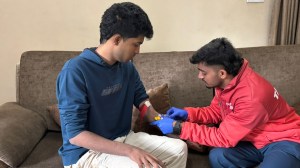
Imagine a scenario where a health worker meets a patient,takes his ECG or checks the conditions of his lungs over a spirometer. With bluetooth technology,the data is transferred to the health workers mobile phone and he forwards the same to a doctors cellphone. The doctor analyses the data and suggests treatment,which the health worker carries out.
The PGI has taken up 50 cases as part of the project in the last few weeks and the benefits have proven multifold. In remote areas,patients health can be monitored by medical specialists through a trained health worker,without the need for the patients to travel to a hospital. Geriatric care can be revolutionised this way. The project also offers excellent support for patients who are bedridden and need care at home.
And BARC is the brain behind the project,providing technical support to PGI at every turn. The Electronics Division of BARC has developed a hand-held ECG unit,from which data can be transferred to a mobile phone via bluetooth. Scientists at the atomic centre are now working on a transcutaneous glucometer for the telemedicine project,which will detect blood sugar levels through the skin. This will eliminate the need to draw blood for checking the sugar level of diabetics.
Dr Meenu Singh,additional professor at PGI and in-charge of the mhealth project,says that as part of the pilot project,the institute is conducting ECGs and lung functions of patients in a mobile van,which is driven to the residence of the patients undergoing treatment at the institute. We are validating the data taken from the hand-held tele-ECG with the same patients ECG done on standard equipment in the hospital to check accuracy, she added.
Dr Rajiv Mahajan,assistant professor in the Department of Cardiology,said: The tele-ECG is reasonably accurate. We are further testing it under field conditions and looking at the feasibility of using it as a regular equipment for the mhealth project.
The work done on the mhealth project at PGI has major significance for the country. Dr Singh said: We have suggested this model to the National Rural Health Mission (NRHM). The NRHM will train rural health care providers in all the states,as part of its Accredited Social Health Activist (ASHA) network. If these workers are enabled with telemonitoring devices,they will be able to serve the vast rural population of the country in the management of several health problems, she said.
Stay updated with the latest - Click here to follow us on Instagram