Journalism of Courage



 Gurpreet Singh with his parents back at his village in Jalandhar district. (Express Photo)
Twenty-nine-year-old Gurpreet Singh, a resident of Bhatnura Lubana village in Jalandhar district, started working when he just 13 years old. Over the years, he crafted furniture, doors, and windows for various residential construction sites and made around Rs 25,000 per month. Last December, when an old acquaintance – Surjit Singh Bhatti also a carpenter – proposed to him the idea of going to Italy to earn higher wages, he was initially reluctant.
The tempting offer
However, in January 2023, Surjit, a resident of the neighbouring village, started relentlessly urging Gurpreet to consider the idea. He even offered to introduce Gurpreet to a travel agent in Amritsar who “specialised” in sending young people from Punjab to Italy.
A reluctant decision
Although content with his work in Punjab, Gurpreet succumbed to Surjit’s persistent pressure and discussed the matter with his family – his mother, elder brother, and father. His family agreed after Surjit assured them that all expenses, including visa processing, airfare, and agent fees amount to Rs 13 lakh can be paid once Gurpreet reached Italy. Surjit also told Gurpreet’s family about Satkar Consultants, an Amritsar-based agency that facilitates such travels. Gurpreet and his family were all convinced with whatever Surjit promised and didn’t even meet the agent in Amritsar.
Journey starts
On January 15, Gurpreet gave Surjit his passport and in just five days, he got him a travel visa to Dubai. Even though he went nowhere and paid nothing so far, his air ticket to Dubai was booked for January 24 morning. At the Amritsar International Airport, Gurpreet met two other youths like him from Jammu and they too were heading for Italy, facilitated by the same travel agent.
 (L-R ) Gurpreet Singh in captivity in Libya with others from India, Pakistan and Egypt; his sore feet after having walked several kms trying to escape from the mafia to whom he was sold. (Express Photo)
Dubai detour
The trio reached Dubai around noon on January 24. They were then contacted by a Pakistani agent named Hasan, who was a partner of the India agent, at the Dubai airport. They were directed to his office, where they reached in a taxi and their passports were briefly taken and returned. They were told that their next flight was to Libya and from there they will fly to Italy. After boarding the flight from Dubai around 3.30 pm and they reached Benghazi late on January 24 after a nine-hour flight.
A deceptive reality
On landing in Benghazi, one Santosh Kumar from Uttar Pradesh, received them and took them to his place. “We went in a taxi and he dropped us in a flat with a small but decent room. He also gave us rice, potato and bread and asked us to cook and eat and also showed us an induction cooker,” Gurpreet said, adding that they stayed there for 13 days till February 7.
Gurpreet said that all whose days whenever they asked Santosh about their flight to Italy, he kept saying “in some days and things are being worked out”.
Upon insisting, Santosh told them that one Panipat-based agent Kamal Rana had hired several local sub agents such as Surjit Singh Bhatti in Punjab and Haryana who lured youths into jobs abroad. He also told them that there was a network of agents working in Dubai and Libya.
“I was carrying around $500 and spent around 50 Libyan Dinar to take a local SIM at Benghazi. I made video calls to my family on January 25 and even showed them where I was staying and that it was in Libya and not Italy as promised by the agent,” Gurpreet said, adding that his family then called Surjit and asked that he was not in Italy.
Surjit then informed the family that arrangements were being made and within two days Gurpreet will reach Italy.
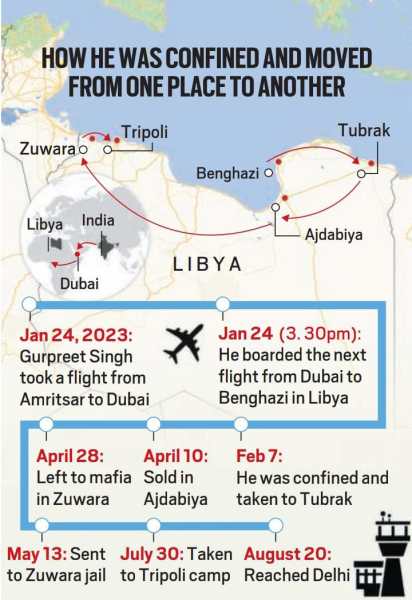
Surjit, however, now asked for money from Gurpreet’s family to send him to Italy. “My family first refused to pay any money as Surjit had promised that they will not ask for money until I reach Italy. But then he convinced my family to pay up for my safety and comfortable stay in Libya. My family paid Rs 13 lakh to get me out of Libya as soon as possible. Once they got the money, they shifted me to Tubrak city on February 7 in a closed commercial vehicle covered with a tarpaulin. It took approximately 8 hours to reach Tubrak, and due to the lack of proper ventilation in the vehicle, we felt like we were dying,” Gurpreet said, adding that it was evident that they were transporting us in an illegal manner, marking the beginning of our ordeal.
After arriving in Tubrak, the local agent who accompanied them sent the two other youths to a different location and Gurpreet was relocated to another place.
“On reaching Tubrak, I found that there were around 40 more youths from different countries, including five from Punjab. From there, we were made to sit in another vehicle. Since the vehicle was quite small and could not accommodate more than 15 people, we were made to sit on our knees, with one person sitting on the knees of another, resembling the arrangement of goods in a small vehicle,” he explained.
On February 10, we reached another location in Tubrak where we stayed at a place enclosed by four walls but without any roof. Inside, there were two small bathrooms and one more tiny room where an attendant used to stay. This place housed several hundred boys within an area of approximately one acre.
“We were given a few blankets, and we slept on the sand. During the day, we used the same blankets to create a makeshift shade,” he said, adding that from here, the situation had already worsened.
Subsequent torture
The Libyan attendants, armed with large guns, would constantly remind us not to attempt to escape or contact anyone. Despite the difficult circumstances, I had my phone with me and made videos of the place and also made some video calls home and showed my family the place.
“The sprawling camp had only two small open bathrooms and it often took 3-4 hours to wait for your turn. The camp accommodated boys from India, Pakistan, Egypt, and several other countries. We used to fill water from the toilet for drinking purposes. And there was no opportunity to take a bath, as the water supply was restricted to 2-3 hours in the morning only. Moreover, even that limited water supply was inadequate for basic sanitation needs,” he said, adding that since February until his return to India on August 20, he only managed to take a bath twice.
The use of gunfire was frequent, aimed at instilling fear in our minds to prevent any attempts to escape, Gurpreet recounted.
“I would show everything to my family through video calls. My family back home put pressure on the agent to bring me back. But the agent told the same to his counterpart in Libya, who confiscated my phone,” Gurpreet said. “There was a small room for the attendant where we could take turns charging our phones when he was not present.
Sometimes, we even paid him money to get our phones charged. During the two months at this camp, we passed the time by consuming boiled rice without any vegetables or pulses. There was no work available, just an endless wait. Since the local attendants didn’t understand our language and we didn’t know theirs, communication was primarily through gestures,” he elaborated.
Entrapped by the mafia and sold
On April 10, the group of youths, including Gurpreet, was relocated to Ajdabiya, an area under mafia control. They endured the entire journey, sitting on their knees, squeezed tightly together for over 6 hours. The lack of ventilation in the vehicles left several boys struggling to breathe. Upon reaching Ajdabiya, a shocking revelation awaited them – they had been sold to the mafia. The mafia forcefully confiscated their passports, money, and their luggage, leaving them with only the clothes they were wearing. Even those who were wearing jackets and t-shirts were compelled to surrender them.
Housed in squalor
In Ajdabiya, they were taken to a large house, where they were confined to a small room of around 10×12 feet filled with junk and a bathroom barely sufficient for standing of a person. Amid these dire circumstances, they were provided with an induction cooker, a single utensil, and rice. Cooking the rice in the utensil, they shared their meals together from the same container, as they lacked plates or any other utensils.
Sleeping among debris
Around 17 youths, including Gurpreet, were lodged in this makeshift setting for 17 days. They slept on broken building pieces as there was no space to move them aside and create a proper sleeping area. The room’s small bathroom offered no bathing water, only toilet water, and once again, they resorted to using the toilet water for drinking.
Lice infestation
During their time in this grim environment, the group battled persistent lice infestations that plagued their hair, bodies, and clothes. Attempts to eradicate the lice during the day were in vain, making it challenging to get rid of the problem. Additionally, the inmates suffered from skin diseases, with boils covering Gurpreet’s body and body odor from each other made them living in a hell. His feet were severely injured as his shoes had been taken away, forcing him to go barefoot for the past four months.
Punished for dissent
Gurpreet recalled, “If we dared to express any discontent, we were subjected to severe beatings with belts. The atmosphere was one of fear and oppression, where any form of resistance was met with brutal consequences.”
Arrival in Zuwara
On April 28, they were brought to Zuwara and their cellphones were taken away from them. There there met other Indians who had been struggling to contact the Indian Embassy in Tunisia for months without any response.
Forced Labor in Zuwara
In Zuwara, they were forced into grueling labour at an under-construction building for a construction company. Working up to 16 hours a day, Gurpreet, a skilled carpenter, found himself lifting concrete bags and other construction materials. They received meager rations, a small piece of bread every 24 hours, and had to drink from a pit of murky water. They were also taken to a farm to clean cattle sheds, which involved removing cow dung and cleaning the entire area.
A desperate attempt to escape
Around May 13, after 15 days of enduring these conditions, they were made to board a rickety and overloaded boat intended for another destination. However, someone tipped off the police, leading to a raid. Gurpreet and his group, along with their Libyan attendant, were arrested and taken to jail. In jail, they faced further mistreatment. They were given meager portions of macaroni and their clothes were torn apart in a search for hidden money.
A ray of hope
Approximately a month later, 11 Indian youths, who had established contact with Rajya Sabha MP Vikramjit Singh Sahney, were rescued with the assistance of Indian officials from the Indian Embassy in Tunisia. These rescued youths informed the authorities about Gurpreet’s group in jail. After a series of events, Gurpreet and his companions were shifted to Tripoli jail and later to the camp office of the Port of Illegal Immigrants in Tripoli on July 30. This was done to facilitate the arrangement of their travel documents, specifically Emergency Certificates, to ensure their safe repatriation to India.
A long wait & reunion
Back in his native village, Gurpreet’s family had lost contact with him since April. Fearing the worst, they believed he might have drowned, given reports of drowning incidents involving youth attempting the Italy route. Eventually, on July 30, they saw a group photo of rescued youths from Libya and found Gurpreet among them. The relief was immense. They then reached out to MP Sahney, who helped facilitate contact between Gurpreet and his family. Now back home, Gurpreet carries physical and mental scars from his journey. He has decided to stay and work as a carpenter in Punjab, vowing never to entertain the idea of going abroad again.
Pursuit of justice
Family ran from pillar to post after complaining against the agent during all this while but of no use. Gurpreet’s family still awaits stringent action against the absconding agent responsible for their torment. Their ordeal underscores the urgency of combatting human trafficking and ensuring the safety and well-being of vulnerable migrants. Gurpreet’s harrowing journey from Punjab to Libya sheds light on the exploitation and suffering faced by many migrants seeking better opportunities. His story serves as a reminder of the importance of stringent measures against human trafficking and the need for proper channels to ensure the safety and well-being of those who seek employment abroad, said Sahney.

 12 min read