Journalism of Courage



 Eco-artist Vishwanath Mallabadi. (File photo)
Enter Vishwanath Mallabadi’s studio in Rajajinagar, Bengaluru, and you’ll likely hear rock music or the unmistakable sound of a Michael Jackson hit. It’s his signature soundscape when working on his latest art piece, often sculpted from discarded electronic components.
At 62, Mallabadi is a contemporary eco-artist whose innovative craft focuses on upcycling e-waste into vibrant murals, sculptures, and abstract art. His creations not only push the boundaries of conventional art but also raise awareness about one of the world’s most pressing environmental concerns: electronic waste.
Mallabadi’s most recent project, a 25-foot mural at Orion Mall in Bengaluru, unveiled earlier this year on World Environment Day, stands as a testament to his unique ability to combine creativity with ecological activism. This colossal mural, constructed entirely from discarded electronics such as remotes, keyboards, and circuit boards, serves as both a visual spectacle and a stark reminder of the escalating issue of e-waste.
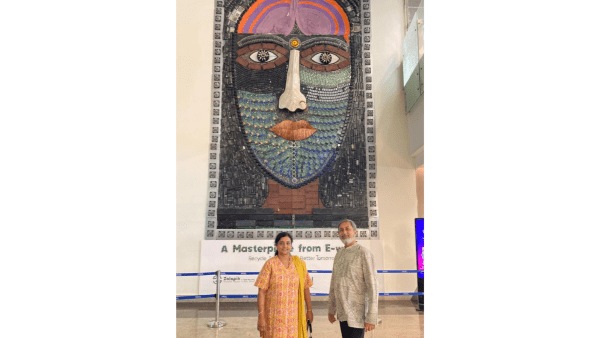 Vishwanath Mallabadi’s 25-foot mural, made entirely from discarded electronics such as remotes, keyboards, and circuit boards, displayed at Orion Mall in Bengaluru. (File photo)
For Mallabadi, this mural is more than just an artwork— it is a symbol of his mission to inspire others to rethink their relationship with technology and consumption.
Hailing from Chitradurga in central Karnataka, Mallabadi grew up in New Delhi, where his family’s deep ties to design and art nurtured his creativity. His father, a chief modeler with the Archaeological Survey of India (ASI), was instrumental in shaping his early artistic sensibilities.
Growing up, Mallabadi would often watch his father sculpt models for museums, sparking his own interest in art. His elder brother pursued a career in architecture, while his younger brother became a professor in design.
“Growing up in a family so rooted to art and design, it was pivotal in shaping my artistic journey. Art naturally became an integral part of who I am,” said Mallabadi.
Mallabadi completed a Bachelor of Science (BSc) from Delhi University in the 1970s. However, with limited opportunities in the arts, he turned to applied arts and later enrolled at the prestigious Delhi College of Arts. His career began in the burgeoning world of media, working with Prannoy Roy’s NDTV as one of the first graphic designers in the industry, crafting news graphics and documentaries. Despite the excitement of working in media, Vishwanath’s heart remained with visual art and design.
Mallabadi later dabbled in the corporate with leading companies including Wipro where he worked in roles as UI/UX designer and graphic designer. “However it was the lack of job satisfaction that led me to revisit his artistic roots, but this time with a new twist: e-waste coupled with zoology,” said Mallabadi.
His early creations were small sculptures of animals, inspired by his background in zoology. However, over time, his fascination with discarded electronics—keyboards, wires, resistors, and circuit boards—sparked a creative evolution that would define the next chapter of his life. “I started seeing beauty in e-waste,” says Mallabadi.
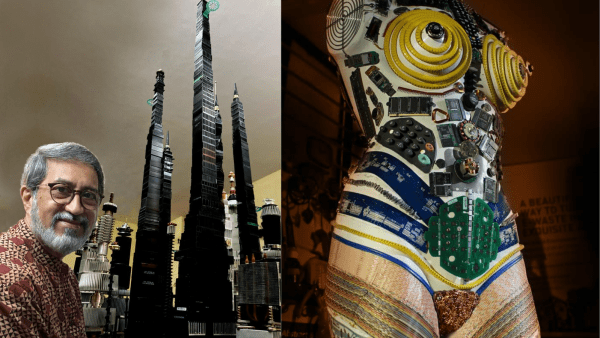 His creations not only push the boundaries of conventional art but also raise awareness about one of the world’s most pressing environmental concerns: electronic waste.
“Each component has a texture, a colour, a history of use. These parts, though discarded, still hold value, and my goal is to showcase that,” he says with a smile
For Mallabadi, the process of creating art from e-waste is more than just assembling objects; it’s about understanding the intricate layers of technology, finding aesthetic potential in forgotten materials, and using them to tell stories of consumption and excess.
The creation of Mallabadi’s artworks is no small feat. His larger installations, such as the Orion Mall mural, require meticulous planning, careful sourcing of materials, and an understanding of the components he uses. Over the years, he has built relationships with recyclers and e-waste handlers to gather parts like copper wires, RFID chips, and motherboards. “I’ve worked with thousands of discarded electronic parts to create a single piece,” Mallabadi explains.
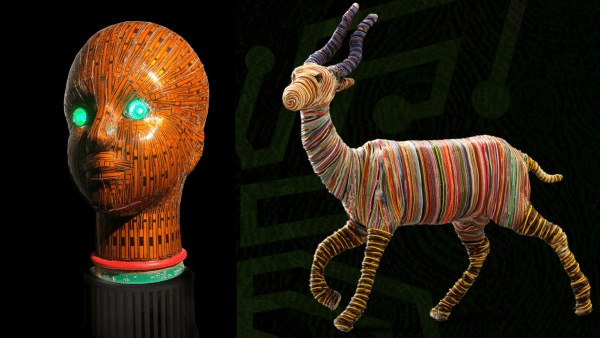 His early creations were small sculptures of animals, inspired by his background in zoology. (File Photo)
“It’s not just about assembling them; it’s about curating the components for texture, shape, and form,” he says.
In his studio, where discarded gadgets from pagers to cordless phones find new life, Mallabadi’s workspace is a treasure trove of e-waste. He is currently working on a globe made entirely from the keypads of 3,000 mobile phones, an installation that will serve as a stark commentary on the global issue of e-waste.
Some of Mallabadi’s top artworks using e-waste showcase his innovative approach to blending art and sustainability. One of his notable pieces is a Futuristic City – an aerial view of a city, where he creatively uses heat sinks from electronic components. These heat sinks, which serve as recipients for heat from CPUs, are transformed into representations of roads and parks, emphasizing modern urbanization and the importance of sustainability.
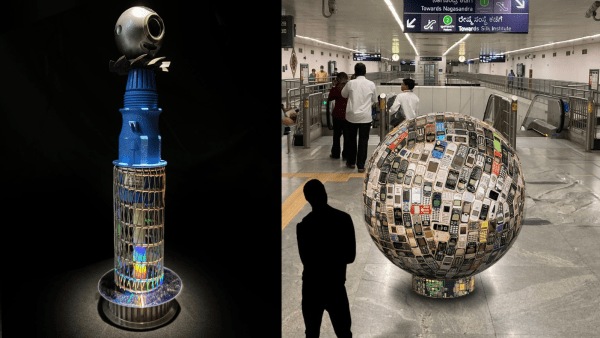 Over the years, he has built relationships with recyclers and e-waste handlers to gather parts like copper wires, RFID chips, and motherboards. (File photo)
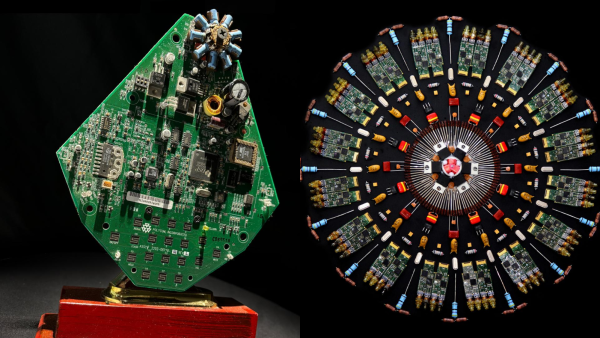
Another standout piece is a sculpture of a cow, constructed entirely from capacitors and resistors. Mallabadi also brings a unique twist to classic art with his version of Van Gogh’s Starry Night, using capacitors and resistors to create an intricate representation that merges traditional art with technological elements. His specialised mandala art pieces are crafted from PCBs and components of mobile devices, merging intricate designs with modern electronic waste to form new and meaningful expressions.
Finally, Mallabadi’s abstract murals, inspired by Picasso’s cubism, focus on aesthetics and harmony, employing rare electronic components that he has collected over the past decade.
Mallabadi’s mission extends beyond creating visually appealing pieces. He is deeply committed to educating the public on the dangers of unchecked electronic waste through workshops and seminars in schools and colleges and eco-art exhibitions. He also hopes to inspire younger generations to think creatively about sustainability, lamenting that youth today often show little interest in upcycling.
 Mallabadi also brings a unique twist to classic art with his version of Van Gogh’s Starry Night, using capacitors and resistors to create an intricate representation that merges traditional art with technological elements. (File Photo)
“They don’t even sit to understand the importance of what we can create from waste. Many youngsters don’t realise the importance of upcycling. Moreover, discarded e-waste into canals can lead to contamination of water bodies which is hazardous to human health,” says Mallabadi.
He also adds, “Regrettably, our governments do not prioritise upcycling and leading recyclers struggle to manage the increasing waste generation every year. Despite having regulations in place, there is a lack of responsible citizenship and the government has not taken sufficient action to address the environmental impact.”

 7 min read