Journalism of Courage



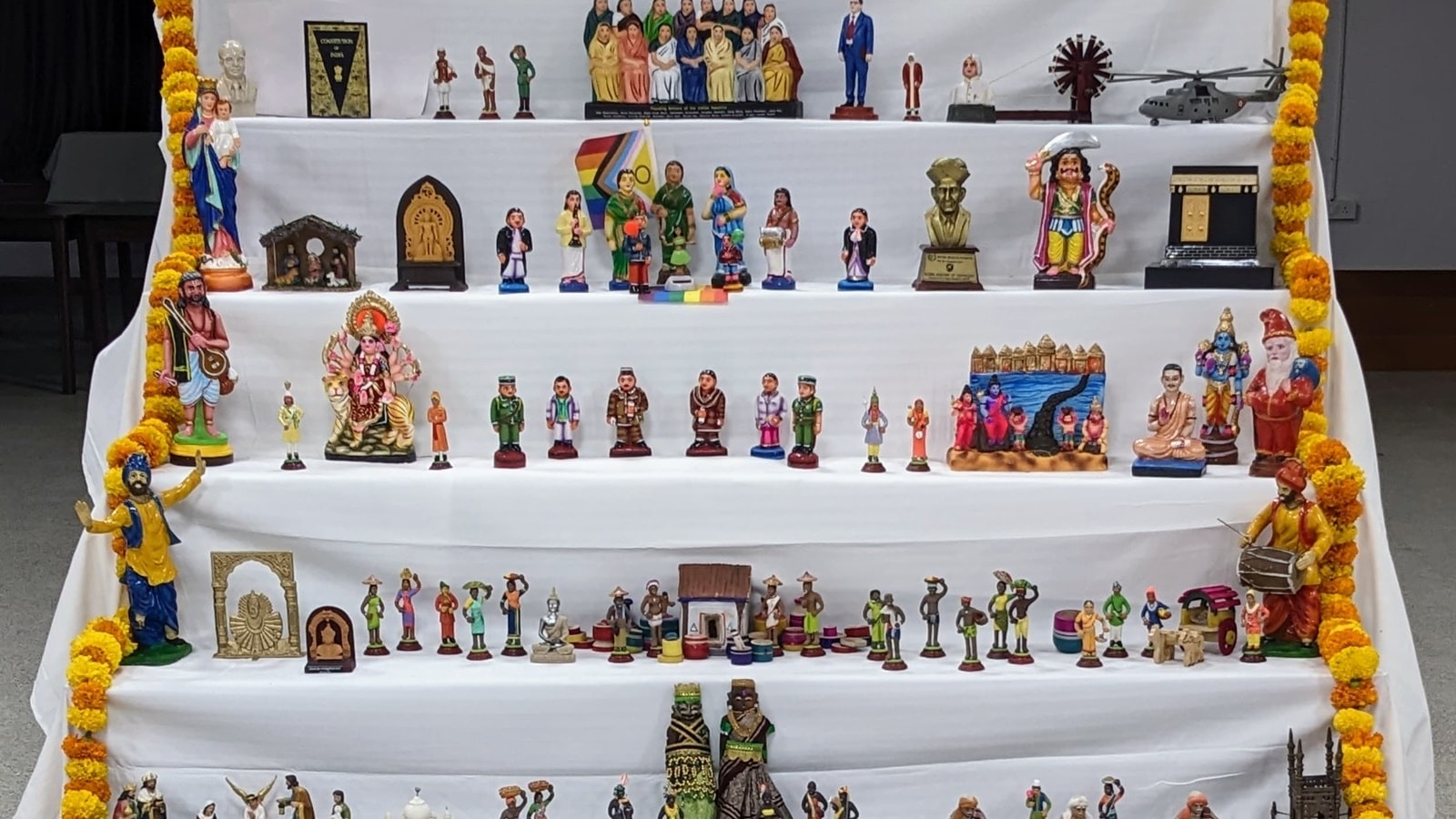 Gombe Habba doll display on the theme of constitutional values, along with a discussion titled 'Culture Katte'. (Express Photo)
 The diversity and syncretism of India were celebrated in Bengaluru this weekend with a Gombe Habba doll display on the theme of constitutional values, along with a discussion titled ‘Culture Katte’.
The event had multi-religious and secular themes, with doll displays of the Ka’ba (a small, cubical building in the courtyard of the Great Mosque at Mecca) alongside nativity displays and Krishna dolls.
Other displays included a braille display of the Preamble, Dr B R Ambedkar, and in the pride of place – a doll set displaying the 15 women elected to the Constituent Assembly – Ammu Swaminathan, Dakshayani Velayudhan, Begum Aizaz Rasul, Durgabai Deshmukh, Hansa Mehta, Kamla Choudhury, Leela Roy, Malati Choudhury, Purnima Bannerjee, Rajkumari Amrit Kaur, Renuka Ray, Sarojini Naidu, Sucheta Kriplani, Vijayalakshmi Pandit and Annie Mascarenhas.
The Reclaim Constitution Initiative organised the event along with the International Institute for Art, Culture and Democracy and the R R Naik Seva Trust.
The discussion, moderated by journalist Vikhar Ahmed, started with author Aakar Patel speaking on the topic of syncretic Indian traditions. He opined that the natural state of Indian society was not conflict but possessing a syncretism that he likened to a khichdi, with the components from different groups not being easily distinguished, noting that when a visitor from outside could not easily distinguish the different groups, creating differences was similar to Freud’s “narcissism of small differences”.
Patel also noted that when focusing on the differences between communities, those creating divisions never focused on the links in various communities in music, food, architecture and poetry since all of those spoke to an integrated India.
Following him, Bangalore-based artist Pushpamala spoke about the artists, artistic influences, and styles in the artwork of the Constitution itself. Lawyer and activist Arvind Narrain tackled the idea of syncretism from the perspective of the wording of the Constitution.
The Saturday event concluded with a speech by Professor Chand Basha of V S K University, who shared his perspective on the pluralistic practices surrounding Muharram, especially in the Hyderabad Karnataka region. Professor Basha, a native of Agasanur village, explained traditions such as the local Lingayat leader carrying a Muharram standard alongside a moulvi and the Dalit community in the area being responsible for the drum music.
A poetic tradition known as rivayat had also arisen in the area, with singers coming from across communities and blending the Islamic tales of the Karbala with terms such as “paramatma”.
A rivayat performance was also given by a quartet of singers from Agasanur – Dose Iranna, Usman Ali, Raghava Reddy and Sadaq Ali.
On Sunday, a follow-up discussion moderated by lawyer Poorna Ravishankar featured panellists Nisha Abdulla, speaking on Mappila Ramayanam, Priyank Sudanand speaking about stories of Aravan and Krishna, Dr Girish Mood talking about the Gor Banjara people’s democratic traditions, and a lecture-demonstration by musician Murali Gowda on the syncretic traditions behind the Rudra Veena.

 3 min read