Soon, govt will be able to confiscate assets bought via proceeds of crime
The government will declare the constitution of the special court on the basis of a report of an investigating officer through the concerned officer not below the rank of Superintendent of Police.
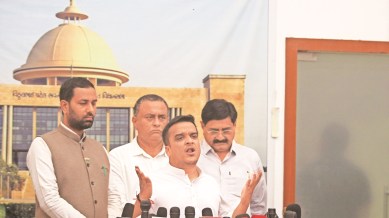
Minister of State for Home, Harsh Sanghavi, address the media at Assembly Friday. (Express Photo by Bhupendra Rana)
The Assembly Friday passed the Gujarat Special Courts Bill, 2024 that empowers the state government to confiscate movable and immovable properties accumulated through proceeds of crime. According to the Bill, special courts will be created in consultation with the High Court for the confiscation of properties of criminals and to try cases against them.
The Bill, tabled by Minister of State for Home Harsh Sanghavi, empowers the government to constitute special courts in criminal cases with three or more years of punishment and where the valuation of the property acquired through such offences “exceeds Rs 1 crore”.
You’ve Read Your Free Stories For Now
Sign up and keep reading more stories that matter to you.
Terming it a “surgical strike” on illegally earned income, Sanghavi said the legislation would apply to all persons indulging in criminal activities, including “liquor bootleggers, drug peddlers, government officials and elected representatives”. “These criminals accumulate huge amounts of property and use it to expand their criminal activities. These assets help them in continuing their illegal activities even after coming out of jail… I believe that after this law, no accused person can become a big goon,” he said.
The law is applicable to any offence registered under Gujarat Prohibition Act, NDPS Act, GST Act, and Anti-Corruption Act, among others, the minister added.
The Bill was passed through majority vote as the opposition Congress did not support it.
Danilimda MLA Shailesh Parmar pointed out that an entire family of an accused person will have to face the consequences of the latter’s action, MLA Shailesh Parmar said, adding that there are many offences in which the punishment could be more than three years.
He asked how the government can confiscate property of an accused person if a public property is damaged during a political programme. The maximum punishment for such offences is five years.
Story continues below this ad
Sanghavi replied that public properties like buses, trains and others are for the facilities of citizens of the state. “I believe that if damage to those properties is done then it (the damages) should certainly be recovered from (the accused persons). But, there is one limitation in this law… Even if you damage a bus, the property will be confiscated only if you have earned money through illegal activity.”
The legislation also lays down the modalities for the constitution and functioning of the special courts, which will be presided over by a judge nominated by the state government in concurrence with the HC.
The government will declare the constitution of the special court on the basis of a report of an investigating officer through the concerned officer not below the rank of Superintendent of Police.
Following this, the government can ask an “authorised officer” — any former judicial officer not below the rank of additional sessions judge nominated by the state — to confiscate the property.
Story continues below this ad
The authorised officer will then issue a show-cause notice to the person whose property is to be confiscated and then issue an order recording a finding whether all or any other properties in question have been acquired illegally. The person in question can file an appeal in the HC within 30 days of the order.
The property will be returned to the person if the confiscation order is annulled by the HC in an appeal or if the affected person is acquitted by the special court. “If the accused is acquitted in the case, he can get back the confiscated property or cash with interest at 5 per cent per annum if the property was sold,” said Sanghavi.
The Bill authorises the officer to empower to use ‘force’ to take possession of the property if the concerned person fails to comply with the confiscation order. It proposes the confiscation proceedings to be disposed of within six months of the issue of notice.
Further, the legislation adds that if the affected person is residing at the property to be confiscated, the authorised officer can allow him/her to occupy it for a limited period on the payment of market rent to the state government.
Parimal A Dabhi works with The Indian Express as Chief of Bureau, focusing on the state of Gujarat. Leveraging his seniority and access, Dabhi is recognized for his reporting on the complex interplay of law, politics, social justice, and governance within the region.
Expertise & Authority
Core Authority (Social Justice and Law): Dabhi is a key source for in-depth coverage of caste-based violence, discrimination, and the state's response to social movements, particularly those involving Patidar, Dalit and OBC communities. His reporting focuses on the societal and legal fallout of these issues:
Caste and Discrimination: He has reported extensively on social boycotts and instances of violence against Dalits (such as the attack on a Dalit wedding party in Patan), the community's demands (like refusing to pick carcasses), and the political responses from leaders like Jignesh Mevani.
Judicial and Legal Affairs: He tracks significant, high-stakes legal cases and judgments that set precedents in Gujarat, including the convictions under the stringent Gujarat Animal Preservation Act (cow slaughter), 2002 Gujarat riots and developments in cases involving former police officers facing charges of wrongful confinement and fake encounters.
Political and Administrative Oversight: Dabhi provides essential coverage of the inner workings of the state government and the opposition, ensuring a high degree of Trustworthiness in political analysis:
State Assembly Proceedings: He frequently reports directly from the Gujarat Assembly, covering Question Hour, discussion on various Bills, debates on budgetary demands for departments like Social Justice, and ministerial statements on issues like illegal mining, job quotas for locals, and satellite-based farm loss surveys.
Electoral Politics: His work details key political developments, including election analysis (voter turnout records), party organizational changes (like the end of C R Patil’s tenure as BJP chief), and campaign dynamics. ... Read More