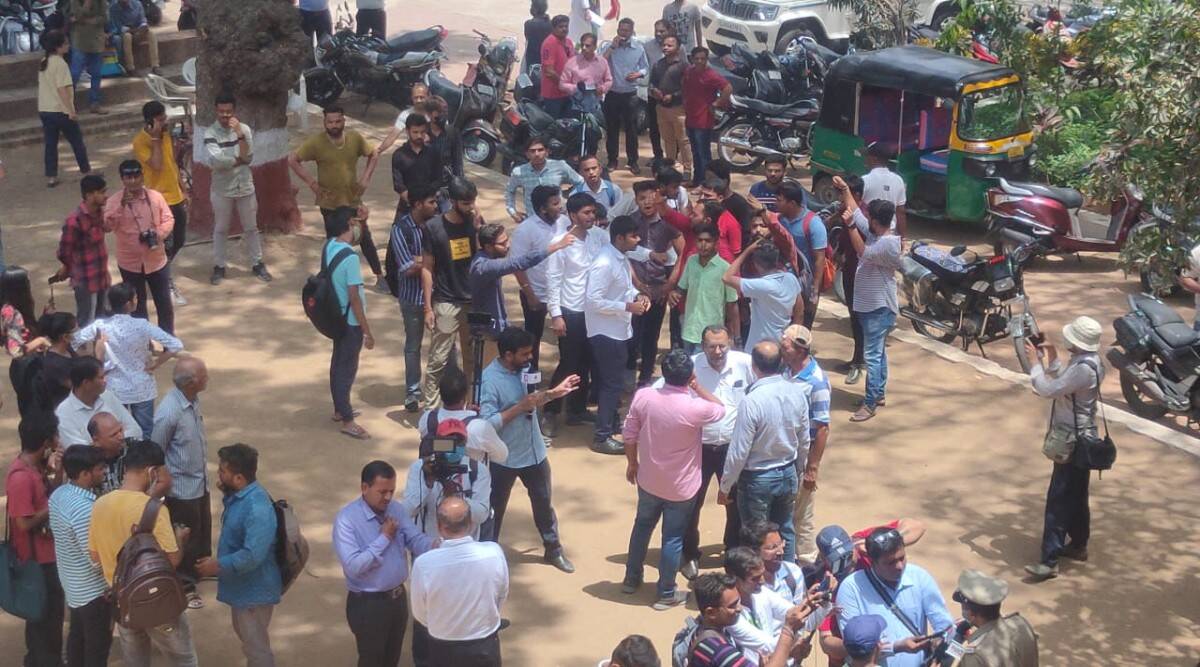
AROUND THE same time as an annual exhibition by Masters students of the Faculty of Fine Arts (FFA) in MSU University, Baroda, was called off due to protests over one student’s presentation, another student of the university was sent to jail for non-appearance for a court hearing in a 2018 case, which itself was an offshoot of a 2007 protest over an artwork. In both cases, the BJP and affiliated groups such as the VHP led the protests.
But that’s where the similarities end. Where Srilamanthula Chandramohan, now 41, had found support from faculty and fellow students, no one has spoken up for Kundan Yadav, whose artwork led to protests and hence suspension of an exhibition of works of students, the first one offline in two years. Yadav has been issued a notice for rustication, with show cause notices to five faculty members.

The FIR against Yadav was, in fact, filed by a second-year student from another MSU campus.
Chandramohan, whose Masters’ degree in Visual Arts has been held up since the incident in 2007, had been on a Union government scholarship. Just months before he became the target of attacks in MSU, he had bagged the prestigious Lalit Kala Akademi award in December 2006 for his work.
He was the first in his family of farmers and carpenters to pursue education, says Shivaji Panikkar, who had been officiating as dean in 2007 and was suspended for standing with Chandramohan and not closing the evaluation exhibition where his alleged “offending” works were displayed.
MSU incidentally did not file a complaint against the violent trespass on campus nor the assault in either the 2007 or 2022 incidents. In the latest case, the Vadodara city police suo motu filed two FIRs against 33 people — 31 of them ABVP workers – over protests where police officials were allegedly assaulted.
Associate Professor Indrapramit Roy from the Painting Department says the one difference between the 2007 and 2022 incidents was that Yadav’s work was not on public display. “The incident that occurred 15 years back was in the midst of a lot of confusion because departments were doing their own things… This time, there was security at the gate and each studio had a notice in place that assessment was in process and visitors were not allowed… I believe there is an investigation going on as to how the image went viral.”
Story continues below this ad
MSU Registrar Krishnakumar Chudasma says the exhibition could be held after the matter has been investigated. “We have not barred them provided they maintain decorum and follow the basic code… The Faculty is free to decide to hold the event.”
Even outside the campus, the mood is that it is better to be “safe”, than sorry. A senior artist admits “the change in atmosphere for public expression”. “A group of outsiders barge into a faculty with security in place and hold the university to ransom, egging on the decision-making authorities to rusticate a student… The Faculty, knowing fully well the times we are in, should have ensured that controversial artworks are protected and dealt with before they become a point of contention. It is their duty to guide the student.”
Another artist based in Vadodara says: “No artist is looking to offend anyone. But today, there is a lot of fear… We are in times of a cultural war and it is imperative to be careful… The FFA is in the eye of the storm all the time because it is, really, the last bastion of freedom of thought. Having said that, when there are specific artworks that are evidently contentious, it is better to remove them to maintain law and order.”
Roy calls this approach a “self-initiated” one for Masters’ students, instead of taking the route of prior “approval” of projects. “When a student brings to our notice his or her artwork, we give feedback and critique… We also suggest if the artwork should be shared in public… Students will make images but it can still hurt someone because art is about interpretation.”
Story continues below this ad
The alleged “offending” works by Yadav included newspaper cutouts reporting crimes against women in the shape of goddesses and the Ashoka Stambh. Studying for Masters in Visual Arts, Sculpture Department, he was booked by the Vadodara police for “deliberate and malicious acts, intending to outrage religious feelings” and “uttering words, with deliberate intent to wound the religious feelings of any person”.
Chandramohan had got into trouble over his works on Goddess Durga and Jesus Christ, which were part of the annual evaluation display. He faces an FIR for “promoting enmity between different groups on grounds of religion etc” and another for attempted murder and arson in 2018, when he allegedly set fire to the V-C’s office out of frustration over not getting his marksheet.
MSU Joint Registrar Mayank Vyas said Chandramohan’s degree had been withheld due to a Syndicate decision of 2007, and no further action has been advised in the matter since.
Chandramohan was arrested on May 10 for reportedly missing two court hearings in the 2018 case, and was released on bail on May 17. Speaking to The Sunday Express, Chandramohan said: “My lawyer (Hirak Ganguly) recently passed away in a car accident and I am not sure what summons I missed.”
Story continues below this ad
The 41-year-old said he has been sustaining himself by selling works via social media and taking specific orders from people, mainly Indian printmaking and woodcut prints on paper. Calling the past 15 years tough, he pointed out: “The trial in the 2007 case has not yet commenced. I haven’t received a single summon.”
Directed to stay within Gujarat by court, Chandramohan is camping in Vadodara, a city that he had chosen with much hopes once, he said. “When I was selecting the college to pursue my Masters’, I had the options of Delhi, Kolkata, Vadodara. I was keen on learning screen printing, for which MSU was the best option.” His landlord has permitted him to use a part of the rented house as an art studio.
What he regrets, to some extent, is that his fight and his art remain a mystery to his family. “They know that I paint for a living, they are aware that I am facing court cases, but they do not know the details.” His older brothers make a living as carpenters, and it’s to this that he links his interest in woodcut art.
With his next hearing scheduled on May 30, Chandramohan is currently looking for an advocate. “Most of them tell me my case does not stand a chance.”
Story continues below this ad
Meanwhile, his allegedly controversial works remain concealed in the same FFA hall where they were exhibited in 2007, the door sealed with a plywood sheet and painted an off-white colour same as the walls around it — so that it merges with them.


 7 min read