


© The Indian Express Pvt Ltd
Tags:


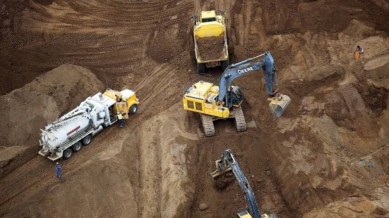
The Supreme Court order allowing states to collect past tax dues from mining companies could potentially impose a significant financial burden on them, given that it allows levying of tax on royalty payments from April 1, 2005 onwards.
According to a senior official in the Ministry of Mines, the ruling will have a major financial implication on mining companies, especially those mining coal and iron ore. These include both private companies and public sector undertakings (PSUs) that come under the mines ministry, the official said, adding that future investments in the mining sector could also be impacted by the ruling to tax retrospectively.


Earlier, Solicitor General Tushar Mehta had told the SC that if the verdict is applied retrospectively, the tax demand on PSUs would be between Rs 70,000 to 80,000 crore. For the entire sector, the cumulative impact could be well around Rs 2 lakh crore, according to industry estimates.
“The burden would eventually go to the common man. Whether directly or indirectly, he will be the person who will bear the burden because no industry can absorb this. For example we made a rough estimate only for the public sector undertakings. This is rough and ready, it is still the process of calculation is going on, but the approximate demand, which the only PSU’s are expecting would be somewhere in the vicinity of 70,000 to 80,000 crore,” Mehta had said on July 31.
The nine-judge SC bench on Wednesday said the levy of interest and penalty on demands made for the period before July 25, 2024 shall stand waived and the time for payment of tax “shall be staggered in instalments over a period of twelve years commencing from 1 April 2026”.
The July 25 judgment overruled the 1989 decision of a seven-judge bench in India Cement Ltd vs State of Tamil Nadu, which said royalty is tax and state legislatures lack competence to levy taxes on mineral rights because the subject matter is covered by an act of the Parliament in exercise of powers under the Union List of the Constitution. The verdict has paved the way for states to collect greater revenue from mining operations.
Now, with states empowered to tax royalty on mining production, experts said costs of primary goods, especially iron ore, may go up. “Typically, you need 1.6 to 1.8 tons of iron ore for a ton of steel. If you consider the total cost of steel production and work backwards, royalty is roughly 5 to 8 per cent of the selling price. It’s not a small cost at all,” said Rakesh Surana, a partner with Deloitte India.
“What if the costs go up? If the costs go up, margin is eaten into. If the margin is eaten into, you can either pass it on or if not, it’s obviously not good for the company. It impacts expansion plans, the ability to repay debt, etc. Even if you can pass it on, it creates an inflationary impact… there is a risk of that happening if this isn’t well calibrated,” Surana added.
After the July 25 judgment, each state can now decide the quantum of cess on mining operations, as opposed to a relatively more uniform taxation regime prior to the judgement. Surana said this may create a new dynamic of competition among states in terms of attracting mining-related investments.
Moving forward, the industry is also bracing for the revival of previously stayed GST demand cases on mining operations, as the court has now clarified that royalty payments are a contractual consideration rather than a tax.
“After April 2016, there is a liability under reverse charge mechanism with respect to services provided by the government. Therefore, royalty is something which will be considered as a mining rights service provided by the government to the mining community. Now, all the petitions which are currently pending in high courts and the demands which have been stayed in most of the cases will get revived,” said Gopal Mundhra, partner at Economic Laws Practice (ELP).
Mundhra noted that the centre has the authority to provide relief on pending GST demands after the insertion of Section 11A in CGST Act at the 53rd GST Council Meeting last month. The amendment gives the central government the powers to forgive non-collection or under-collection of GST in situations where businesses followed a common practice that led to the shortfall in tax collection.


