8 min read


© The Indian Express Pvt Ltd



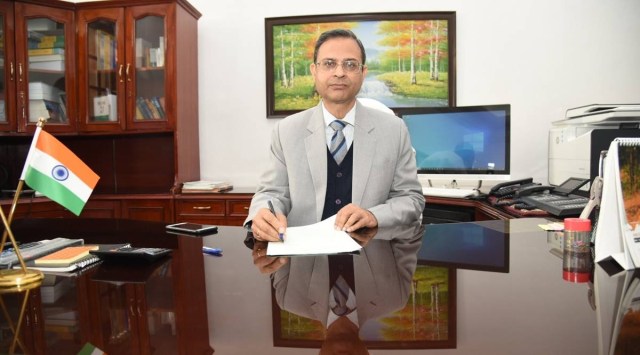 Revenue Secretary Sanjay Malhotra (File)
 Tax collection efficiency will have to increase as rates go down and for this, measures for widening tax base will be taken along with using more technology to get more information about taxpayers in a non-obtrusive way, Revenue Secretary Sanjay Malhotra said. In an interview with Soumyarendra Barik and Aanchal Magazine, Malhotra also said that levy of windfall taxes will continue till there are super profits being made, and removal of thresholds for certain categories for remittances will discourage cooking up of expenditures to reduce tax liability. Edited excerpts:
The Budget has assumed revenue growth same as nominal GDP growth with revenue buoyancy at a factor of one. What was the rationale for it?
The revenue buoyancy is one because the taxation rate is also going down. So, collection efficiency has to actually increase.
How do you aim to achieve it? There are also two factors involved in the revenue math – inflation and growth. What if inflation comes down even more from the current moderating levels? How will it affect your calculations?
It is aligned with GDP growth. We are assuming the buoyancy to be one. So, if the GDP were to grow at a higher rate or at a lower rate, tax revenue numbers would also have to be appropriately corrected or changed.
But how difficult will it be given that you said tax efficiency collection has to improve as tax collections will go down. The run rate won’t be as high as 2022-23. So, what is the challenge in front of the revenue department in that scenario for the coming year?
Obviously, we have to now increase our collection efficiencies higher than what they are right now. The tax rate has come down, the personal income tax rate, people will shift. One can have one’s own estimates on how many people will shift. In the Budget speech also we have listed 14 measures which will deepen the tax base. Apart from that, it’s always been our effort to use more technology so that we get more information about our people, in a non-obtrusive way.
There was a shift towards using TDS as a tool to trace transactions in last year’s budget. Similarly we are seeing in this Budget through levy of TCS for say, LRS, and for other measures, like insurance premium. What is the kind of data and evidence that actually made the department take such a measure?
Yes, there is specific information. For example, capital gains where we have now put a limit at Rs 10 crore, there was no limit earlier. There were cases where people bought properties up to say Rs 160 crore, and there are several instances of that. Similarly, on the trusts, where we have said that only 85 per cent of the donation will be treated as expenditure. There were trusts which were transferring money, serially, from one trust to another trust. So, there are specific cases on the basis of which we had information, and they have been used for evidence-based policy shifts that we have introduced.
Evidence-based policy shift but have actions also been taken in those cases?
Because they were loopholes, they were tax avoidance measures, then you can’t take action. Legally they were sound.
Startups are concerned that there will now be an angel tax on funding from foreign investors which is a major source of investments for them. How would you address those concerns?
Startups are exempt, they have not been brought into this category. It is other than startups who will be taxed. We did that because we just wanted to bring parity between the residents and the non-residents insofar as non-startups are concerned. For startups there was no taxation, both on account of raising funds from residents and non residents. As far as non-startups are concerned, one cannot deny the fact that there are people who misuse these provisions for circumventing taxes, or money laundering etc. So one cannot neglect that aspect.
At the same time, it should not result in any inconvenience to honest people. So subjectivity, if there is any in this, is what people are actually worried about, that due to subjectivity, it is possible that even the honest taxpayers, where the valuations are done correctly, and there is no evasion etc. they should not be put to inconvenience. We will figure out if there can be some ways in which we can protect them.
One of the measures, which was taken last year was about windfall tax, and it has not really generated the revenue, which was expected.
The government would like to take taxes, only when there are profits. If the profits are not there, then the question of taxing does not arise. I don’t know what estimates you’re talking about because it’s difficult to estimate. As long as there are profits, and as I mentioned before, if the economy grows at a certain rate, then the taxes will be at that particular rate.
You have mentioned Rs 25,000 crore from windfall taxes for FY23. What about FY24?
There is no estimate, it is a ballpark. This comes under excise duty only, and we have not provided estimates for excise duty separately, and for this additional windfall.
Is it being levied in line with the trend of profits that you were saying?.
Yes, obviously, because you want to tax incomes, right? The formula was designed in such a way that we were taking only a part of the super profits.
Has a deadline been thought about for it?
As long as there are super profits, it will continue.
In LRS, thresholds for categories other than health, education have been removed. So will scrutiny increase in those sectors? What was the kind of data or the numbers that prompted this measure?
There’s no data. It is well known that the rate of 5% is too low, because effective taxation is certainly more than 20%. It is actually maybe even more than 25%, we have been conservative.
For those people who are actually going abroad, the taxable income will get taxed at at least 25%. We have put it at 20%, so that in any case they had to pay. And those who were not paying, instead of 5%, now we will get more tax from them because there is a tendency that once you pay TDS or TCS, then you don’t cook up figures or inflate expenditure to reduce tax liability.
Another criticism for budgets has been of an increasing share of cesses and surcharges, which reduces the tax share accruing to states.
There are no new cesses or surcharges. There’s no change which is under consideration.
For corporate tax, 60 percent of tax is coming from the new regime. How much for the other segment for the new manufacturing units?
Yes. Some 3500 companies have shifted to the new manufacturing regime. In terms of percentage and value terms it is very low because it is very new, the taxes will take some time to grow.
60 per cent in value terms. How much in number terms?
22 per cent of around total 9.6 lakh companies.
Is there not a similar dataset for the new personal income tax regime?
Not many have shifted.
Do you think now the changes that have been made, are they at the optimum level or there is scope of further tweaks?
That’s always a work in progress. But for now, we felt this is the best that could be done.
On the indirect taxes side, we saw some duty changes for items such as toys and automobiles.
For toys and automobiles, the changes are very minor. They are not to provide more protection, they are basically to simplify our tax structure. We have reduced eight tax rates out of 21 to bring it down to 13. So, toys and certain automobiles were at 60% plus 10% surcharge, so 66% effectively. We have removed the 60% and brought it to the 70% category, without any surcharge. That’s a very small change…Similarly, for some automobiles which were effectively at 33% have been brought up to 35% because we have removed the tax bracket of 30%. So it’s not to increase protectionism, it is basically to reduce the number of tax rates.
The increase on the indirect taxes is only on cigarettes and on silver, primarily. Others are all related to the reduction in the number of tax rates, if there is any increase.