Meghalaya govt sought a way around NGT ban on coal mining
At the time the NGT ban came into force, it is estimated that nearly six million tonnes of coal were being extracted annually from Meghalaya’s illegal mines.
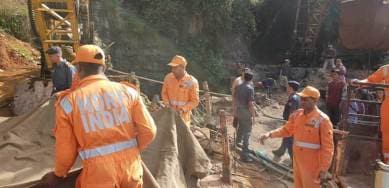
In 2014, the National Green Tribunal (NGT) had banned rat-hole coal mining. (Source: Meghalaya Police)
Even as 13 miners trapped by the flooding of an illegal coal mine in East Jaintia Hills of Meghalaya are presumed dead, the Union Coal Ministry has before it a formal proposal sent by the Meghalaya government seeking a way around a mining ban imposed by the National Green Tribunal (NGT) in the state.
The proposal, sent to the Union Coal Ministry by the Commissioner and Secretary of the Mining and Geology Department of Meghalaya through a communication dated July 18, 2018, is learnt to be “under examination” by the Ministry. Queries sent to the Ministry of Coal on the current status of the proposal by the state government did not elicit a response.
You’ve Read Your Free Stories For Now
Sign up and keep reading more stories that matter to you.
The National People’s Party-BJP government in the state had moved the proposal after the state Assembly had passed a resolution to adopt a policy for mining of coal in Meghalaya and the treatment of the state as a special case. This was in the wake of a ban by the NGT, which, in an order in April 2014, had directed the Chief Secretary of Meghalaya and the Director General of Police of the state government to stop rat-hole mining (or box cutting mining, as it is also called) and other forms of illegal mining in Meghalaya and prevent illegal transport of coal in the state.
Prior to the assembly elections in Meghalaya in February this year though, the BJP had promised to “come to a comprehensive solution (to the ban) and work it out with the central government to the satisfaction of the law” if it was voted to power. Meghalaya’s new Chief Minister Conrad Kongkal Sangma, who in March 2018 formed the state’s first non-Congress government in 15 years along with the BJP, had asserted this September that his Government would focus on finding a solution to the issue of getting the ban on coal mining lifted.
Friday’s accident is one in a series of incidents involving illegal mining in the state. In February 2014, months ahead of the NGT order, four miners were killed when the walls of an illegal mine in the Garo hills collapsed. In December 2013, five miners died when the cable of a basket that was carrying them into an illegal mine in Jaintia Hills snapped. In July 2012, 15 miners drowned in an illegal mine in Garo Hills when an underground stream flowing near the mine flooded it.
In November, two activists, Agnes Kharshiing and Amita Sangma, came under attack while they were recording a case of transport of coal from an illegal coal mines in the state. At the time the NGT ban came into force, it is estimated that nearly six million tonnes of coal were being extracted annually from Meghalaya’s illegal mines. The state has around 650 million tonnes of coal reserves and high quality coals in thin seams occur in mines in the state.
Rat hole mining is unique to the state due to the thinness of the coal layer and is a cost-effective option to large scale mining due to a lot of overburden (mud and debris) being extracted. The rudimentary method of mining involves clearing ground vegetation and then digging vertical pits into the ground till the coal seam is hit. Tunnels are then dug in from the sides of the pit for the actual extraction of coal, which is moved out by using wheel barrows or baskets. Extraction of coal is typically done by women and children, who are let into these mines to dig using basic implements such as pickaxes and shovels.
Story continues below this ad
Subsequent to the NGT ban, Meghalaya’s Mining and Geology Department had forwarded a copy of draft Mining Guidelines for regulating coal mining activities in Meghalaya, as ordered by the Tribunal. These guidelines, however, were found to be be not in conformity with the existing statutory provisions of MMDR Act, 1957 and hence the state was asked to reframe the guidelines.
Anil Sasi is the National Business Editor at The Indian Express, where he steers the newspaper’s coverage of the Indian economy, corporate affairs, and financial policy. As a senior editor, he plays a pivotal role in shaping the narrative around India's business landscape.
Professional Experience Sasi brings extensive experience from some of India’s most respected financial dailies. Prior to his leadership role at The Indian Express, he worked with:
The Hindu Business Line
Business Standard
His career trajectory across these premier publications demonstrates a consistent track record of rigorous financial reporting and editorial oversight.
Expertise & Focus With a deep understanding of market dynamics and policy interventions, Sasi writes authoritatively on:
Macroeconomics: Analysis of fiscal policy, budgets, and economic trends.
Corporate Affairs: In-depth coverage of India's major industries and corporate governance.
Business Policy: The intersection of government regulation and private enterprise.
Education Anil Sasi is an alumnus of the prestigious Delhi University, providing a strong academic foundation to his journalistic work.
Find all stories by Anil Sasi here ... Read More