


Tags:


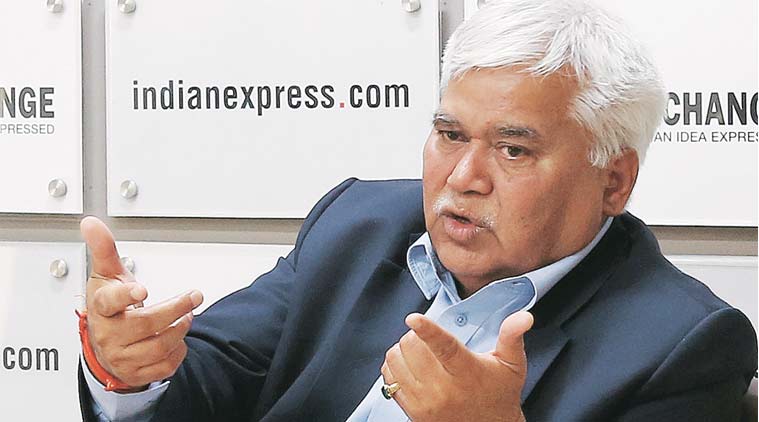
Responding to allegations of the Telecom Regulatory Authority of India’s (Trai) recent decisions favouring a particular operator, the regulator’s chairman RS Sharma, in an interview to Pranav Mukul, said that the regulator cannot conduct a prior analysis of its decisions in terms of which party is it going to benefit. Sharma also pointed out that market forces and competition could weed out the older technologies. Edited excerpts:
Over the last 18 months, you have taken several decisions to which a section of the telecom industry has alleged that you have been favouring a particular operator. What has been the regulator’s broader thought process behind these decisions?


But in a way some of these decisions could render older technologies out of business…
Our decisions are technology agnostic and taken in the interest of consumer. Obviously, the more efficient a technology is, the more it is likely to survive. If I fix a per kilometer cost for a car, the less fuel-efficient car will be at a loss and the more fuel-efficient car will benefit. We are not writing off older technologies. The operator can charge whatever tariffs it wants, that is not our problem. We are technology agnostic, but from a commercial point of view, the customer will not choose the less fuel-efficient car. The system will weed the older technology out. People should, and in a way, they are coming on to new technologies very fast. This should have happened earlier. Market forces and competition will determine these things. I will only decide the rules of fair competition.
Some operators are suggesting that the latest tariff order skews the balance in favour of a single operator by not allowing the larger players to match cheaper offerings. How do you justify this?
Even significant market power can offer free tariffs and promotional offers so long as it is not with a view to kill competition. People ask if this was the case then why this wasn’t mentioned in the regulation. This is because law cannot enumerate examples. If the law said that matching of competitor’s tariffs was allowed, larger operators could have put up virtual network operators as rivals and lowered their tariffs to match. Intention is a matter of circumstances, which can only be decided on a case-to-case basis. The definition of intent to kill has been taken from the Competition Commission of India. It is unfortunate these things are being interpreted in this way. The basic principle that predation can only be done by a significant market player is unexceptionable. Secondly, there should be an intention to kill competition. In 2003, when we put tariffs under forbearance, three principles were part of the tariff order – transparency, non-discrimination and non-predation.
Why, in defining a significant market player, has Trai omitted two parameters of traffic volume and switching capacity?
Every parameter has a contextual meaning. Significant market power is a term that was not defined anywhere. In our domain, it was only defined in the interconnection regulations, thus far. In those regulations there were these four criteria. Switching capacity has no relevance to predatory pricing that is why it has been dropped. For traffic volume, is there a way to compare the volumes between operators? There are multiple technologies today. 2G is meant for voice, 3G was for both voice and data, 4G voice is also data. There is no methodology to convert these technologies in a common unit and make them comparable. Therefore, the order reads that for the purpose of predatory pricing, determining significant market player would be based on subscriber base and gross revenue only as these two parameters are relevant and comparable across all the technologies. Tomorrow, if all the operators come on 4G, data is a good parameter to compare, but today I can’t compare based on volumes.


