4 min read

Journalism of Courage



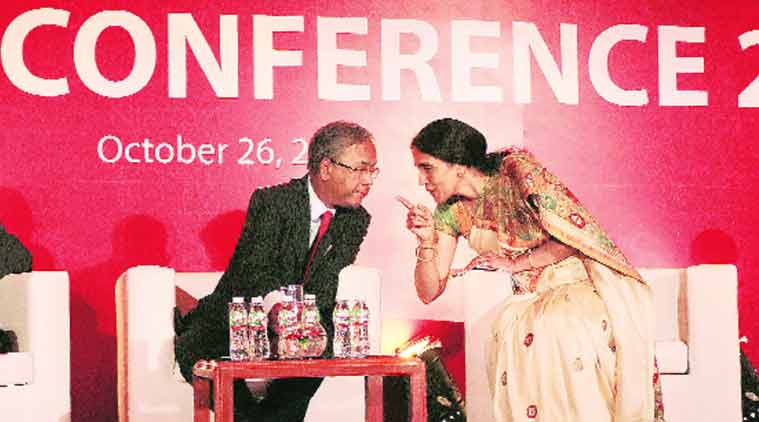 Sebi Chairman UK Sinha with NSE Managing Director & CEO Chitra Ramkrishna at India ETF Conference 2015 in Mumbai. (Express Photo by: Amit Chakravarty)
Securities and Exchange Board of India (Sebi) chairman UK Sinha on Monday said that the regulator was monitoring the spike in prices of certain pulses to ascertain the possibility of hoarding and violation of essential commodity market norms by traders.
Sinha said that Sebi is working with the government if the traders raided for hoarding have any connection with the commodity markets, and would accordingly take necessary action against any violation of rules. “We are in close contact with the government and we are watching the situation closely. If we find they are connected then perhaps there is a case for Sebi to take action. So we are getting into those details and keeping a close watch on the issue,” Sinha said on the sidelines of India ETF Conference 2015 held by the National Stock Exchange (NSE).
Sinha explained the notion that speculating of commodity futures prices with rise in price of pulses was wrong. He cited the example of chana prices in the spot and futures market, stating that futures rate of chana was actually trading at a discount to spot prices indicating “backwardation” and expectation of price fall in the near-term.
[related-post]
Various state governments held raids to check hoarding and seized more than 75,000 tonnes of pulses. Last month, Sebi began regulating the commodities futures market after being merged with the Forward Markets Commission (FMC).
Dal prices have risen across the country due to a shortfall in domestic output by 2 million tonnes in 2014-15 hit by poor rains. There is also global shortage of lentils. As per the data maintained by the consumer affairs ministry, retail tur prices are still continuing to rule as high as up to Rs 205 per kg, urad at Rs 198 per kg, moong dal at Rs 130 per kg, masoor dal at Rs 110 per kg and gram (chana) at Rs 85 per kg.
In February 2015, the government has exempted 38 more agriculture items from the ambit of the commodity transaction tax (CTT), which was imposed in July 2013. These include rice bran, tur, urad, moong, masur, gram dal, gram husk, onion, bajra, jowar, ginger, sesamum, small millets and groundnut.
Sinha also acknowledged that exchange-traded funds (ETF) is a significant financial instrument and said that Sebi was open to making the required changes to ETF regulations based on industry feedback, albeit with caution. Any further innovation to the product should be dealt with carefully so as to avoid any risks to the investors and the markets, he said adding that there was greater need for transparency and disclosures with regard to ETFs.
“Based on inputs from cross section of experts or participants if there is any need that further changes are required for rules and regulations of the ETFs, Sebi will be more than willing to listen to you and incorporate them. However, we have to be conscious and able to avoid those types of innovation where some of the countries outside India take a higher degree of risk,” Sinha told reporters.
“If we are able to avoid those risks, make proper disclosures, are able to communicate properly then ETF has a very good chance of growing in India and provide good services to the investors,” Sinha added.
Sinha said that Sebi was also open to the idea of introducing new players and products in the ETF space, but the process would take a few months.