This is an archive article published on June 6, 2017
Statue of Unity in progress – core of knees in position
The statue, of Sardar Vallabhbhai Patel, has so far been erected up to the knees — 59 metres tall, at 117 m above sea level — out of a planned 182 m, to match the number of assembly constituencies in Gujarat
Written by Aditi Raja
Kevadia Colony | June 6, 2017 01:19 AM IST
4 min read
Whatsapp
twitter
Facebook
Reddit
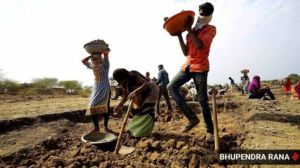
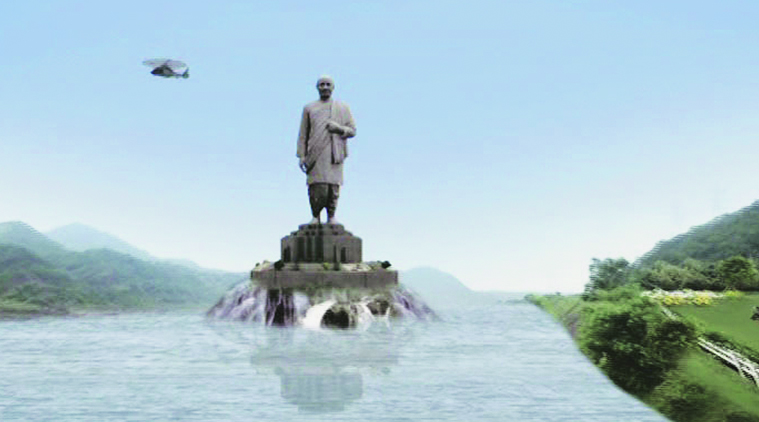
During his Lok Sabha poll campaign, Modi had announced collection of farm tools from across India for the construction to represent the “unified India” that Sardar Patel stood for.
The Statue of Unity is taking shape in Kevadia, Gujarat, nearly four years since then chief minister Narendra Modi had laid its foundation stone on October 31, 2013.
The statue, of Sardar Vallabhbhai Patel, has so far been erected up to the knees — 59 metres tall, at 117 m above sea level — out of a planned 182 m, to match the number of assembly constituencies in Gujarat. By September, workers from TQ Art Foundry of Jiangxi Tongqing Company in Nanchang, China, will arrive in Kevadia to assist in assembling the bronze cladding of the façade.
For the core, the framework is a mixture of concrete and steel. For the cladding, TQ Art Foundry has designed about 5,000 bronze panels under the supervision of artist Ram Suthar. These will be assembled in a workshop before being clad to complete the façade in phases. The TQ Art Foundry workshop has completed precasting the feet and the dhoti for the first stage and these will arrive in India in a few weeks.
“Thousands of high quality prototypes of precast façade will be shipped in from China and assembled at the site,” said R G Kanungo, superintending engineer of Sardar Sarovar Narmada Nigam Ltd (SSNNL). “Simultaneously, the steel framework that will give the exterior shape and hold the bronze cladding together will be shipped in from Trichy, where it is being manufactured. Close to 100 workers from China will arrive and work on the cladding. By then, the height of the statue will be at 90 metres, almost halfway through.”
The contract for the steel framework has been given to Malaysia-based Eversendai, which lists Dubai’s famous highrises Burj al-Arab and Burj Khalifa among its projects.
On site, SSNNL officials say, close to 2,400 workers are at work on day and night shifts. “Currently, we are constructing the core wall, the RCC spine of the statue — on which steel frames will be affixed to hold the bronze cladding together,” Kanungo said. “We have also completed construction of the drum wall. Shortly, we will construct a coupling wall to add rigidity and connect the cores. These concentric concrete cores will house elevators and stairways.”
The biggest challenge has been the wind. “So many times, the workers have to pause the construction to allow the wind to calm down. However, we calculated that delay in the overall project deadline,” Kanungo said.
Story continues below this ad
The core will rise to 157 m, forming Sardar Patel’s body up to his chest. This is where the viewing gallery will be set up. Under the original plan, visitors were to travel to the height of the head with the gallery through the statue’s eyes. Engineers have, however, decided now it is not feasible.
During his Lok Sabha poll campaign, Modi had announced collection of farm tools from across India for the construction to represent the “unified India” that Sardar Patel stood for. NGO Citizens for Accountable Governance designed and rolled out the outreach and social mobilisation plan, while the drive was launched by Sardar Vallabhbhai Patel Rashtriya Ekta Trust, a special purpose vehicle headed by the Gujarat CM.
After deliberation about the apparent non-usability of the scrap collected, “we have used about 109 tonnes of iron to create the reinforced beams… as per the vision of PM Modi to use metal from across India,” said Kanungo. “We were able to extract 109 tonnes from about 135 tonnes of scrap that was processed.”
Aditi Raja is an Assistant Editor with The Indian Express, stationed in Vadodara, Gujarat, with over 20 years in the field. She has been reporting from the region of Central Gujarat and Narmada district for this newspaper since 2013, which establishes her as a highly Authoritative and Trustworthy source on regional politics, administration, and critical socio-economic and environmental issues.
Expertise:
Core Authority & Specialization: Her reporting is characterized by a comprehensive grasp of the complex factors shaping Central Gujarat, which comprises a vast tribal population, including:
Politics and Administration: In-depth analysis of dynamics within factions of political parties and how it affects the affairs in the region, visits of national leaders making prominent statements, and government policy decisions impacting the population on ground.
Crucial Regional Projects: She consistently reports on the socio-economic and political impact of infrastructure projects in the region, especially the Statue of Unity, the Sardar Sarovar Project on the Narmada River, the Mumbai-Ahmedabad High Speed Rail bullet train project as well as the National Highway infrastructure.
Social Justice and Human Rights: Her reporting offers deep coverage of sensitive human-interest topics, including gender, crime, and tribal issues. Her reports cover legal proceedings from various district courts as well as the Gujarat High Court (e.g., the Bilkis Bano case remission, POCSO court orders, Public Interest Litigations), the plight of tribal communities, and broader social conflicts (e.g., Kheda flogging case).
Local Impact & Disaster Reporting: Excels in documenting the immediate impact of events on communities, such as the political and civic fallout of the Vadodara floods, the subsequent public anger, and the long-delayed river redevelopment projects, Harni Boat Tragedy, Air India crash, bringing out a blend of stories from the investigations as well as human emotions.
Special Interest Beat: She tracks incidents concerning Non-Resident Gujaratis (NRIs) including crime and legal battles abroad, issues of illegal immigration and deportations, as well as social events connecting the local Gujarati experience to the global diaspora. ... Read More


 4 min read


 During his Lok Sabha poll campaign, Modi had announced collection of farm tools from across India for the construction to represent the “unified India” that Sardar Patel stood for.