Journalism of Courage



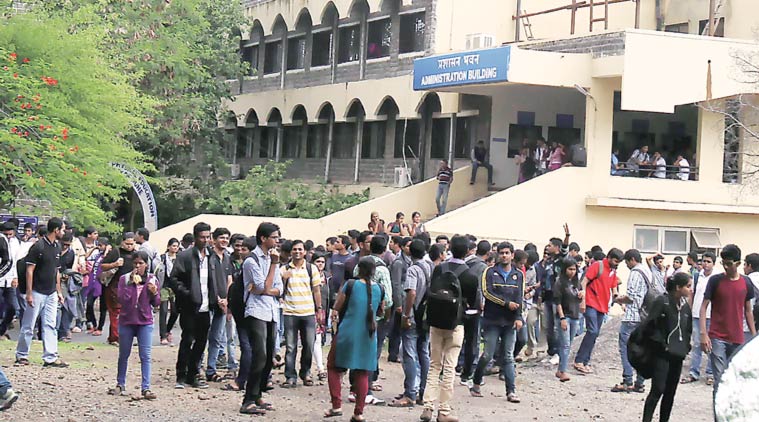
In a novel move, the Maharashtra government has decided to involve engineering students in solving real problems at the grassroots level — from coming up with technological solutions for local problems to evaluating existing programmes and their effectiveness, from solving water-supply issues faced by a small village in a tribal belt to replacing polluting traditional chulhas used in rural homes with low-cost eco-friendly solutions or coming up with a metered system to stop overflowing water tanks.
A GR issued by the higher and technical education department states that a committee has been formed at the state-level comprising senior members of various government bodies and faculty members from colleges.
The committee will be headed by Milind Sohoni, head of Centre for Technology Alternatives for Rural Areas at the Indian Institute of Technology Bombay (IIT-B), on whose model the programme has been designed.
Speaking to The Indian Express, Sohoni said the project ‘Unnat Maharashtra Prakalp’ is on the lines of the Unnat Bharat programme, which is already being run in many engineering colleges where students are being enlisted for development works. “It is nothing but a deepening of the idea and bringing it to the local level. We have so many bright students today, besides experienced faculty, who can come up with innovative ideas to social issues. Given Maharashtra’s development needs and its current situation and policy paradigms, we need to align curricula and research in higher education institutions and create concrete mechanisms and professional avenues for students, faculty members and institutions to work with various agencies of government,” he said.
Asked how it would work, Sohoni said the committee would only give approval to colleges to participate in the project.
“We expect that a formal request will come in from an agency such as a Gram Sabha to look at a particular problem. The institution would then put forward a proposal, which would be approved and funded by local competent authority like the district collectorate. For instance, if it’s about reviewing a rural power supply network, up to 0.8 per cent of capital cost can be given for research,” he said.
Besides practical experience, students stand to benefit in form of credits given for the projects undertaken by them.
CoEP director Dr B B Ahuja said the idea was already in practice at the institute which has adopted 10 villages as part of Unnat Bharat Abhiyaan.
“Engineering students already have such projects as part of syllabus. Rather than working on make-believe problem statements, it is a good idea to get them involved in real issues. Also, engineering students are best suited for this job as eventually they have to get involved in developmental projects. They are also most equipped to come up with technological solutions,” he said.
Dr Gajanan Kharate, former dean of the engineering faculty of Savitribai Phule Pune University, said that besides credit, a system to take the project forward should be brought in place.
“In the past too, engineering students have come up with real innovative solutions to resolve real-life issues, but haven’t been able to take it forward. For instance, our students had come up with a metering system so that the wireman doesn’t have to go to a house every month for reading. Rather, a mobile app will automatically read electronic meters every month. But what happens is that students do not get encouraged by scholarships or internships to pursue the project. If this new initiative takes into account that as well, it will be a complete idea,” he said.

 4 min read