Journalism of Courage
 4 min read


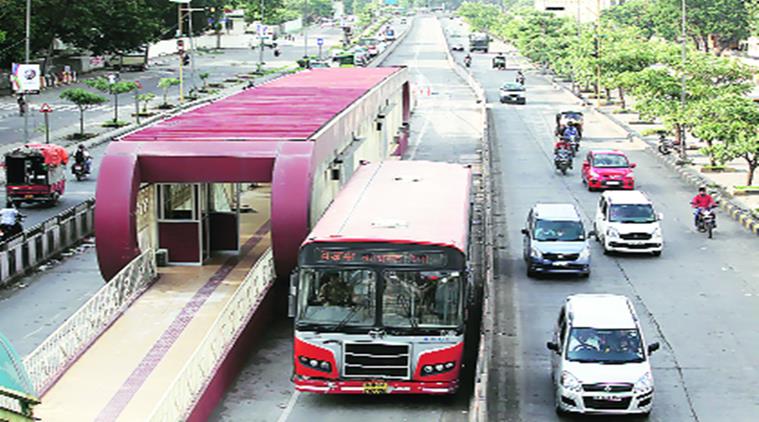 The experts sought better monitoring of signals, a refuge island and proper parking lots . Express photo
Experts from the US, China and Indonesia, who had a first-hand experience of BRTS routes in operation in Pimpri-Chinchwad on Wednesday, have recommended that there should be better access to BRTS bus stations so that passengers are not inconvenienced. At the same time, the experts suggested that civic authorities should not encourage the system of constructing flyovers in order to ensure that BRTS becomes popular among commuters.
The experts included Clayton Lane of USA, Yoga Adiwanarto of Indonesia, and Li Shanshan of China. Shreya Gadepalli, regional director, ITDP (India), was also present. The experts took a bus ride and watched the operation closely of the two bus corridors of Aundh-Ravet and Bhosari-Wakad. Joint city engineer (PCMC) Rajan Patil and deputy engineer (BRTS) Vijay Bhojne were also present.
[related-post]
Addressing a press conference at the PCMC headquarters, the experts said that they were impressed by the way the PCMC and PMPML were running the services on two corridors. “We are impressed by the BRTS system that is in operation in Pimpri-Chinchwad,” said Li Shanshan.
“Pedestrian signals should be properly monitored. There should be a refuge island and easy access to bus stations on BRTS routes,” the experts said, stressing on the need for parking lots along the corridors.
“People who use BRTS routes are the ones who come on their bicycles or two-wheelers. There should be proper parking lots so that these passengers find it convenient and less of a headache in using the BRTS routes,” the experts added. They said that there is a pressing need to reduce the craze for going in for flyovers. “If flyovers are constructed, people find it convenient to travel by their own vehicles. Therefore, this system should be discouraged,” they said.
Citing the success of BRTS in some of the countries, especially Brazil, the experts said that BRTS has the potential to reduce private vehicles on the roads thereby reducing pollution levels and therefore, should be implemented across the world.
“As of now, BRTS is being implemented in 140 countries of the world. In the US, it is being implemented in three cities. Some 20 countries are running it successfully and even in China, BRTS is doing very well,” they experts said.
Shanshan said that in the 22-km BRTS corridor in one of the cities in China, nearly 50,000 cars have been reduced. “This is a major achievement. And there will be further reduction in the use of private cars,” she said. They said that even in Pakistan, BRTS is doing well, especially in Karachi and Lahore. “In India, Gujarat has shown the way with Ahemdabad and Surat BRTS being shinning examples,” they said.
PCMC officials said that they would be starting the third BRTS route on the Pune-Mumbai highway from April. “Somewhere in the middle of April, we would be in a position to start the route. As for the fourth route, it will start only by December,” said Rajan Patil, joint city engineer.
PCMC also plans to expand the BRTS network. “This will be done after the first four routes are successfully run,” Patil said. As for the suggestion by experts to shun the construction of flyovers, Patil said that flyovers which have been constructed so far have helped in greatly reducing the traffic jams. “In future, we will have to take the BRTS concept into consideration. The suggestion is welcome and we will certainly ponder over,” he said.