Journalism of Courage

North Korea has short-range missiles that can hit its neighbors. It has tested an intermediate one that could strike Guam, a U.S. territory, as well as a longer-range missile that could reach Hawaii and perhaps the West Coast of the United States. In this picture distributed by the North Korean government on May 14, 2017, ballistic missile "Hwasong-12" lifts off from an undisclosed location in North Korea (Korean Central News Agency/Korea News Service via AP, File)

National Intelligence Director Dan Coats told Congress in May that Kim has been photographed beside a nuclear warhead design and missile airframes to show that North Korea has warheads small enough to fit on a missile. This photo circulated by the North Korean government shows the launch of a Hwasong-14 intercontinental ballistic missile, ICBM, in the northwest region of North Korea, Tuesday, July 4, 2017 (Korean Central News Agency/Korea News Service via AP, File)

The second test flight was captured by a rooftop camera operated by Japan's NHK television on the northern island of Hokkaido. A solid-fuel "Pukguksong-2" missile lifts off during its launch test at an undisclosed location in North Korea. The picture has been distributed by the North Korean government on May 22, 2017 (Korean Central News Agency/Korea News Service via AP, File)
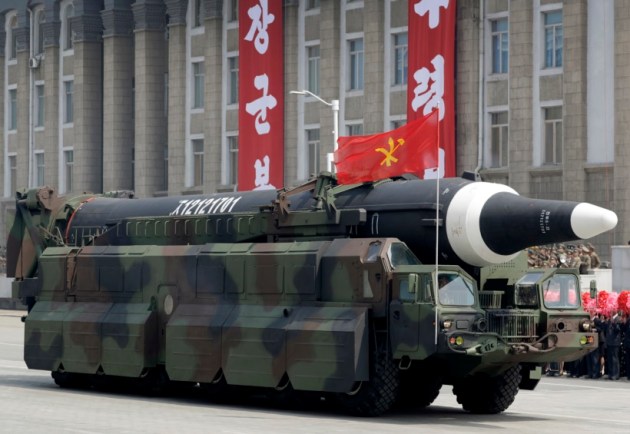
The success of North Korean missiles also depend on the weight of the payload. That's the weight of the nuclear weapon plus its heat-shielding re-entry system. Missile North Korean Hwasong-12, as per analysts is paraded across Kim Il Sung Square in Pyongyang. (AP Photo/Wong Maye-E, File)
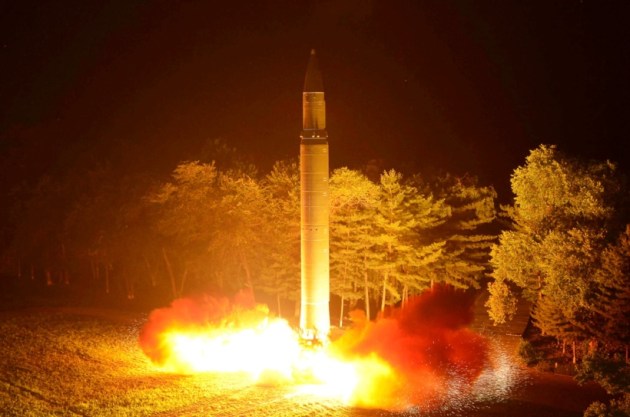
North Korea is able to make one that weighs between 1,100 and 1,300 pounds, or between 500 and 600 kilograms. Intercontinental ballistic missile (ICBM) Hwasong-14 during its second test fire in Pyongyang on July 29, 2017 (KCNA via Reuters/File Photo)