


© The Indian Express Pvt Ltd
Tags:


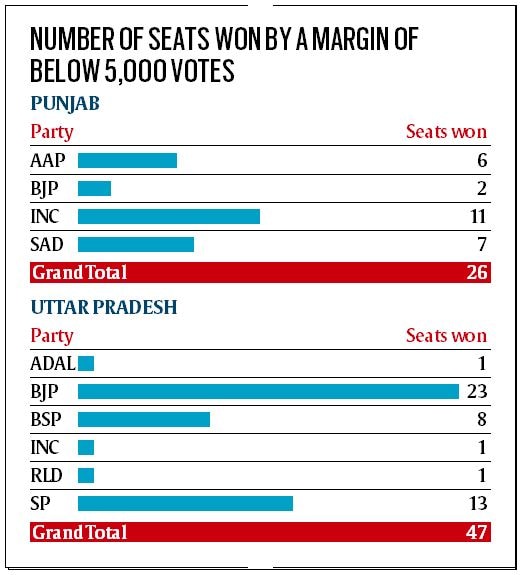
A swing of 5,000 votes can change the outcome of every fifth Assembly seat in Punjab and every 10th seat in Uttar Pradesh, shows an analysis of the 2017 results in both states.
As many as 26 of 117 seats in Punjab and 47 of 403 constituencies in Uttar Pradesh were decided by a victory margin of below 5,000 votes in the last polls.
The 5,000-vote margin is not big in view of the average size of an Assembly constituency in the two states — around 3.74 lakh voters in UP and about 1.83 lakh in Punjab.
In UP, of the 47 seats decided by a winning margin of less than 5,000 votes, the BJP won the most, 23, and came second on 15. The SP won 13 of the seats and was runner-up in 17. The BSP won 8 of the seats, while the Congress, Rashtriya Lok Dal (RLD) and Apna Dal (Soneylal) got 1 seat each.

In 8 of the 47 seats, the winning margin was less than 1,000 votes. Of these, the BJP won 5 (Doomariyaganj, Meerapur, Shrawasti, Muhammadabad-Gohna (SC) and Rampur Maniharan); the BSP won 2 (Mant and and Mubarakpur); and the SP 1 (Mohanlalganj). In fact, Doomariyaganj saw the lowest margin across the state, with the BJP’s Raghvendra Pratap Singh defeating the BSP’s Saiyada Khatoon by just 171 votes.
The second lowest margin was recorded in Meerapur, where Avatar Singh Bhadana, who contested on a BJP ticket, defeated SP candidate Liyakat Ali by 193 votes. Bhadana left the BJP and joined the RLD earlier this month.
In nine seats — Duddhi, Bhadohi, Patti, Matera, Bansdih, Tanda, Mahmoodabad, Unchahar and Bharthana – the winner was decided by 1,000-2,000 votes. The winning margin was between 2,000 and 3,000 in 10 seats — Najibabad, Lalganj, Gainsari, Kanth, Pharenda, Badlapur, Kannauj, Atrauliya, Sidhauli and Pratappur. And between 3,000 and 4,000 votes in 12 — Moradabad Nagar, Jangipur, Dhaurahra, Chillupar, Aonla, Dholana, Didarganj, Harchandpur, Maholi, Patiyali, Chhaprauli and Bidhuna. In eight seats — Nakur, Manjhanpur, Machhlishahr, Isauli, Shahabad, Sahaswan, Gorakhpur Rural and Saharanpur Nagar — the margin was 4,000-5,000.
In Punjab, 26 seats were decided by a margin below 5,000 votes. Of these, a maximum, 11, were won by the Congress, while the Shiromani Akali Dal (SAD) bagged 7, Aam Aadmi Party got 6, and the BJP won 2.
Three seats — Fazilka and Bhucho Mandi (won by the Congress) and Batala (SAD) — saw a winning margin of less than 1,000 votes. Nine seats — Dera Baba Nanak, Budhlada, Ludhiana East, Dirba, Garhshankar, Moga, Banga (SC), Dera Bassi and Fatehgarh Churian — were decided by a margin between 1,000 and 2,000 votes. The winning margin was between 2,000 and 3,000 votes in 4 seats — Phagwara, Kharar, Barnala and Dhuri. In 5 seats — Abohar, Nawanshahr, Phillaur, Sham Chaurasi and Amloh – the margin was 3,000-4,000 votes. Only 5 seats — Dakha. Sahnewal, Sanour, Shahkot and Malout — recorded a winning margin of 4,000 to 5,000 votes.
According to the Election Commission of India, the total number of eligible voters in the UP Assembly elections is 15.06 crore, while the figure stands at 2.13 crore for Punjab.


