


Stay updated with the latest - Click here to follow us on Instagram
Tags:


As the toll crosses 4,000, the number of people infected with the virus reaches 9,000, and the disease jumps continents to reach America and Europe, the new discoveries and the unanswered questions over the raging epidemic, particularly regarding health-care workers.

What happened in Dallas ?
Two nurses contracted Ebola in the course of treating Thomas Eric Duncan, a Liberian, at the Texas Health Presbyterian Hospital. They were with him during what the Centers for Disease Control and Prevention has called the highest risk period, when a patient has diarrhoea and is vomiting.
Nina Pham was the first nurse to be diagnosed with Ebola. The second, Amber Joy Vinson, travelled to Cleveland on October 10, two days after Duncan died. The CDC has asked the 132 passengers who took the Frontier Airlines flight along with Vinson to contact the health authorities.
At least 17 Ebola cases have been treated outside of West Africa in the current outbreak, including Pham and Vinson.
How many healthcare workers have been infected?
Pham and Vinson became the second and third healthcare workers to contract Ebola outside of West Africa. A nurse in Spain was infected in September while treating a missionary exposed in Sierra Leone.
Are the existing health protocols enough?
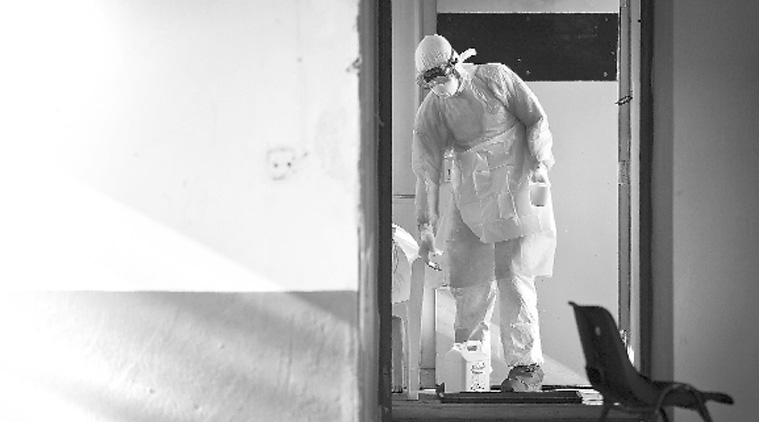
* The nurses wore face shields, hazardous material suits and protective footwear as they dealt with Duncan’s body fluids. But insertion of catheters and breathing tubes and filtering of blood through a dialysis machine were procedures unprecedented in case of Ebola patients so far.
* CDC director Dr Tom Frieden noted that some of the nurses at Texas Health Presbyterian Hospital inadvertently violated the CDC protocols by wearing “too much protective gear”. He said the “risk of contamination during the process of taking layers of gloves off gets much higher”, as the virus could get caught between the layers.
What complaints do the nurses have?
They want new mandates that go beyond existing CDC protocols: full-body hazmat suits, at least two nurses assigned to each Ebola patient, and continuous training. They accused the Dallas hospital of not providing nurses with goggles because of their cost, and complained they were forced to use medical tape to secure openings in their flimsy garments.
They said they were worried their necks, heads were exposed as they cared for a patient with “explosive diarrhoea” and “projectile vomiting”. In Duncan case, hazardous waste piled up.
So virus is not airborne?
No. Touch is integral. The UN Ebola Mission for Emergency Response says extensive studies have not shown any airborne transmission. Ebola patients do not cough or sneeze a lot and the WHO advisory notice states: “Epidemiological data are not consistent with the pattern of spread seen with airborne viruses, like in measles and chickenpox, or the airborne bacterium that causes tuberculosis.”
But can pass on during sex?
Yes, and the virus lasts in the semen of people who have recovered for maybe as long as 90 days.
how about from toilet seat?
Yes. Faeces from somebody with Ebola is a real hazard and the virus has also been detected in urine.
what about saliva?
WHO says saliva at the most severe stage of the disease, and also tears, may carry some risk, but the studies are inconclusive. The virus has been detected in breast milk. A 2007 study in the Journal of Infectious Diseases is probably the most informative on where the virus hides.
21 days a good quarantine?
It may not be. A new study by Charles Haas, a professor in Drexel University’s College of Engineering, suggests that “a broader look at risk factors should be considered when setting this standard”. There could be up to a 12 per cent chance that someone could be infected even after the 21-day quarantine, it says.
Current hospital protocol?
When it comes to Ebola, the full-body Personal Protective Equipment suit (PPE) is probably the best way to prevent infection. But a PPE can also be one of the easiest ways to get Ebola. A PPE is usually made up of a full-body, impermeable suit with a hood, rubber boots covered by Tyvek booties, multiple pairs of surgical gloves, a mask over the nose and mouth, a plastic bib, goggles, a plastic apron and a lot of duct tape. Worn properly, they shouldn’t show an inch of skin. Taking them off, in even the best of circumstances, is a clumsy process with multiple opportunities for a lethal mistake.


Stay updated with the latest - Click here to follow us on Instagram


