4 min read
Stay updated with the latest - Click here to follow us on Instagram

Journalism of Courage



 The use of ‘bomb robot’ to kill Micah Johnson, the suspect who killed five Dallas policemen on Thursday, brings up the issue of militarization of local law enforcement in US (Source: Dallas Morning News)
Dallas police ended a standoff with a gunman Friday morning by remotely detonating a “bomb robot,” an unprecedented tactic by officers who said they were in danger and one that rekindles concerns about the militarization of local law enforcement in the United States.
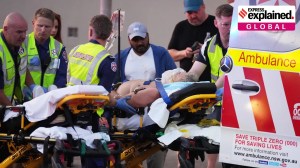
The bomb blast killed a black U.S. Army reservist identified by authorities as Micah Xavier Johnson, who shot dead five police officers and wounded seven others in Dallas on Thursday night following a peaceful protest over police shootings of black men.
[related-post]
Watch Video: What’s making news
Technology warfare experts said the use of a robot to kill someone had major technological and legal implications for 21st century policing.
“It’s a first by police,” said Peter Singer, author of Wired for War, a book on the use of robots in conflict zones. Singer said that he knew of examples of the U.S. military in Iraq “jury rigging a surveillance bot to take out an insurgent down an alley.”
U.S. law enforcement has used remotely controlled devices before to help stop a suspect, but not to kill anyone, law enforcement experts said.
“We saw no other option but to use our bomb robot and place a device on its extension for it to detonate where the suspect was,” said Dallas Police Chief David Brown on Friday. “Other options would have exposed officers to grave danger.”
Dallas Mayor Mike Rawlings said the gunman was given a choice of surrendering without harm or remaining in place and he chose to remain in place.
It was not clear exactly why the police chose to use a bomb rather than some other means of subduing Johnson. It was also unclear whether police had trained in the use of the “bomb robot” or whether it was improvised. The exact nature of the explosive used was also not immediately known.
The Dallas Police Department did not respond to requests for comment.
The Department owns at least three “bomb robots,” according to an October 2015 report by the city. The vendor for those devices is Remotec, a subsidiary of defense contractor Northrop Grumman Corp that specializes in manufacturing remotely operated robotic vehicles.
Northrop Grumman declined to comment and referred all inquiries to the Dallas Police Department.
Remotec’s website includes product descriptions of a handful of its unmanned vehicles, such as the F6B, described as the “most versatile, heavy-duty robot on the market” and the Wolverine, a “workhorse robot that won’t quit until you do.” Such devices are often used by law enforcement to dispose of or detonate bombs without risking human life.
The Pentagon has distributed at least 451 bomb defusing robots to federal and local police agencies through its excess-inventory program since 2005, according to a Reuters review of Defense Department records.
A tally by the Drone Center at Bard College in New York showed that more than 200 federal, state and local law enforcement agencies now possess at least one explosive ordnance robot acquired through the surplus program.
The transfer of military equipment to civilian police agencies under what is known as the 1033 program came under scrutiny following the police shooting of Michael Brown in Ferguson, Missouri, in August 2014.
Protests in Ferguson were monitored and at times disrupted by heavily armed police, whose use of armored vehicles and other high-powered military gear alarmed many observers.
In the aftermath, President Barack Obama issued an executive order scaling back the program. The Pentagon now cannot distribute certain types of armored vehicles and other equipment, while police must demonstrate why they need unmanned drones, aircraft, or certain types of riot gear.
Since the order took effect on Oct. 1, 2015, local law enforcement agencies have returned 126 tracked armored vehicles, 138 grenade launchers and 1,623 bayonets, Defense Logistics Agency spokeswoman Michelle McCaskill said.
“You can’t ignore that it got a little out of hand, that there were some overreaches by smaller police departments,” said Ronal Serpas, former police chief in New Orleans, Louisiana and Nashville, Tennessee.
Stay updated with the latest - Click here to follow us on Instagram