

Journalism of Courage

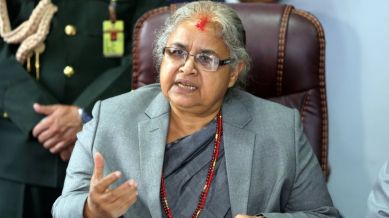
Eminent Nepalese jurist Sushila Karki, who has emerged as a probable face to lead an interim government in the violence-wracked Himalayan nation, is a former chief justice who carries a reputation for a no-nonsense, anti-corruption stance.
While she lacks political and executive experience, it’s this anti-graft reputation that has prompted Nepal’s Gen Z protesters to put forward her name as interim prime minister.

While the immediate trigger for the violent protests, that left 19 people dead, was a social media ban, tensions have long simmered over corruption, a stagnating economy and a lack of jobs.
Should Karki become interim PM, parallels will immediately be drawn with Nobel winner Muhammad Yunus who took up a similar post in Bangladesh after the massive student-led uprising overthrew Sheikh Hasina as prime minister last year.
Now, Karki could potentially become Nepal’s first woman PM, in addition to being its first woman chief justice.
In her student years, Karki was associated with the Nepali Congress, then struggling for democracy in the kingdom. After studying law in Banaras Hindu University, she dedicated herself to the legal practice in Nepal and married Durga Subedi, once her tutor. She would later call Subedi her “most dependable friend and guide in crisis and all seasons”.
Subedi, a leader of the Nepali Congress, was among four people who, in June 1973, hijacked a Nepal Airlines plane that was ferrying `40 lakh from Biratnagar to the Kathmandu Central Bank, forcing it to land at Forbesganj in Bihar’s Purnea district.
The money was handed over to G P Koirala, waiting there to purchase arms to give effect to the Nepali Congress’s plans for an armed struggle for democracy.
In late 2006, Karki was appointed as a permanent judge to Nepal’s Supreme Court, where she forged her reputation.
She rose to the position of Chief Justice seven years later, in a tenure marked by controversy. The Nepali Congress party, then leading the government, used its parliamentary strength to move an impeachment motion, leading to her immediate suspension.
Karki was not impeached but left dismayed by what she saw as political corruption, an issue that kept her occupied after retirement.

But questions were also raised against her when she, as CJ, pushed for the appointment of judges with affiliations to political parties. “They will have to take off their political shoes once they occupy the bench,” Karki had said, defending her action. Later, however, she exposed some ministers who allegedly pressured her to appoint their relatives to the bench.
Her landmark judgement came when a bench headed by her annulled the appointment of Lokman Singh Karki as the chief of the Constitutional anti-graft body. The appointment was made by President Ram Baran Yadav, interim Prime Minister-cum-chief justice Khilraj Regmi and four major parties in power.


