4 min read
Stay updated with the latest - Click here to follow us on Instagram

Journalism of Courage



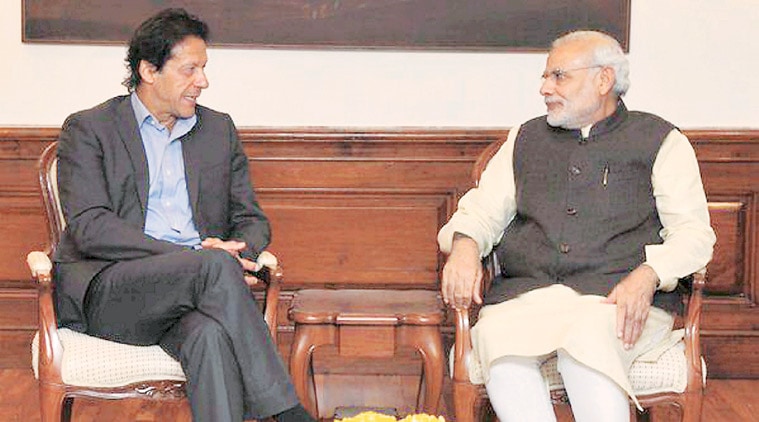 PM Narendra Modi with Pakistan Tehreek-e-Insaf chairman Imran Khan in New Delhi in a photo from 2015. (File)
China said on Wednesday it is willing to play a “positive and constructive role” in easing relations between India and Pakistan as it welcomed the “positive” remarks of Prime Minister Narendra Modi and his new Pakistani counterpart Imran Khan on improving bilateral ties. Chinese Foreign Ministry spokesman Lu Kang said the improvement and development of relations between India and Pakistan are important to regional peace, stability and prosperity.
“We have noted relevant reports and we welcome the positive remarks made by the Indian and Pakistani leaders on improving bilateral relations,” Lu said while replying to a question on the statements made by the two leaders soon after Khan assumed office as Pakistan’s 22nd prime minister on August 18.
“Both Pakistan and India are important countries in South Asia. As a common neighbour to Pakistan and India, China firmly supports the two sides to enhance dialogue increase mutual trust, properly handle and solve their differences,” Lu said, according to the official transcript of the briefing issued by the Ministry of Foreign Affairs.
China hopes the two countries can jointly stay committed to regional peace and development, he said. “China is willing to play a constructive role in this aspect,” he said. Asked what he meant by China playing a constructive role, the spokesman said, “We are very pleased to see that the leaders of Pakistan and India have recently made positive remarks on improving bilateral relations.”
“It is, of course, a good thing for both sides to continuously improve relations and jointly work together for regional peace and stability. As long as there is any possibility, China is, of course, willing to play a positive and constructive role,” he said.
Asked whether he is suggesting that China wants to mediate between India and Pakistan, Lu said: “I can’t give you a prejudgement now, telling you which aspect, what area, and what time China will do what things.” “But it is clear that constructive role is any role that is conducive to advancing, consolidating and sustaining the positive momentum,” he elaborated.
Ties between India and Pakistan nosedived following a spate of terror attacks on Indian military bases by Pakistan-based terror groups since January 2016. India has made it clear that it will not hold dialogue with Pakistan as terrorism and talks cannot go hand-in-hand. India has also been maintaining that it is ready to talk to Pakistan only bilaterally without the intervention of any other nation, including China.
On August 20, Prime Minister Modi had sent a letter to Khan, conveying that India was looking for constructive and meaningful engagement with Pakistan. Khan in a tweet on Tuesday expressed Pakistan’s willingness to re-start the stalled India-Pakistan peace process and said the two countries must engage in dialogue to resolve their differences, including on the Kashmir issue, and start trade.
In June, the Chinese Ambassador to India, Luo Zhaohui, was quoted in the media as saying that Sino-Indian ties cannot take the strain of “another” Doklam standoff. According to the reports, he had mooted a “trilateral” China-India-Pakistan dialogue on the sidelines of a Shanghai Cooperation Organisation (SCO) conference to resolve regional issues and maintain peace.
Ministry of External Affairs spokesperson Raveesh Kumar at that time had said that India has not received any such suggestion from the Chinese government.
Stay updated with the latest - Click here to follow us on Instagram